01
Consultation
Technical needs assessment
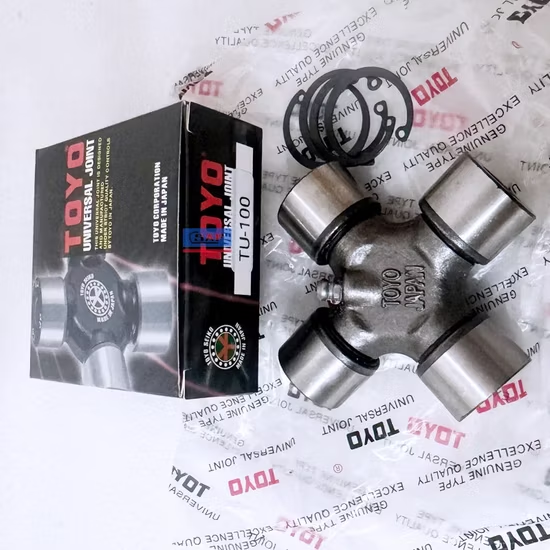


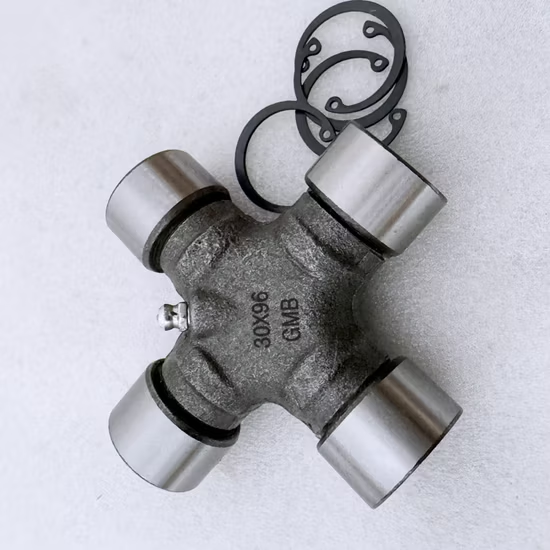
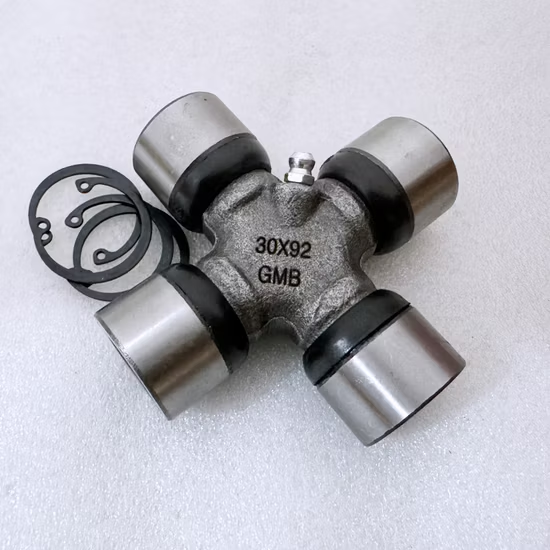
Universal U Joint Cross Bearing for Automotive and Heavy Machinery — ISO certified design engineered for high-impact loads and continuous operation in drivetrains.
Original Batch Traceability — Every cross bearing shipment includes manufacturer lot documentation to verify metallurgical origin and prevent soft inner ring failures.
| Parameter | Value |
|---|---|
| Product Type | U Joint Cross Bearing |
| Material Options | Standard alloy steel or stainless steel variants |
| Certification | ISO |
| Origin Options | Germany, Japan, Sweden, Malaysia, China |
| Target Applications | Automotive, Tractor, Construction Machinery, Rolling |
| Industry | Typical Applications |
|---|---|
| Automotive & Heavy Vehicles | Drivetrain propeller shafts, wheel hub assemblies, steering column joints |
| Agriculture & Tractors | PTO shaft connections, implement hitch joints, harvester drivelines |
| Construction & Mining | Articulation joints in loaders, conveyor drive shafts, crusher feed mechanisms |
| Industrial Rolling & Handling | Rolling mill drive spindles, material handling conveyor universal joints |
Visual inspection alone cannot detect the internal flaws that destroy drivetrains.
Counterfeit cross bearings often feature soft inner rings and cloned QR codes that easily pass casual visual checks in the warehouse. Once installed in a high-torque propeller shaft, these substandard components rapidly succumb to brinelling and catastrophic seizure under heavy loads. Relying on an unverified universal u joint cross bearing supplier introduces severe operational risks, as cross-reference errors frequently overlook critical internal design variations . A basic part number match does not guarantee the correct needle roller profile or seal configuration required for your specific equipment.
Selecting the correct material is critical for drivetrain longevity. While standard alloy steel handles the high shock loads typical in heavy vehicle propeller shafts, stainless steel variants are available for agricultural or marine equipment exposed to corrosive environments. A qualified universal u joint cross bearing supplier evaluates your specific operating environment to recommend the optimal metallurgy, ensuring the bearing surface resists micropitting and wear without sacrificing core toughness.
Universal joints operate under complex oscillating loads with frequent start-stop cycles, making them highly susceptible to false brinelling and grease starvation. The operating temperature directly impacts grease viscosity and sealing lip integrity, especially in construction machinery exposed to abrasive dust. Effective sealing must balance contamination exclusion with minimal friction to prevent heat buildup . Proper lubrication intervals and seal selection are therefore just as critical as the dimensional accuracy of the cross itself.
The internal geometry and material choices dictate the cross bearing's performance envelope. Standard bearing steel provides the necessary core strength and surface hardness for high-torque automotive and rolling mill applications. For equipment operating in highly corrosive or washdown environments, stainless steel variants offer substantially higher corrosion resistance. The selection process must also account for the specific seal type—whether lip seals for dirt exclusion or open designs for centralized lubrication systems—to ensure compatibility with the host machinery's maintenance protocols.
Substituting a universal joint cross based solely on outer dimensions often leads to premature drivetrain failure. If the internal needle roller clearance or seal configuration does not match the original equipment design, the joint will experience accelerated wear, excessive vibration, and eventual yoke damage. According to ISO 281 principles, operating a bearing outside its intended design parameters drastically reduces its calculated life . This results in unplanned downtime, voided equipment warranties, and secondary damage to adjacent transmission components.
We address the most common failure points in cross bearing procurement through rigorous technical validation. Our cross-reference matching for OEM numbers like Gun-42, 37125-99900, ND40124, and Uj118 verifies internal seal designs and needle profiles, not just basic dimensions. We consolidate mixed-brand requirements from SKF, FAG, NSK, and NTN into single shipments, eliminating multi-vendor coordination. Every batch includes manufacturer traceability to prevent the installation of soft inner ring counterfeits. Furthermore, our engineering team reviews application parameters to confirm the selected cross can withstand your specific torque and oscillation profiles.
To ensure precise fitment and optimal drivetrain performance, please provide the specific OEM equipment numbers or existing cross dimensions. Supplying operational parameters such as maximum torque transmission, oscillation angles, and environmental exposure allows our engineering team to verify the correct internal clearance and seal configuration. This technical review guarantees the recommended cross bearing perfectly matches your application requirements before procurement.
Q: How do I determine the exact cross bearing model for my heavy vehicle drivetrain?
A: Provide the OEM equipment number, existing cross dimensions, or the specific vehicle chassis details. Our engineering team cross-references these parameters against authorized manufacturer catalogs to identify the exact internal design, seal configuration, and needle roller profile required, ensuring precise fitment without relying on guesswork.
Q: What are the common failure modes of universal joint crosses in construction machinery?
A: Construction machinery crosses frequently suffer from false brinelling due to heavy oscillating loads, seal failure from abrasive dust ingress, and journal wear caused by grease starvation. Selecting the correct seal type and adhering to strict regreasing intervals under the guidance of ISO 15243 failure analysis frameworks significantly mitigates these operational risks.
Q: When should I choose a stainless steel cross bearing over standard alloy steel?
A: Stainless steel variants are recommended for agricultural implements, marine drives, or food processing conveyors exposed to moisture, washdowns, or corrosive chemicals. While standard alloy steel offers superior load capacity for high-torque applications, stainless options provide the necessary corrosion resistance for harsh, wet environments.
Q: How do you ensure the cross bearings supplied are genuine and not counterfeit?
A: We source exclusively through authorized distribution channels and provide comprehensive documentation with every shipment. This includes manufacturer batch traceability, material test reports, and QR codes that can be verified directly through the brand's official application, effectively eliminating the risk of soft inner ring clones.
Q: What maintenance and lubrication practices are recommended for prolonged cross bearing life?
A: Regular purging with high-quality extreme pressure grease is essential until fresh lubricant is visibly expelled from all four seal lips. This practice not only replenishes the lubricant film but also forces out accumulated abrasive contaminants and moisture, preventing internal corrosion and micropitting on the needle roller trunnions.
Our 5-step process ensures every order is engineered, validated, and supported for optimal performance.
Technical needs assessment
Custom specifications
Free samples for $50k+
Pre-shipment inspection
On-site & predictive
Our certified engineers respond within 24 hours with detailed technical specifications, pricing, and lead time information.