01
Consultation
Technical needs assessment


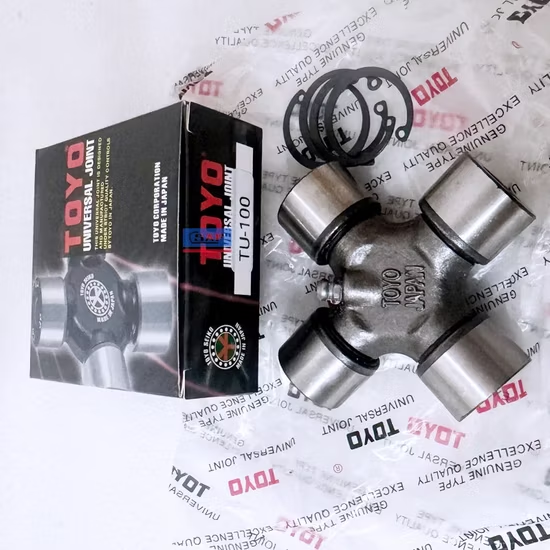
Universal U-Joint Cross Bearing for Automotive Drivelines — high-precision stainless steel construction with ISO certification for harsh operating environments.
Multi-Brand Authorized Coverage — Consolidate mixed-brand universal joint requirements into a single shipment with full batch traceability across all major manufacturers.
| Parameter | Value |
|---|---|
| Product Type | Universal U-Joint Cross Bearing |
| Structure | Single |
| Material Options | Stainless steel or standard bearing steel variants available |
| Quality Grade | High precision manufacturing |
| Certification | ISO compliant |
| Customization | Full OEM dimensional and spatial constraint support |
| Origin | Sourced from verified manufacturer production facilities globally |
| Industry | Typical Applications |
|---|---|
| Automotive Repair | Car wheel hubs and steering column drivelines |
| Agricultural Machinery | Tractor PTO shafts and implement linkages |
| Construction Equipment | Heavy machinery articulation joints and rolling equipment drives |
Dimensional alignment without material verification guarantees premature cross joint failure under thermal stress.
Replacing a worn cross joint based solely on a basic cross-reference number is a common trap in heavy vehicle repair. I have pulled apart wheel hubs in the Middle East where the replacement part matched the base designation perfectly, yet the internal spider gear seized within weeks. The internal design, seal type, and material grade were entirely wrong for the high-ambient-temperature environment, causing rapid thermal binding . When sourcing from a universal u-joint cross bearing supplier, buyers must look beyond the basic number to verify exact OEM equipment alignment and material suitability.
Selecting the right universal u-joint cross bearing supplier involves matching material options to the specific operating environment. Standard bearing steel works well for enclosed, lubricated drivelines, but stainless steel variants are necessary for agricultural or construction machinery exposed to moisture, chemical fertilizers, and road salts. High-precision manufacturing ensures smooth articulation, reducing the vibration that typically accelerates wear in car wheel hubs and tractor PTO shafts.
Universal joints endure complex combined loading, shifting continuously between radial and axial stresses as the driveline articulates. In construction and agricultural applications, these components face severe contamination from dust and mud, demanding robust sealing solutions to retain grease and exclude debris. Inadequate sealing leads to lubricant starvation, while improper grease selection for high-temperature wheel hub applications causes the lubricant to bleed out, leaving the cross bearing to run dry and overheat .
Unlike standard catalog bearings, universal joints are highly application-specific. The cross-references Gum77, Gum-77, St-0008, S2765, and Uj617 represent specific spatial constraints and cap configurations rather than just basic dimensions. Selecting the correct variant requires verifying the exact OEM equipment number to ensure the bearing caps, snap rings, and seal lips fit the yoke perfectly. ISO certification provides a baseline for quality, but exact dimensional fitment is what prevents the cross from walking out of the yoke during high-torque operation.
Installing a dimensionally similar but internally inferior cross joint leads to catastrophic driveline damage. A seized universal joint in a car wheel hub or tractor PTO shaft does not just fail; it transfers destructive torsional shock loads to the transmission and axle components. According to ISO 281 frameworks for dynamic load ratings, operating a joint outside its designed articulation angle or load capacity drastically reduces fatigue life, resulting in unplanned downtime and voided equipment warranties .
Our approach eliminates the guesswork that causes field failures. We provide cross-reference alignment that checks internal design and cap configurations, not just base numbers. For mixed fleets, our multi-brand authorized coverage handles diverse OEM requirements in one order. Every batch includes traceability to the manufacturer, and our application-based selection review ensures the chosen stainless steel or bearing steel variant matches your specific load, speed, and contamination exposure.
To ensure precise fitment, provide the exact OEM equipment number, driveline series, and yoke dimensions. Sharing operational parameters such as maximum articulation angle, continuous torque load, and environmental exposure allows our engineering team to determine the correct cross-reference model and material option. This technical复核 prevents the installation of incompatible joints that lead to premature binding.
Q: How do I determine the exact cross joint model based on OEM numbers?
A: Base numbers often overlap across different driveline series. Provide the specific OEM equipment number and yoke dimensions. We cross-reference these against manufacturer catalogs to verify cap diameters, seal types, and snap ring configurations, ensuring the selected Gum-77 or St-0008 variant matches your exact spatial constraints and torque requirements.
Q: When should I choose stainless steel over standard bearing steel?
A: Standard bearing steel is suitable for enclosed, well-lubricated drivelines. Stainless steel variants are necessary when the universal joint is exposed to moisture, road salts, or agricultural chemicals. The enhanced corrosion resistance prevents pitting on the trunnion surfaces, which otherwise accelerates wear and causes premature seizure in harsh environments.
Q: What are common failure modes of u-joint bearings in heavy machinery?
A: The most frequent failures stem from lubrication starvation and contamination ingress. When seals fail, abrasive particles enter the cap, grinding away the needle rollers. Additionally, operating beyond the designed articulation angle causes edge loading on the trunnions, leading to brinelling and eventual cross fracture under heavy torsional shock loads.
Q: How do I handle cross-reference alignment for proprietary OEM u-joints?
A: Proprietary joints often feature unique cap retention methods or non-standard seal designs. Relying solely on basic dimensions leads to fitment errors. We analyze the OEM part number to match the exact internal geometry and retention hardware, preventing the cross from shifting or the caps from ejecting during high-torque operation.
Our 5-step process ensures every order is engineered, validated, and supported for optimal performance.
Technical needs assessment
Custom specifications
Free samples for $50k+
Pre-shipment inspection
On-site & predictive
Our certified engineers respond within 24 hours with detailed technical specifications, pricing, and lead time information.