01
Consultation
Technical needs assessment

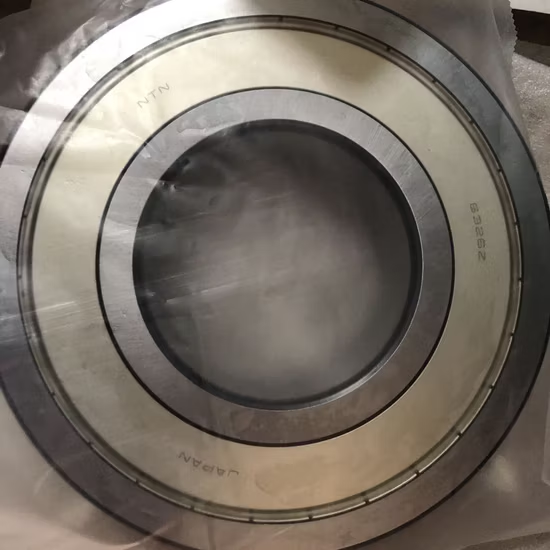


S609 Stainless Steel Deep Groove Ball Bearing — engineered for food processing machinery with 420, 440, or 304 stainless steel material options.
Batch-Level Traceability — every S609 shipment includes verifiable lot documentation linked directly to the manufacturer's production facilities.
| Parameter | Value |
|---|---|
| Designation | S609 |
| Bearing Type | Deep Groove Ball Bearing |
| Material | Available in 420, 440, or 304 stainless steel variants |
| Noise and Vibration Level | Z1V1, Z2V2, Z3V3, Z4V4 options |
| Bore Diameter (d) | 9 mm |
| Outside Diameter (D) | 24 mm |
| Width (B) | 7 mm |
S denotes an unverified suffix requiring manufacturer catalog confirmation for exact internal design specifics.
| Industry | Typical Applications |
|---|---|
| Food and Beverage Processing | Washdown conveyors, rotary fillers, slicing machine drive shafts |
| Packaging Machinery | Form-fill-seal equipment guide rollers, labeling machine spindles |
| Pharmaceutical Manufacturing | Cleanroom transfer belts, blister packaging actuators |
Material mismatch and compromised internal hardness lead to rapid pitting and seizure under aggressive cleaning protocols.
In food processing environments, equipment faces daily exposure to caustic detergents, high-pressure water jets, and extreme temperature fluctuations. When a standard carbon steel component is mistakenly installed, or when a counterfeit stainless variant with inadequate core hardness is used, the bearing quickly succumbs to micro-pitting and spalling. I have personally analyzed numerous seized units from wet processing zones where the inner ring exhibited severe corrosion tracks and premature fatigue, directly causing unplanned line stoppages . Sourcing a genuine S609 stainless steel deep groove ball bearing ensures the metallurgy can withstand these harsh sanitary conditions without degrading.
Selecting the correct alloy is critical for longevity in wet environments. The S609 stainless steel deep groove ball bearing is available in martensitic grades like 420 and 440 for higher load capacity and wear resistance, or austenitic 304 for superior chemical resistance in highly corrosive washdown areas. By aligning the specific material option with the exact chemical exposure and mechanical load of the application, procurement teams can prevent premature raceway degradation and maintain strict hygiene standards.
Food processing machinery subjects miniature bearings to a unique combination of radial loads from conveyor tension and axial thrust from directional changes, all while enduring thermal shock from alternating hot wash and cold rinse cycles. These temperature swings drastically affect internal clearance and lubricant stability. If the grease washes out or the clearance closes due to thermal expansion, friction spikes and cage failure follow. Proper seal selection and verifying the correct internal clearance class are essential to maintain a stable lubricant film and prevent moisture ingress during high-pressure cleaning .
The Z1V1 through Z4V4 noise and vibration classifications dictate the operational smoothness of the bearing. In high-speed food packaging spindles or sensitive dosing pumps, excessive vibration accelerates wear on adjacent seals and compromises product fill accuracy. Selecting a higher grade, such as Z3V3 or Z4V4, ensures tighter geometric tolerances in the raceways and rolling elements, resulting in significantly smoother rotation, reduced acoustic emissions, and extended service life in precision automated machinery.
Installing a bearing with substandard metallurgy in a critical food safety zone inevitably leads to catastrophic consequences. Beyond the immediate cost of unplanned downtime and emergency maintenance, a seized bearing can cause secondary damage to drive motors and gearboxes. Worse, spalling metal particles or degraded seal materials can contaminate the product stream, triggering costly batch recalls and severe regulatory compliance violations. Relying on verified material test reports prevents these compounding financial and reputational losses.
Our procurement process eliminates the risk of receiving cloned or substandard inventory. We provide comprehensive cross-brand interchange support, ensuring that when replacing an existing unit, the clearance, cage material, and precision suffixes align perfectly with the OEM requirements, not just the base designation. Every batch is backed by strict traceability protocols, allowing buyers to verify the exact origin and material grade, ensuring the corrosion resistance and mechanical reliability required for continuous food production operations.
To ensure the selected bearing perfectly matches your operational demands, please provide the specific radial and axial loads, operational speeds, and the exact chemical composition of your washdown fluids. Sharing the OEM equipment number or existing part designation allows our technical team to perform a precise cross-reference check, verifying that the internal clearance and seal configuration align with your machinery's original design parameters.
Q: How do I choose between 420, 440, and 304 stainless steel for this application?
A: Martensitic grades like 420 and 440 offer higher hardness and load capacity, making them suitable for conveyor drive shafts. Austenitic 304 provides superior resistance to harsh chemical detergents and is ideal for direct food contact zones or high-salinity washdown areas. Provide your specific cleaning agents and load data for a precise recommendation.
Q: What does the Z3V3 designation mean for my packaging machinery?
A: The Z3V3 classification indicates strict limits on both acoustic noise and vibration amplitude during rotation. In high-speed form-fill-seal equipment or precision dosing pumps, this ensures smoother operation, reduces wear on adjacent components, and maintains the accuracy required for consistent product packaging.
Q: How can I verify the authenticity of the bearings before installation?
A: Every batch we supply includes traceable documentation and a unique QR code. You can scan this code using the manufacturer's official mobile application to instantly verify the origin, material grade, and production lot, ensuring no cloned or substandard components enter your facility.
Q: Why is internal clearance critical in food processing environments?
A: Daily washdowns involve extreme temperature swings from hot sanitizing cycles to cold rinses. These thermal shocks cause the bearing rings to expand and contract. Selecting the correct internal clearance prevents the bearing from seizing under thermal expansion or running too loose during cold cycles, which would otherwise accelerate fatigue and premature failure.
Our 5-step process ensures every order is engineered, validated, and supported for optimal performance.
Technical needs assessment
Custom specifications
Free samples for $50k+
Pre-shipment inspection
On-site & predictive
Our certified engineers respond within 24 hours with detailed technical specifications, pricing, and lead time information.