01
Consultation
Technical needs assessment



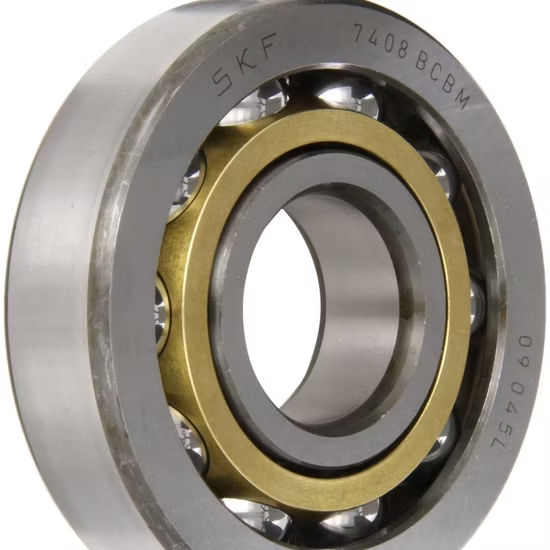
71901 CD/P4a Angular Contact Ball Bearing — featuring a 15° contact angle to minimize friction heat and P4a super precision for enhanced running accuracy in high-speed spindles.
Official App QR Verification — Scan the unique manufacturer code on every 71901 CD/P4a package to confirm super precision authenticity and batch traceability instantly.
| Parameter | Value |
|---|---|
| Designation | 71901 CD/P4a |
| Bearing Type | Angular Contact Ball Bearing |
| Bore Type | Cylindrical |
| Material | Bearing Steel |
| Contact Angle | 15° (CD suffix) |
| Precision Class | P4a |
| Vibration Level | Z1V1 / Z2V2 / Z3V3 |
| Origin | Germany / Japan / Sweden / Malaysia / China |
Note: The lowercase 'ga' suffix occasionally appearing in alternate trade listings remains unverified against official manufacturer catalogs for this specific precision class.
| Industry | Typical Applications |
|---|---|
| Machine Tool Manufacturing | High-speed motorized spindles and precision grinding heads |
| Robotics & Automation | High-precision rotary joints and articulated arms |
| Precision Equipment | High-speed pumps and optical measuring instruments |
Matching the base designation while ignoring the P4a running accuracy tolerance destroys high-speed stability.
Procurement teams often secure bearings that look identical on paper, only to face catastrophic thermal binding when the spindle ramps up. I have inspected grinding heads in the Yangtze River Delta where standard precision replacements caused severe vibration and scrapped expensive workpieces. The internal geometry and raceway roundness demanded by super precision applications simply do not exist in lower grades . When sourcing a 71901 CD/P4a angular contact ball bearing, overlooking the exact precision suffix and contact angle design invites premature cage failure and costly unplanned downtime.
Achieving stable rotation at extreme RPMs requires components engineered specifically for minimal friction heat and tight dimensional control. The 15° optimized design contact angle reduces the sliding friction inherent in steeper angles, making this 71901 CD/P4a angular contact ball bearing ideal for motorized spindles. Our technical team reviews your specific speed and load parameters to ensure the selected precision class and internal geometry perfectly match the OEM equipment requirements.
High-speed operations generate significant friction heat, directly impacting internal clearance and lubricant film thickness. A standard clearance bearing will thermally bind as the inner ring expands, whereas precision preloaded arrangements maintain the necessary stiffness without seizing. Oil-air or oil-jet lubrication is typically mandatory here to manage temperatures and flush out microscopic wear particles . Any contamination in the lubrication system rapidly degrades the raceway surface finish.
The CD suffix dictates a 15° contact angle, specifically optimized to balance axial rigidity with the high-speed capability required in modern machining centers. This geometry minimizes centrifugal forces on the rolling elements compared to steeper 25° or 40° alternatives. Furthermore, the P4a classification guarantees enhanced running accuracy beyond standard P4 dimensional tolerances. This tighter control over radial and axial runout prevents the micro-vibrations that ruin surface finishes in precision grinding and milling operations.
Installing a standard grade bearing in a high-speed spindle inevitably leads to premature failure and catastrophic damage to the spindle housing. The resulting unplanned downtime halts entire production lines, voiding equipment warranties and destroying profit margins. According to ISO 281 frameworks for dynamic load ratings, operating a component outside its verified precision and thermal limits drastically accelerates fatigue . True cost savings come from specifying the exact super precision grade initially.
We maintain authorized distribution channels across all major international brands, allowing you to consolidate mixed-brand orders without compromising authenticity. Cross-referencing is executed by matching the exact 15° contact angle and P4a running accuracy, not just the base 71901 number. Every shipment includes batch traceability to the manufacturer, verified through official QR apps, ensuring the internal design and precision suffixes align perfectly with your spindle requirements.
Share your specific radial and axial loads, maximum RPM, and operating temperatures so our engineers can verify the L10 life and preload suitability. Providing the exact OEM equipment number allows us to perform a rigorous cross-reference check on the internal design and precision suffixes. This technical review ensures the selected configuration matches your spindle's thermal and dynamic requirements perfectly.
Q: What distinguishes P4a precision from standard P4 in angular contact bearings?
A: While P4 defines strict dimensional tolerances, the 'a' suffix indicates enhanced running accuracy. This tighter control over radial and axial runout is critical for high-speed spindles, minimizing micro-vibrations that degrade machined surface finishes and ensuring stable rotation at extreme RPMs.
Q: How do I verify the authenticity of super precision bearings?
A: Genuine super precision components feature unique batch codes. You can scan the QR code on the packaging using the manufacturer's official mobile app. This instantly confirms the origin, precision class, and production date, protecting your operation from sophisticated counterfeits with soft inner rings.
Q: Why must the contact angle suffix match exactly during cross-referencing?
A: The contact angle determines the bearing's axial load capacity and high-speed behavior. Substituting a 25° angle for the required 15° CD design increases friction heat and centrifugal forces, leading to rapid thermal binding and cage failure in high-speed motorized spindles.
Q: What information is needed to confirm the correct preload arrangement?
A: Please provide your spindle's maximum operating speed, axial thrust loads, and required rigidity. Our engineering team uses these parameters to calculate the optimal preload, ensuring the bearing set maintains stiffness without generating excessive friction heat during continuous high-speed machining.
Our 5-step process ensures every order is engineered, validated, and supported for optimal performance.
Technical needs assessment
Custom specifications
Free samples for $50k+
Pre-shipment inspection
On-site & predictive
Our certified engineers respond within 24 hours with detailed technical specifications, pricing, and lead time information.
![NSK NTN Timken Koyo 7200 CD/P4a Angular Contact Ball Bearing [WARN] draft identifier mismatch](https://skfiso.com/wp-content/uploads/2026/09/nsk-ntn-timken-koyo-7200-cd-p4a-angular-contact-ball-bearing-warn-draft-identifier-mismatch-c6f736.avif)