01
Consultation
Technical needs assessment


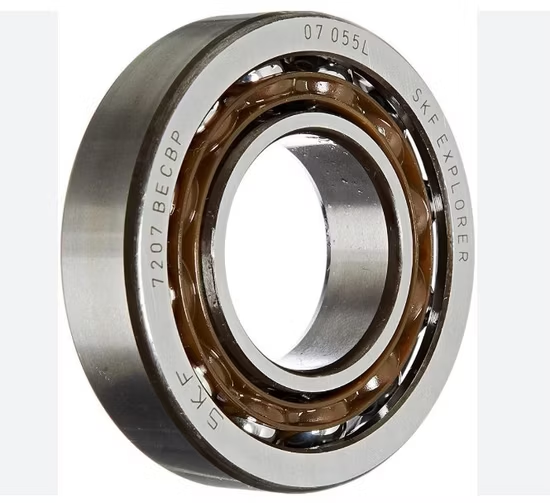
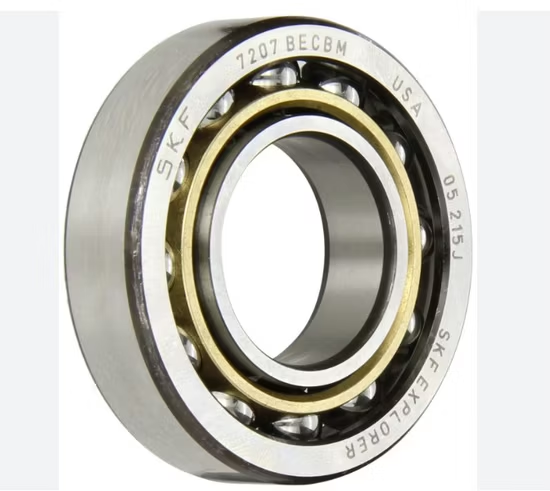

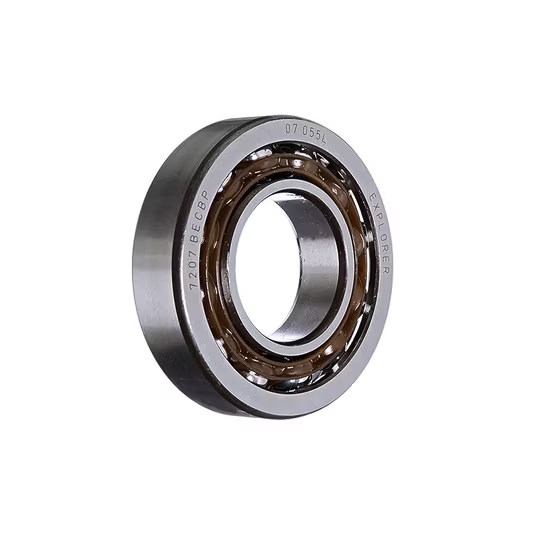
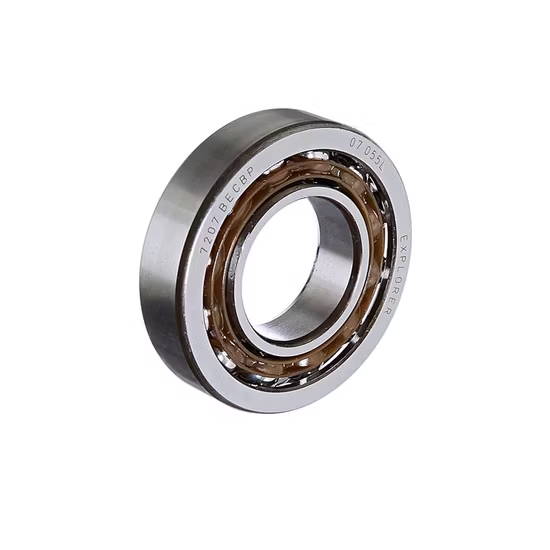
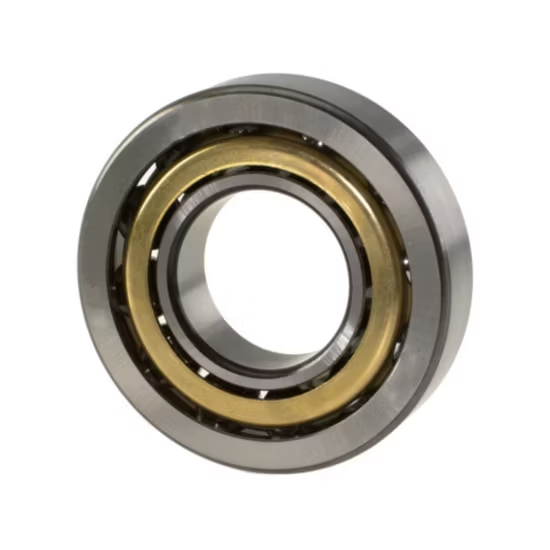
7207 Becbm Angular Contact Ball Bearing — featuring 40° contact angle for elevated axial load capacity under combined loading conditions.
Batch-traceable to the original manufacturer with full documentation and QR verification through brand official apps for every unit shipped.
Mixed-Brand Sourcing — one consolidated shipment covers SKF, FAG, and NSK equivalents for your 7207 Becbm angular contact ball bearing requirements without juggling multiple vendors.
| Parameter | Value |
|---|---|
| Designation | 7207 Becbm |
| Product Type | Angular Contact Ball Bearing |
| Bearing Type | Unseparated |
| Material | Bearing Steel |
| Cage Material | Machined Brass (M) |
| Contact Angle | 40° (BE) |
| Arrangement | Universal Pairing, Medium Preload (CB) |
| Vibration Level | Z1V1 / Z2V2 / Z3V3 |
| Origin | Germany / Japan / Sweden / Malaysia / China |
| HS Code | 8482102000 |
| Industry | Typical Applications |
|---|---|
| Machine Tool Manufacturing | High-speed milling spindle nose bearings and precision grinding wheel heads |
| Industrial Automation | Multi-axis robotic arm joint actuators requiring rigid axial positioning |
| Fluid Power Systems | High-pressure pump drive shafts and hydraulic motor rotor supports |
| Heavy Machinery | Planetary gear sets in industrial gearboxes subjected to combined loading |
Matching the base number while ignoring the cage material and preload suffix is the primary cause of spindle thermal seizure.
Procurement teams frequently approve cross-references that align the 7207 dimension series but substitute a polyamide cage for the required machined brass, or swap a light preload for a medium one. In high-speed precision equipment, this subtle deviation alters the internal heat generation and rigidity balance. The result is often a catastrophic spindle lock-up after just a few hundred hours of operation, voiding warranties and causing massive downtime . Sourcing the exact 7207 Becbm angular contact ball bearing requires strict verification of every suffix to ensure the internal geometry and thermal characteristics match the original equipment design.
The 7207 Becbm angular contact ball bearing is engineered specifically for applications where单向 axial loads or heavy combined loads dominate the operational profile. The 40° contact angle provides a substantially higher axial load-carrying capacity compared to 15° or 25° variants, making it the definitive choice for vertical pump shafts and heavily loaded gearbox stages. Our technical team reviews your specific load vectors to confirm that this steep contact angle aligns with your machine's rigidity requirements, preventing premature raceway fatigue.
In high-speed spindle applications, frictional heat rapidly diminishes internal clearance and alters the lubricant's viscosity. The machined brass cage maintains structural integrity and stable lubrication film thickness even when temperatures rise beyond the thermal limit of standard bearing steel. Furthermore, the universal pairing design allows the maintenance team to adjust the mounting preload to compensate for thermal shaft expansion, ensuring the bearing does not bind under continuous high-RPM operation .
The "BE" designation confirms the optimized internal geometry with a 40° contact angle, maximizing thrust capacity. The "CB" suffix dictates a universal pairing arrangement with a medium preload, which is critical for achieving the precise stiffness needed in machine tool spindles without generating excessive friction. Finally, the "M" indicates a machined brass cage, which offers superior vibration damping and high-speed stability compared to stamped steel or polymer alternatives. Together, these three suffixes define a highly specialized component that cannot be freely interchanged with standard clearance or light preload variants.
Installing a bearing with an incorrect preload class or cage material leads to accelerated wear, unpredictable vibration spikes, and eventual catastrophic damage to the surrounding housing and shaft. When a medium preload (CB) is mistakenly replaced with a light preload variant, the spindle loses its necessary rigidity, causing chatter marks on machined surfaces and scrapping expensive workpieces. Adhering strictly to the specified suffix architecture prevents these unplanned downtime events and protects the capital investment in precision machinery.
We enforce strict cross-reference protocols that verify the contact angle, cage material, and preload class simultaneously, ensuring the 7207 Becbm angular contact ball bearing you receive matches the OEM specification exactly. Our authorized distribution network provides full batch traceability, eliminating the risk of counterfeit rings with compromised metallurgical hardness. We supply comprehensive dimensional and running accuracy inspection reports, confirming the precision tolerances before the components leave our facility. Additionally, our application engineers offer mounting guidance to ensure the universal paired sets are installed in the correct orientation to achieve the designed preload.
To ensure optimal performance and longevity, please provide your specific radial and axial load profiles, operational speed ranges, and expected thermal gradients. Our engineering team will utilize these parameters to conduct a rigorous L10 life calculation and verify that the medium preload and brass cage configuration perfectly match your application. If you are replacing an existing component, share the OEM equipment number so we can perform a comprehensive cross-reference check against the original manufacturer's specifications.
Q: Why must the cage material and preload suffixes be matched exactly during cross-referencing?
A: The machined brass cage (M) provides essential high-speed stability and vibration damping that polymer cages cannot replicate. Similarly, the medium preload (CB) establishes the exact axial rigidity required for precision spindles. Substituting either parameter alters the internal heat generation and stiffness balance, leading to thermal binding or severe machining chatter under operational loads.
Q: How does the CB medium preload differ from other universal pairing classes?
A: Universal pairing allows bearings to be mounted in any arrangement, but the preload class defines the internal axial force. Medium preload (CB) offers a balanced compromise between high axial rigidity for heavy cutting loads and manageable frictional heat generation. Lighter preloads may lack the necessary stiffness, while heavier preloads could cause excessive temperature rise and premature lubricant degradation in continuous high-speed applications.
Q: What are the operational limits of the machined brass cage compared to polyamide?
A: Machined brass cages excel in high-speed, high-vibration, and elevated-temperature environments where polyamide cages might soften or degrade. The brass construction maintains its structural integrity and provides superior guidance for the rolling elements under heavy combined loads, making it the mandatory choice for demanding machine tool spindles and heavy-duty industrial gearboxes where operational reliability is critical.
Q: How can I verify the authenticity of the received bearings?
A: Every genuine 7207 Becbm angular contact ball bearing we supply features a unique traceability code. You can scan this code using the manufacturer's official mobile application to instantly verify the production batch, origin, and technical specifications. We also provide physical Certificate of Conformity documents and dimensional inspection reports to guarantee the product meets all required precision standards.
Q: What is the correct procedure for mounting universally paired angular contact bearings?
A: Universally paired bearings must be mounted strictly according to the "V" marks etched on their outer rings. These marks indicate the precise alignment required to achieve the specified medium preload when clamped together. Installing them out of sequence or in the wrong orientation will either eliminate the preload entirely or double it, both of which will result in rapid operational failure and severe equipment damage.
Our 5-step process ensures every order is engineered, validated, and supported for optimal performance.
Technical needs assessment
Custom specifications
Free samples for $50k+
Pre-shipment inspection
On-site & predictive
Our certified engineers respond within 24 hours with detailed technical specifications, pricing, and lead time information.
![7026 CD/P4a Angular Contact Bearing High Speed Super Precision [WARN] draft identifier mismatch](https://skfiso.com/wp-content/uploads/2026/09/7026-cd-p4a-angular-contact-bearing-high-speed-super-precision-warn-draft-identifier-mismatch-20c7ea.avif)
![71800 CD/P4 Angular Contact Bearing High Speed Super Precision P4 [WARN] draft identifier mismatch](https://skfiso.com/wp-content/uploads/2026/09/71800-cd-p4-angular-contact-bearing-high-speed-super-precision-p4-warn-draft-identifier-mismatch-eb7ebb.avif)