01
Consultation
Technical needs assessment


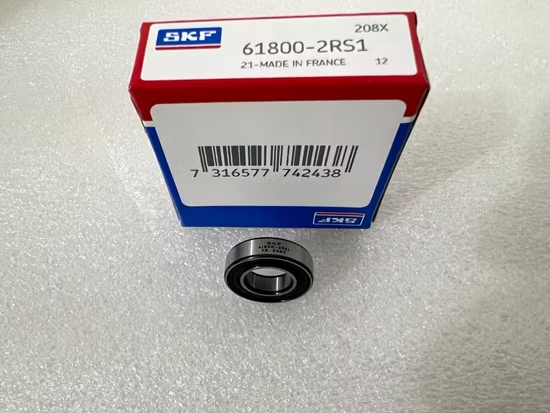
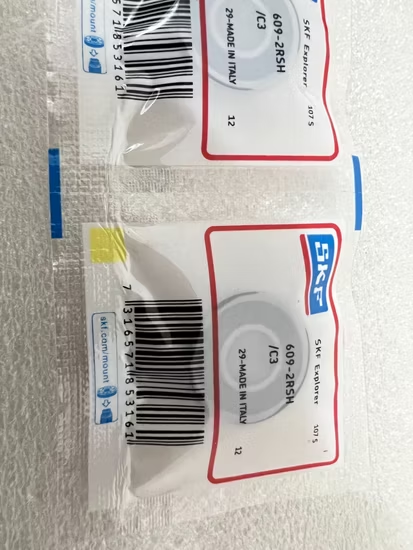
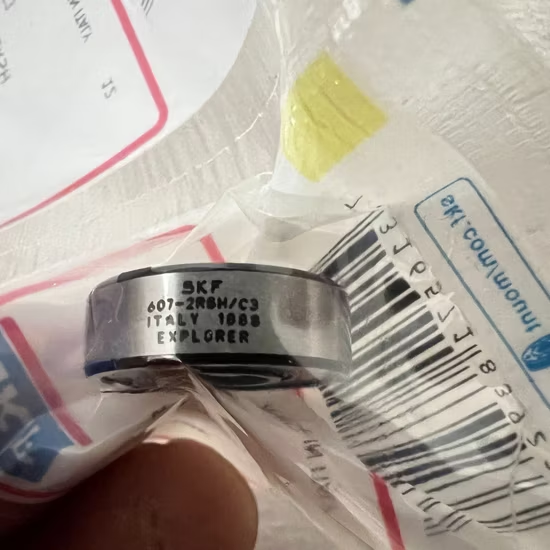
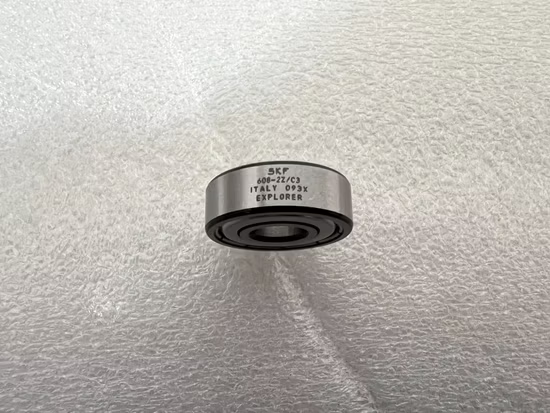
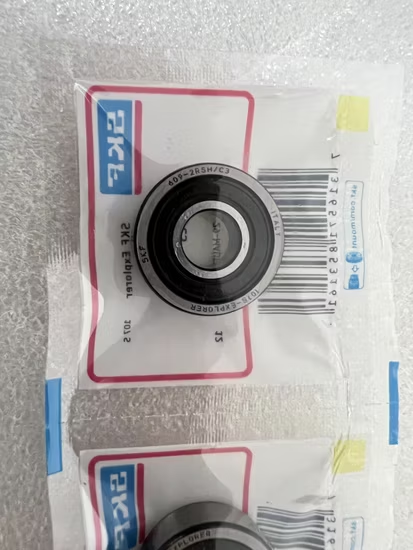
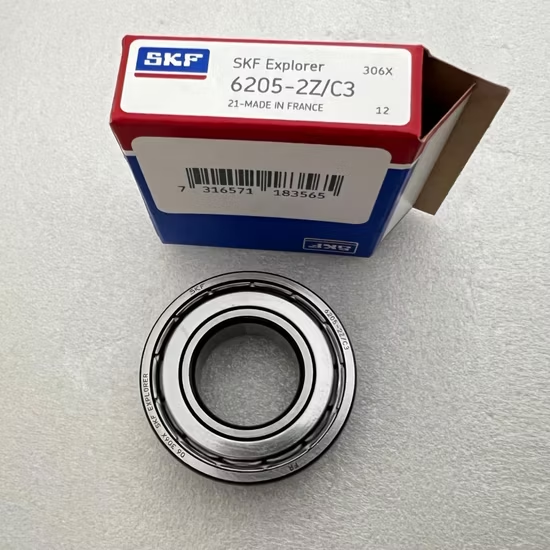
62200 Deep Groove Ball Bearing — designed for radial load support in high-speed rotating equipment with low vibration requirements.
Verify product authenticity by scanning the manufacturer QR code through the official brand application for full batch traceability confirmation.
Traceable Batch Origins — Every 62200 deep groove ball bearing ships with manufacturer lot documentation for complete supply chain visibility.
| Parameter | Value |
|---|---|
| Designation | 62200 |
| Bearing Type | Deep Groove Ball Bearing |
| Bearing Style | Open, Rubber Seals, Iron Seals |
| Quality Level | Z1V1, Z2V2, Z3V3, Z4V4 |
| Feature | Low Noise, High Speed, Long Service Life |
| Origin | Germany, Japan, Sweden, Malaysia, China |
| HS Code | 848210 |
| Industry | Typical Applications |
|---|---|
| Electric Motors | Rotor shaft support, cooling fan assemblies |
| Industrial Gearboxes | Low-speed input shafts, auxiliary drive mechanisms |
| General MRO | Conveyor idler rollers, light-duty pump shafts |
| Household Appliances | Washing machine drum supports, HVAC blower motors |
Matching the base designation without verifying internal clearance and sealing options leads to premature thermal binding in continuous duty motors.
Procurement teams often approve purchase orders based solely on the base number, overlooking how internal design variations dictate field performance. A standard clearance installed in a high-temperature motor environment will rapidly eliminate operational play as the shaft expands, causing the rolling elements to skid and the cage to fail . In the Pearl River Delta manufacturing hub, I have inspected countless seized units where the only fault was a mismatched internal geometry that passed a superficial visual check. Securing the correct 62200 deep groove ball bearing requires looking past the stamped outer ring to confirm the exact sealing configuration and noise grade required by the specific application.
Selecting the appropriate sealing style for a 62200 deep groove ball bearing directly influences both friction generation and contamination ingress. Open variants suit enclosed gearboxes where external oil lubrication and regular maintenance are guaranteed, while rubber seals provide superior exclusion of fine particulate matter in dusty agricultural or mining conveyors. Iron shields offer a middle ground, minimizing friction for high-speed electric motor applications where large debris is absent but basic dust protection is necessary. We cross-reference your specific environmental exposure to ensure the chosen variant prevents lubricant degradation without introducing excessive drag torque.
Continuous duty electric motors generate substantial internal heat, demanding careful consideration of thermal expansion and vibration characteristics. If the internal clearance is too tight, the differential expansion between the rotating shaft and stationary housing will preload the bearing beyond its design limits, resulting in catastrophic thermal runaway. Furthermore, the Z1V1 through Z4V4 quality levels dictate the acceptable noise and vibration thresholds; installing a lower grade in a precision HVAC blower motor introduces unacceptable acoustic resonance. Proper selection aligns the lubricant viscosity, seal friction, and internal geometry to maintain a stable hydrodynamic film .
The Z1V1 to Z4V4 quality classifications define the strictness of vibration and acoustic testing applied during manufacturing. A Z1V1 grade is generally sufficient for heavy-duty, low-speed gearbox applications where ambient noise masks bearing operation. Conversely, Z3V3 and Z4V4 grades undergo rigorous dynamic balancing and surface finish refinement to eliminate high-frequency harmonics, making them mandatory for sensitive household appliances and high-speed servo motors. Understanding these suffixes ensures you do not overpay for unnecessary precision in rugged MRO applications, nor under-specify a component destined for a noise-sensitive assembly.
Relying on a base number match while ignoring critical internal parameters triggers a cascade of operational failures. An incorrect seal type might allow moisture ingress, leading to raceway corrosion that drastically shortens the fatigue life outlined in ISO 281 calculations. Similarly, deploying an open bearing in a contaminated environment forces frequent, unplanned downtime for relubrication and eventual replacement. These misalignments void equipment warranties and shift the financial burden onto the maintenance department, turning a minor procurement saving into a major operational liability .
We process every inquiry through a rigorous technical review that catches cross-reference errors before the order is placed. Our authorized multi-brand distribution network ensures that whether you require a unit originating from Germany, Japan, or China, the batch traceability remains intact and verifiable. We specifically check for the common mistake of substituting iron shields where rubber seals are mandated by the OEM equipment manual. By validating the exact quality level and sealing configuration against your application parameters, we eliminate the risk of receiving visually identical but functionally incompatible inventory.
To ensure the selected variant perfectly aligns with your machinery, please provide the specific radial and axial load profiles, operational speed ranges, and ambient temperature expectations. Supplying the original equipment manufacturer part numbers allows our engineering team to perform a comprehensive cross-reference check, verifying that the internal clearance and sealing options match the factory specifications. This technical collaboration guarantees that the proposed solution addresses the unique mechanical demands of your application, preventing costly trial-and-error procurement cycles.
Q: How do I verify the authenticity of the received inventory?
A: Each unit features a unique QR code that links directly to the manufacturer's official verification application. Scanning this code confirms the batch number, production facility, and original specifications, ensuring the components are genuine and not counterfeit clones that bypass casual visual inspections.
Q: Why must sealing options be matched alongside the base designation?
A: The base number only defines the external dimensions. Selecting the wrong seal type, such as using iron shields in a wet environment instead of rubber seals, allows moisture ingress that causes raceway corrosion and premature fatigue, completely negating the expected service life of the component.
Q: How do Z1V1 to Z4V4 quality levels impact electric motor performance?
A: These grades indicate the strictness of vibration and acoustic testing. Higher grades like Z4V4 feature refined surface finishes and tighter tolerances that eliminate high-frequency noise, which is critical for sensitive appliances and precision motors where acoustic resonance and vibration are unacceptable.
Q: What information is needed to confirm the correct internal clearance?
A: We require details regarding the operating temperature differential between the shaft and housing, as well as the interference fit dimensions. This data allows us to calculate the thermal expansion and recommend the appropriate internal clearance to prevent the bearing from binding under operational heat.
Our 5-step process ensures every order is engineered, validated, and supported for optimal performance.
Technical needs assessment
Custom specifications
Free samples for $50k+
Pre-shipment inspection
On-site & predictive
Our certified engineers respond within 24 hours with detailed technical specifications, pricing, and lead time information.