01
Consultation
Technical needs assessment


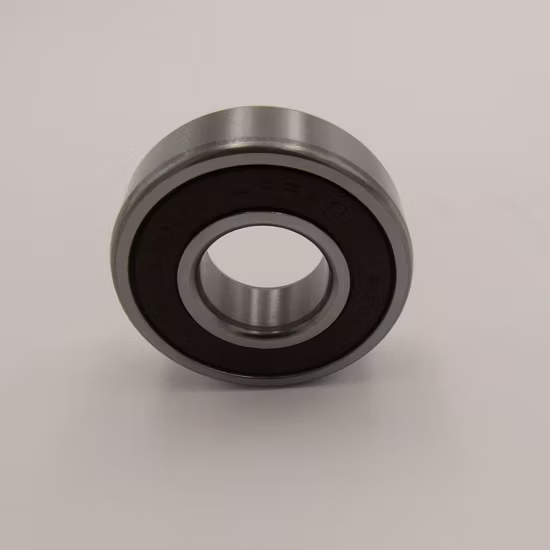
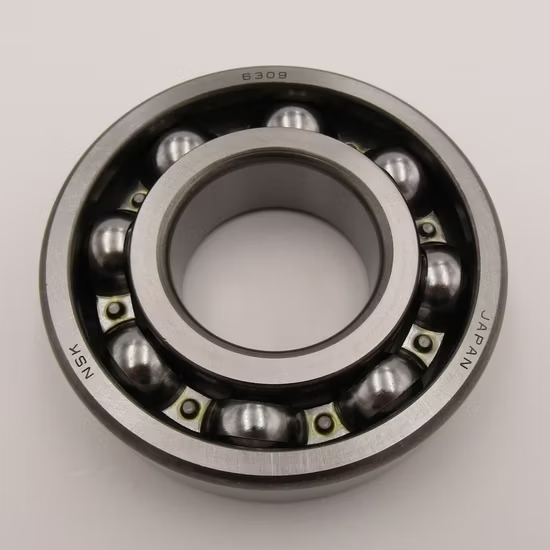

6206-2Z/C3 Deep Groove Ball Bearing features double steel shields for effective dust protection and C3 radial internal clearance to accommodate thermal expansion during high-temperature operations.
Scan To Verify — Every 6206-2Z/C3 deep groove ball bearing we dispatch includes a scannable QR code linked directly to the manufacturer's official authentication application.
| Parameter | Value |
|---|---|
| Designation | 6206-2Z/C3 |
| Bearing Type | Deep Groove Ball Bearing |
| Seal or Shield Type | Double Steel Shields (2Z) |
| Clearance Class | C3 (Greater than Normal) |
| Material Options | Available in stainless steel or standard bearing steel variants |
| Quality Levels | Z1V1, Z2V2, Z3V3, Z4V4 |
| Noise and Vibration | Low noise, high-speed optimized |
| Industry | Typical Applications |
|---|---|
| Electric Motors | Rotor shaft support in high-speed induction motors |
| Industrial Gearboxes | High-speed input shafts and intermediate gear stages |
| General MRO | Conveyor drive pulleys and pump impeller shafts |
A matched base number means nothing when the internal clearance is wrong.
I still see procurement teams ordering replacement parts based solely on the base 6206 number, completely ignoring the suffix string. When a standard CN clearance unit is installed into an electric motor designed for thermal expansion, the bearing seizes as the rotor heats up. This specific cross-reference error accounts for a significant share of premature failures in general machinery . Sourcing the exact 6206-2Z/C3 deep groove ball bearing prevents this thermal binding before the equipment even starts.
Electric motor rotors demand precise clearance management to handle the heat generated during continuous operation. The C3 radial internal clearance built into the 6206-2Z/C3 deep groove ball bearing accommodates this thermal expansion without inducing excessive preload on the rolling elements. Combined with our cross-brand interchange expertise, we ensure the replacement unit matches the exact thermal and dimensional requirements of your specific motor housing.
High-speed shafts in gearboxes and pumps generate substantial friction heat, which alters the internal geometry of the bearing. If the initial clearance is too tight, thermal expansion eliminates the operating gap, leading to catastrophic skidding and cage failure. Simultaneously, the 2Z double steel shields must keep abrasive dust out of the raceway without introducing the high friction typical of rubber contact seals . Balancing these thermal and contamination variables dictates the operational lifespan of the assembly.
The C3 suffix indicates a radial internal clearance strictly greater than the standard CN class, which is mandatory for applications where the inner ring runs hotter than the outer ring. The 2Z designation specifies non-contact double steel shields, offering robust contamination protection while maintaining the low friction required for high-speed rotation. We also supply these units in Z1V1 through Z4V4 quality grades, allowing buyers to specify the exact noise and vibration thresholds needed for precision general machinery. Depending on the operating environment, this designation is available in stainless steel or standard bearing steel variants.
Installing a standard clearance bearing in an application engineered for C3 clearance triggers a cascade of mechanical failures. As the shaft expands, the rolling elements are forced against the raceway with excessive preload, rapidly degrading the lubricant and generating severe vibration. This unplanned downtime disrupts entire production lines and frequently voids equipment warranties due to improper maintenance practices . The financial impact of a single seized motor shaft vastly outweighs the effort required to verify the suffix string before procurement.
We maintain authorized distribution channels across all major international brands, allowing a single purchase order to cover mixed-brand MRO requirements without juggling multiple vendors. Every shipment includes batch traceability back to the manufacturer's production facilities, verified through official QR applications to eliminate the risk of counterfeit inner rings. Our technical team reviews cross-references to ensure the base designation, C3 clearance class, and 2Z shield type all align perfectly with your OEM specifications. We actively reject orders where the requested suffix contradicts the stated operating temperature, preventing field failures before the parts leave our warehouse.
To guarantee the selected unit survives your specific operating environment, please provide the radial and axial load profiles, maximum rotational speeds, and expected thermal gradients. If you are replacing an existing unit, sharing the exact OEM equipment number allows our engineering team to perform a comprehensive cross-reference check. This technical review ensures the C3 clearance and 2Z shielding perfectly align with your machinery's design parameters, eliminating guesswork from your procurement process.
Q: Why is matching the C3 clearance suffix critical for preventing thermal binding in electric motors?
A: Electric motor shafts operate at higher temperatures than the housing, causing the inner ring to expand. The C3 clearance provides the necessary extra internal gap to absorb this thermal expansion. Installing a standard CN clearance unit in this environment eliminates the operating gap, leading to excessive friction, lubricant breakdown, and eventual rotor seizure.
Q: How do 2Z steel shields compare to rubber seals for high-speed gearbox applications?
A: The 2Z double steel shields provide non-contact protection against dust and debris, which generates significantly less friction than rubbing rubber seals. This low-friction characteristic is essential for high-speed gearbox shafts, as it prevents excessive heat buildup while still maintaining adequate contamination exclusion for general machinery environments.
Q: What are the cross-reference pitfalls when substituting standard CN clearance with C3?
A: The most common error is matching only the base 6206 number while ignoring the internal clearance suffix. Substituting a C3 requirement with a standard CN bearing causes thermal binding under load, whereas using a C3 bearing in a low-speed, low-temperature application designed for CN clearance can result in excessive vibration and reduced operational lifespan.
Q: What do Z1V1 to Z4V4 quality levels mean for noise and vibration in general machinery?
A: These designations define the strictness of the geometric tolerances and the resulting acoustic performance. Higher levels, such as Z4V4, indicate exceptionally low vibration and noise output, which is mandatory for precision electric motors and sensitive equipment, whereas Z1V1 is suitable for standard industrial gearboxes where acoustic limits are less restrictive.
Our 5-step process ensures every order is engineered, validated, and supported for optimal performance.
Technical needs assessment
Custom specifications
Free samples for $50k+
Pre-shipment inspection
On-site & predictive
Our certified engineers respond within 24 hours with detailed technical specifications, pricing, and lead time information.