01
Consultation
Technical needs assessment



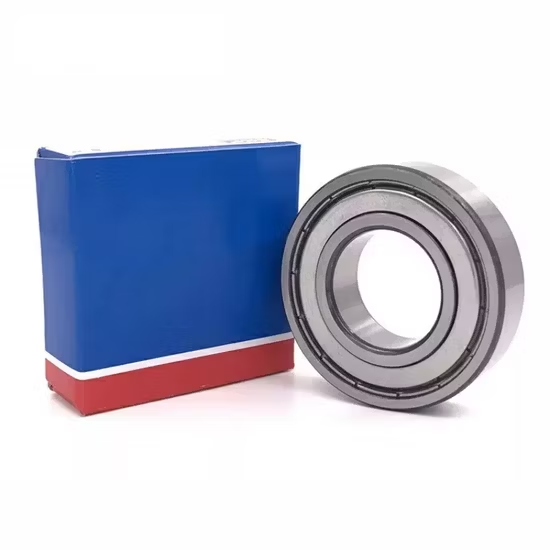
6001 Deep Groove Ball Bearing — manufactured in 420, 440, or 304 stainless steel with open, rubber, or iron seal options for optimal corrosion resistance.
Unified Multi-Brand Sourcing — Procure your 6001 variants across SKF, FAG, and NSK in a single consolidated shipment, eliminating multi-vendor coordination.
| Parameter | Value |
|---|---|
| Designation | 6001 |
| Bearing Type | Deep Groove Ball Bearing |
| Material Options | 420, 440, or 304 Stainless Steel |
| Seal or Shield Type | Open, Rubber Seals, or Iron Seals |
| Noise and Vibration Level | Z1V1, Z2V2, Z3V3, or Z4V4 |
| Origin Options | Germany, Japan, Sweden, Malaysia, or China |
| HS Code | 848210 |
| Industry | Typical Applications |
|---|---|
| Consumer Goods | High-speed toy motor shafts and miniature gearboxes |
| Office Automation | Printer carriage rails and copier scanner mechanisms |
| Light Mobility | Bicycle bottom bracket assemblies and freewheel hubs |
Standard bearing steel corrodes rapidly when exposed to moisture, making the 6001 stainless steel deep groove ball bearing the necessary alternative for damp or washdown environments. . Sourcing teams frequently overlook internal design differences when switching materials, assuming the base number guarantees identical performance. This oversight leads to premature seizing in high-speed toy motors or excessive friction in office equipment carriages.
Selecting the correct stainless variant requires balancing hardness against chemical resistance. Martensitic grades like 420 and 440 offer higher load capacity for bicycle hubs, while austenitic 304 provides superior resistance to mild chemicals in office equipment. As an authorized distributor, we verify that the selected 6001 stainless steel deep groove ball bearing matches the specific environmental exposure of your application, preventing catastrophic material degradation.
During my years as a grinder in Dongguan, I witnessed countless standard 6001 bearings fail in high-speed electric motors due to thermal binding. When rotational speeds generate internal heat, the lack of appropriate internal clearance causes the rolling elements to jam. Matching the correct seal type—whether open for external cooling, iron shields for low friction, or rubber seals for contamination protection—is critical to managing operating temperatures and preventing unexpected motor stalls. .
The Z1V1 through Z4V4 classifications dictate the acoustic and dynamic smoothness of the bearing in operation. For precision office equipment and high-end toys, specifying a Z3V3 or Z4V4 grade ensures minimal vibration transfer to the housing. These grades reflect strict manufacturing tolerances in raceway geometry and surface finish, directly impacting the perceived quality and operational lifespan of the final assembled product.
Purchasing a base 6001 designation without verifying the exact material grade or seal configuration often results in unplanned downtime and warranty voidance. A 304 stainless variant might deform under heavy radial loads in a bicycle hub, while an iron-shielded version might allow moisture ingress in a damp environment. These specification mismatches trigger premature failure modes that compromise the entire mechanical assembly. .
Our distribution model ensures that every 6001 stainless steel deep groove ball bearing is backed by verifiable manufacturer documentation. We cross-reference not just the base designation, but the specific material and noise grade requirements across different brands. This prevents the common error of substituting a standard carbon steel equivalent when a specific stainless grade was explicitly required by the OEM engineering team.
To ensure the selected configuration meets your exact operational demands, please provide the specific radial and axial loads, operating speeds, and environmental exposure details. Our engineering team will review these parameters to recommend the optimal material grade, seal type, and internal clearance for your equipment. Supplying the OEM part number allows us to perform a precise cross-reference check against your original specifications.
Q: What are the practical differences between 420, 440, and 304 stainless steel for these bearings?
A: Martensitic grades like 420 and 440 provide higher hardness and load capacity, making them suitable for bicycle hubs and toy motors. Austenitic 304 offers lower magnetic permeability and superior corrosion resistance, ideal for office equipment exposed to mild chemicals or moisture where extreme load capacity is not the primary requirement.
Q: How do I choose between open, rubber sealed, and iron sealed configurations?
A: Open bearings require external lubrication and are best for high-speed applications needing heat dissipation. Iron shields provide low-friction protection against large dust particles, suitable for enclosed office equipment. Rubber seals offer the highest contamination and moisture resistance but generate slightly more friction, making them ideal for bicycle parts exposed to the elements.
Q: What do the Z1V1 to Z4V4 noise and vibration levels mean in operation?
A: These grades indicate the strictness of manufacturing tolerances regarding raceway geometry and surface finish. Higher grades like Z3V3 and Z4V4 ensure exceptionally smooth rotation with minimal acoustic emission, which is critical for precision office automation and high-end consumer toys where vibration transfer to the housing must be strictly minimized.
Q: How can I verify the authenticity of the bearings using official brand apps?
A: Upon delivery, scan the QR code located on the individual packaging using the respective manufacturer's official mobile application. This digital verification confirms the batch origin, material specifications, and production date, effectively eliminating the risk of installing counterfeits with soft inner rings or cloned packaging into your critical assemblies.
Q: What cross-reference checks are needed when replacing carbon steel with a stainless variant?
A: Simply matching the base 6001 number is insufficient. You must verify that the internal clearance, cage material, and precision grade of the stainless replacement match the original carbon steel design. Stainless steel has different thermal expansion characteristics, so failing to adjust the internal clearance specification can lead to thermal binding in high-speed applications.
Our 5-step process ensures every order is engineered, validated, and supported for optimal performance.
Technical needs assessment
Custom specifications
Free samples for $50k+
Pre-shipment inspection
On-site & predictive
Our certified engineers respond within 24 hours with detailed technical specifications, pricing, and lead time information.