01
Consultation
Technical needs assessment


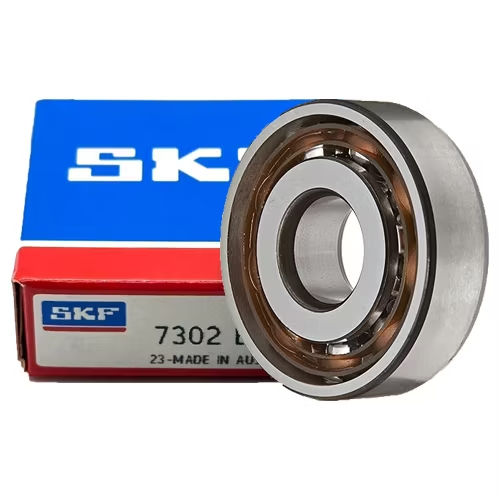
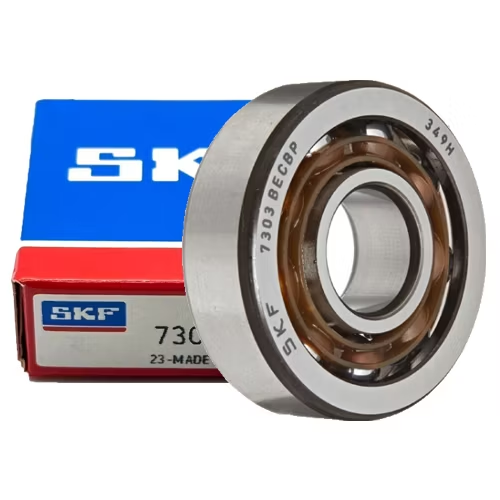
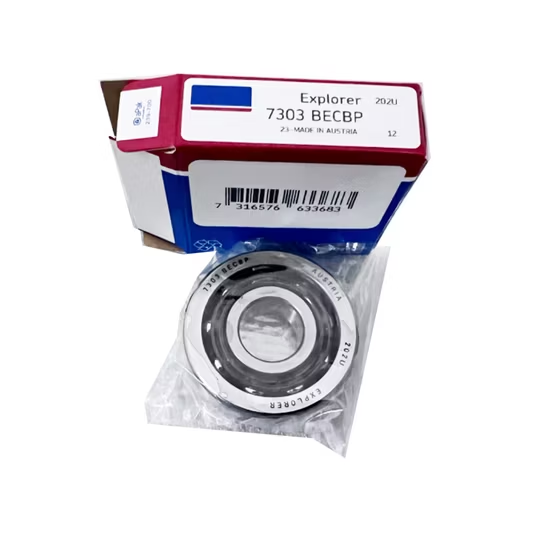

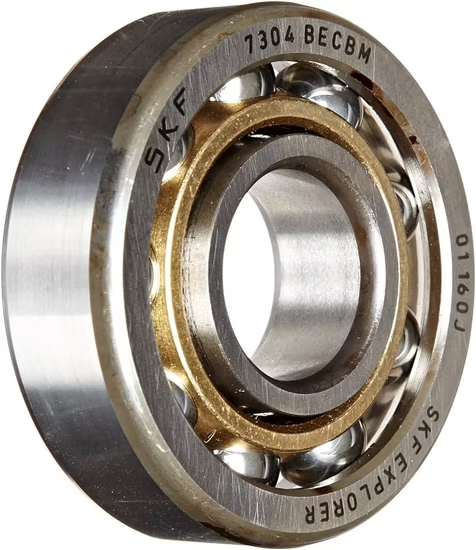
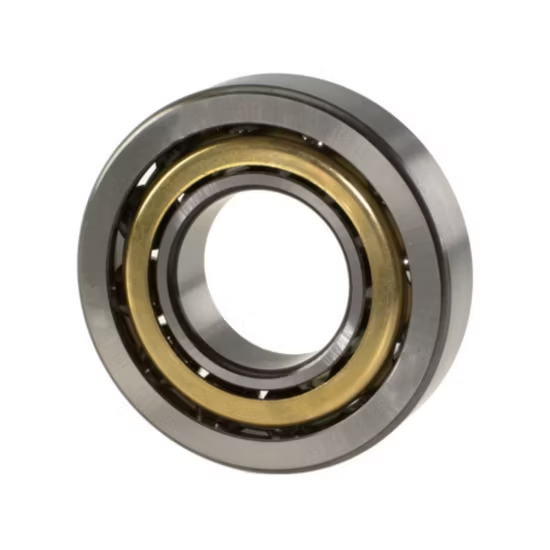
7302 Becbp Angular Contact Ball Bearing — Features a B suffix indicating a 40° contact angle for optimized combined radial and axial load capacity.
Cross-Reference Triad Alignment — We verify base number, internal clearance, and cage material simultaneously to prevent thermal binding in your 7302 Becbp installations.
| Parameter | Value |
|---|---|
| Designation | 7302 Becbp |
| Bearing Type | Angular Contact Ball Bearing |
| Bore Diameter (d) | 15 mm |
| Outside Diameter (D) | 42 mm |
| Width (B) | 13 mm |
| Contact Angle | 40° |
| Material | Bearing Steel |
| Vibration Grade Options | Z1V1, Z2V2, Z3V3 |
| Origin Options | Germany, Japan, Sweden, Malaysia, China |
Note: The 'E', 'C', and 'P' suffix components in this specific designation string are unverified against standard manufacturer catalogs and require direct confirmation prior to bulk procurement.
| Industry | Typical Applications |
|---|---|
| Precision Manufacturing | Machine tool spindle nose bearings |
| Fluid Management | High-speed pump impeller shaft supports |
| Automation | Robotics joint actuator pivot points |
| General Machinery | High-precision equipment rotary tables |
Thermal expansion ignores base numbers.
In high-speed environments, assuming any 7300-series part fits the housing is a critical error. I have seen procurement teams source parts based solely on the prefix, completely missing the cage material and precision requirements. When a standard stamped steel cage is forced into an application demanding a machined brass or precision-engineered polyamide cage, the friction heat builds rapidly. This leads to thermal binding, where the internal clearance vanishes, and the bearing seizes the shaft. A mismatched 7302 Becbp angular contact ball bearing will fail catastrophically under these conditions, turning a simple scheduled swap into an unplanned week-long machine rebuild .
Selecting the correct configuration for precision spindles requires looking past the basic dimensions. The 7302 Becbp angular contact ball bearing is engineered to handle the combined radial and axial loads typical in machine tool spindles and high-speed pumps. By ensuring the cross-reference covers the exact cage type and contact angle, we eliminate the micro-vibrations that degrade surface finishes in precision machining.
Spindle applications generate significant heat, which directly impacts internal clearance. If the selected bearing lacks the appropriate thermal expansion compensation, the 40° contact angle will force the rolling elements against the raceways with excessive preload as temperatures rise. Furthermore, high-speed rotation demands a cage design that minimizes friction and maintains stable lubrication films. Inadequate vibration grading in these tight-tolerance assemblies amplifies harmonic resonance, accelerating fatigue and compromising the dimensional accuracy of the final machined product .
The 'B' suffix definitively establishes a 40° contact angle, optimizing the geometry for substantial axial thrust combined with radial support. This specific angle is non-negotiable for vertical shaft orientations or heavy thrust applications. The bearing steel construction provides the necessary core hardness and fatigue strength to withstand continuous Hertzian contact stresses at elevated rotational speeds. Available vibration grades ranging from Z1V1 up to Z3V3 allow procurement engineers to specify the exact operational smoothness required, ensuring quieter running and reduced harmonic transfer to the machine chassis.
Substituting a visually similar part without verifying the internal geometry leads to premature failure and catastrophic damage to the housing. When the cage material or precision class does not match the original equipment specifications, the bearing operates outside its designed kinematic envelope. This results in accelerated wear, excessive noise, and ultimately, unplanned downtime that voids equipment warranties. Following the failure analysis frameworks outlined in ISO 15243, these incidents are consistently traced back to improper selection rather than manufacturing defects .
We do not just ship boxes; we validate the engineering match. Our cross-reference protocol specifically targets the high-risk suffix combinations that cause field failures. For the 7302 Becbp angular contact ball bearing, we verify that the internal clearance class aligns with your operating temperature profile, preventing the thermal binding common in poorly specified replacements. Every batch is traced back to the manufacturer's production facilities, ensuring you receive genuine components with verifiable metallurgical integrity. We provide application-based selection reviews, checking your load and speed parameters against the specific suffix configuration to guarantee operational reliability.
To ensure optimal performance, share your specific radial and axial load profiles, operational speeds, and steady-state temperatures. Our engineering team will perform a comprehensive L10 life calculation and verify the cross-reference against your OEM equipment numbers. This technical review guarantees the selected configuration perfectly matches your application's unique kinematic demands.
Q: Why do cross-reference errors in suffixes cause thermal binding in angular contact bearings?
A: Suffixes dictate internal clearance and cage design. If a replacement lacks the correct clearance for the operating temperature, thermal expansion eliminates the internal gap. The rolling elements then bind against the raceways, generating massive friction heat that seizes the shaft and destroys the bearing assembly.
Q: How can I verify bearing authenticity using official brand QR apps?
A: Scan the QR code on the physical packaging using the manufacturer's official mobile application. The app cross-references the unique batch data against the central factory database, confirming the production date, facility, and genuine origin, effectively filtering out sophisticated counterfeits with cloned labels.
Q: What is the practical difference between 15°, 25°, and 40° contact angles in the 7xxx series?
A: A 15° angle suits high-speed, light axial loads, while 25° offers a middle ground. The 40° angle, designated by the 'B' suffix, provides maximum axial thrust capacity, making it essential for applications with heavy directional loads or vertical shaft orientations where axial support is critical.
Q: How do I select the correct cage material and precision class for machine tool spindles?
A: Spindles demand high rotational speeds and tight runout tolerances. Machined brass or specialized polyamide cages reduce friction at high RPMs, while higher precision classes ensure minimal radial runout. Share your exact speed and load parameters so we can match the cage and precision suffixes to your spindle's specific requirements.
Our 5-step process ensures every order is engineered, validated, and supported for optimal performance.
Technical needs assessment
Custom specifications
Free samples for $50k+
Pre-shipment inspection
On-site & predictive
Our certified engineers respond within 24 hours with detailed technical specifications, pricing, and lead time information.