01
Consultation
Technical needs assessment

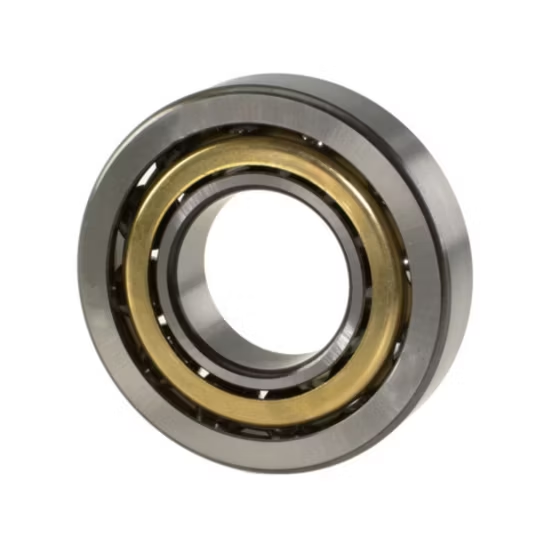
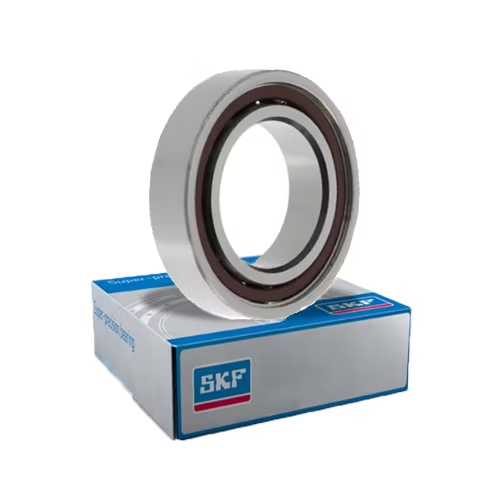

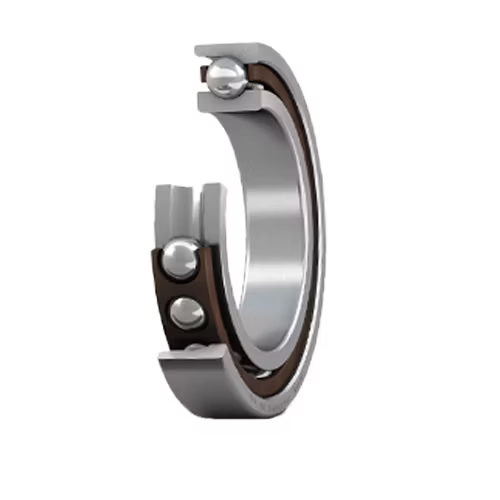
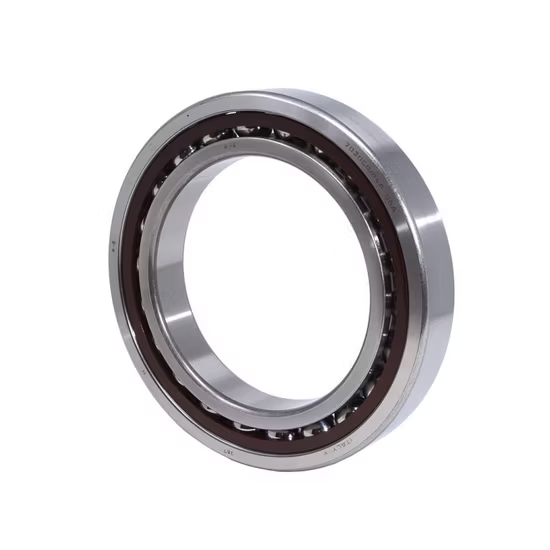
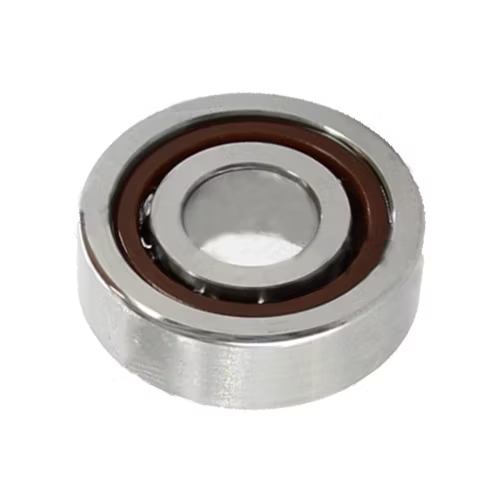
7013 CD/P4a Angular Contact Ball Bearing
Precision cross-reference alignment — We verify base designation, 15° contact angle, and P4a tolerance matching before dispatching any 7013 CD/P4a angular contact ball bearing.
| Parameter | Value |
|---|---|
| Designation | 7013 CD/P4a |
| Bearing Type | Angular Contact Ball Bearing |
| Contact Angle | 15° (CD suffix) |
| Precision Class | P4a (ISO Class 4 dimensional and running accuracy) |
| Material | Bearing steel (ceramic hybrid rolling elements available upon request) |
| Arrangement | Universal pairing (GA light preload variant available) |
| Origin | Germany / Japan / Sweden / Malaysia / China |
| Certification | ISO 9001 compliant, fully traceable batch documentation |
| Industry | Typical Applications |
|---|---|
| Machine Tool Manufacturing | High-speed motorized spindles, precision grinding headstocks |
| Industrial Automation | High-precision robotics rotary joints, servo motor encoders |
| Fluid Machinery | High-speed pump shafts, compressor rotor supports |
A matched set of 7013 CD/P4a angular contact ball bearings can still cause thermal binding if the preload suffix is ignored.
Suffix accuracy dictates spindle survival.
I have seen procurement teams source the correct base number only to receive standard P0 clearance instead of the required P4a precision, leading to catastrophic vibration at high RPMs. The internal geometry and cage design must perfectly align with the spindle's thermal expansion profile . Overlooking the exact CD contact angle and pairing arrangement turns a precision component into a premature failure point.
Deploying a 7013 CD/P4a angular contact ball bearing in a motorized spindle requires strict adherence to the 15° contact angle design, which balances radial support with axial rigidity. Our technical review process ensures the selected bearing aligns with the specific machining loads and thermal growth characteristics of your equipment. We cross-reference the exact OEM requirements to prevent the installation of mismatched precision classes.
High-speed spindles generate significant friction heat, directly impacting internal clearance and lubricant film thickness. A 15° contact angle minimizes friction compared to steeper angles, but it demands precise oil-air or oil-jet lubrication to prevent cage starvation. Thermal expansion of the shaft and housing alters the operational preload dynamically during machining cycles . Selecting the correct universal pairing preload ensures the bearing maintains axial stiffness without generating excessive heat.
The CD suffix designates an optimized 15° contact angle, specifically engineered for high-speed applications where minimizing friction heat is critical. The /P4a suffix indicates ISO Class 4 precision, guaranteeing tight dimensional and running accuracy essential for minimizing spindle runout. When universal pairing with light preload (GA) is specified, the bearings are manufactured to fit together in back-to-back or face-to-face arrangements with a defined axial clearance. This exact suffix matching prevents the thermal binding that occurs when standard clearance bearings are forced into precision housings.
Installing a bearing that matches the base number but lacks the correct P4a precision or CD contact angle leads to unplanned downtime and catastrophic spindle damage. According to failure analysis frameworks, incorrect internal geometry causes uneven load distribution and rapid cage degradation . The resulting vibration compromises surface finish quality and voids the machine tool warranty. Correcting these failures requires expensive spindle rebuilds and extensive production delays.
We maintain authorized distribution across major international brands, allowing mixed-brand orders with unified documentation. Every 7013 CD/P4a angular contact ball bearing is verified for exact suffix alignment, preventing the common error of substituting a 25° AC angle for the required 15° CD design. Our batch traceability links directly to the manufacturer, ensuring authenticity beyond superficial visual checks. We provide application-based selection reviews to confirm the preload arrangement matches your specific spindle stiffness requirements.
To ensure precise selection and L10 life calculation, please provide your spindle's radial and axial loads, maximum operating speed, and expected thermal growth parameters. If replacing an existing component, share the exact OEM equipment number or the complete designation string including all preload and pairing suffixes. This data allows our engineering team to verify cross-references and confirm the optimal clearance and lubrication strategy for your specific application.
Q: How do I verify the authenticity of the 7013 CD/P4a bearing using official apps?
A: Scan the QR code on the packaging using the manufacturer's official mobile application. This verifies the batch number and production facility, ensuring the bearing is genuine and not a counterfeit with a cloned code. We provide full traceability documentation to support this verification process before shipment.
Q: Why must the CD contact angle and P4a precision suffixes align perfectly during cross-referencing?
A: The CD suffix ensures a 15° contact angle optimized for high-speed thermal management, while P4a guarantees tight running accuracy. Substituting a different angle or standard precision causes thermal binding, excessive vibration, and premature spindle failure due to mismatched internal geometry and load distribution profiles.
Q: What is the practical difference between P4 and P4A precision classes for spindle applications?
A: While both fall under ISO Class 4, the P4A designation typically indicates even stricter running accuracy and tighter tolerance bands for specific dimensional parameters. This enhanced precision is critical for high-speed motorized spindles where minimal runout and vibration are required to maintain tight machining tolerances.
Q: How do I select the correct preload (GA/GB/GC) for matched pair angular contact bearings?
A: Preload selection depends on the required axial rigidity and the expected thermal expansion of the spindle. Light preload (GA) is common for high-speed applications to minimize friction heat, while heavier preloads increase stiffness for heavy cutting loads. Share your operational parameters so we can recommend the exact pairing arrangement.
Our 5-step process ensures every order is engineered, validated, and supported for optimal performance.
Technical needs assessment
Custom specifications
Free samples for $50k+
Pre-shipment inspection
On-site & predictive
Our certified engineers respond within 24 hours with detailed technical specifications, pricing, and lead time information.
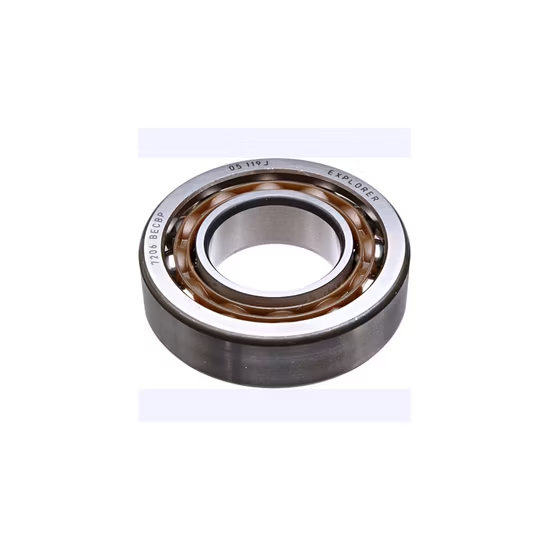
![7216 Becbm 7216 CD/P4a Angular Contact Bearing Wholesale Supplier [WARN] draft identifier mismatch](https://skfiso.com/wp-content/uploads/2026/09/7216-becbm-7216-cd-p4a-angular-contact-bearing-wholesale-supplier-warn-draft-identifier-mismatch-1cd42e.avif)
![7201 Becbp Angular Contact Ball Bearing High Speed Precision NSK Timken [WARN] draft identifier mismatch](https://skfiso.com/wp-content/uploads/2026/09/7201-becbp-angular-contact-ball-bearing-high-speed-precision-nsk-timken-warn-draft-identifier-mismatch-c9f392.avif)
