01
Consultation
Technical needs assessment


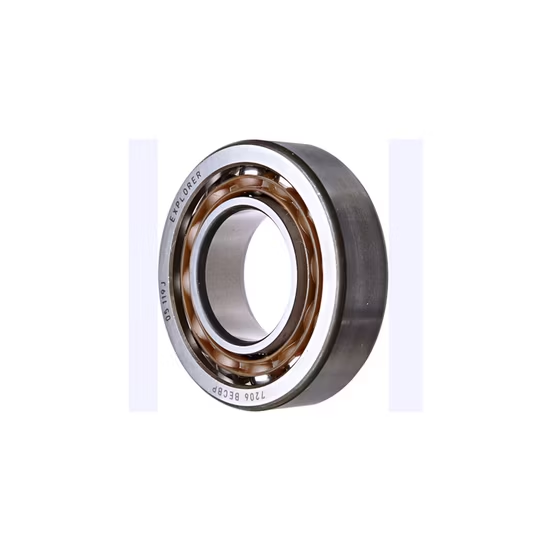
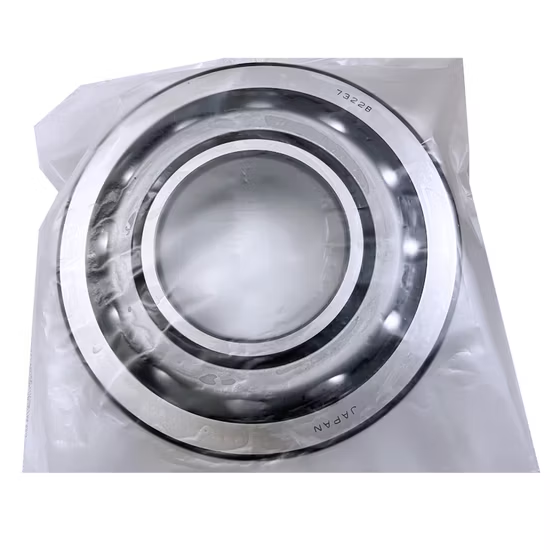
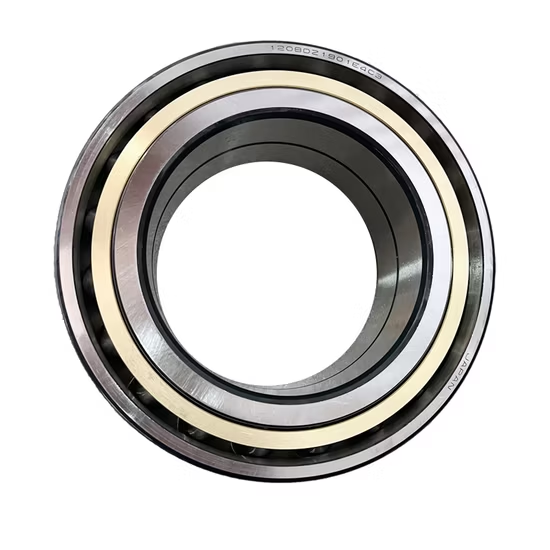

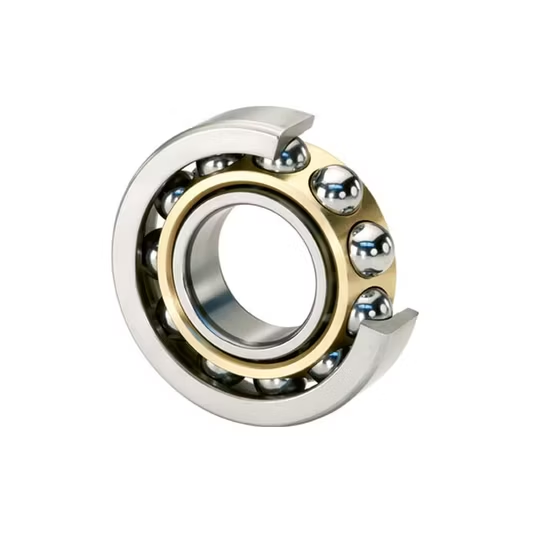
71917 CD/P4a Angular Contact Ball Bearing — engineered with a 15° contact angle to minimize friction heat and P4a precision class ensuring strict dimensional accuracy for high-speed machine tool spindles.
Full Brand Coverage — One consolidated shipment delivers matched 71917 CD/P4a angular contact ball bearing sets alongside your mixed-brand MRO requirements.
| Parameter | Value |
|---|---|
| Designation | 71917 CD/P4a |
| Product Type | Angular Contact Ball Bearing |
| Contact Angle | 15° (CD) |
| Precision Class | P4a (Class 4 dimensional and running accuracy) |
| Material | Bearing Steel (ceramic or stainless steel variants available upon request) |
| Arrangement | Universal matching (cross-reference: 71917cdga/P4a) |
| Origin | Germany / Japan / Sweden / Malaysia / China |
| Industry | Typical Applications |
|---|---|
| Machine Tool Manufacturing | High-speed CNC milling spindle front and rear support nodes |
| Precision Equipment | Optical grinding machine headstock precision rotation axes |
| Robotics | High-torque articulated joint actuators requiring minimal runout |
Precision tolerances mean nothing if the contact angle and clearance fail to match the thermal expansion profile of the spindle housing.
Sourcing high-speed spindle components often involves navigating a maze of visually identical bearings that behave entirely differently under load. I once inspected a CNC milling center suffering from severe chatter and premature cage failure. The maintenance team had replaced the original spindle bearings with standard P0 grade equivalents, completely ignoring the precision and contact angle suffixes. The result was catastrophic thermal binding once the spindle reached its operational RPM. When procuring a 71917 CD/P4a angular contact ball bearing, overlooking these critical designators guarantees unplanned downtime and scrapped workpieces .
Selecting the correct geometry is non-negotiable for machine tool spindles. The 71917 CD/P4a angular contact ball bearing utilizes a 15° contact angle, specifically optimized to minimize friction heat generation while maintaining axial rigidity. This exact configuration allows the spindle to sustain high rotational speeds without compromising the dimensional stability required for tight-tolerance machining. Our engineering team reviews your specific radial and axial load profiles to ensure this contact angle aligns perfectly with your spindle's operational envelope.
High-speed rotation generates significant internal heat, directly impacting internal clearance and lubricant film thickness. A 15° contact angle reduces the sliding friction between the rolling elements and raceways, mitigating thermal buildup. Proper lubrication selection—whether oil-air or high-speed grease—must account for the operating temperature to prevent the lubricant from degrading or churning excessively . Furthermore, the P4a precision class ensures that the bearing's dimensional and running accuracy remain stable even as the spindle housing expands thermally during continuous operation.
The "CD" suffix confirms the 15° optimized internal geometry, which is essential for applications where speed takes precedence over heavy axial thrust capacity. Meanwhile, "P4a" denotes a highly restrictive tolerance band for both dimensional and running accuracy, far exceeding standard commercial grades. This tight tolerance ensures minimal radial and axial runout, which is critical for achieving superior surface finishes on machined parts. When cross-referencing to equivalents like the 71917cdga/P4a, verifying the universal matching and preload arrangement becomes equally vital to maintain the required shaft rigidity.
Installing a bearing that matches the base dimensions but lacks the correct precision class or contact angle inevitably leads to premature failure. The resulting vibration degrades surface finish quality, accelerates tool wear, and ultimately forces an emergency spindle teardown. Such catastrophic damage not only voids equipment warranties but also incurs massive costs from lost production time and replacement components .
We supply the 71917 CD/P4a angular contact ball bearing with strict adherence to cross-reference alignment, ensuring the contact angle and precision class match your OEM specifications exactly. Every batch is fully traceable to the manufacturer's production facilities, eliminating the risk of counterfeit rings with compromised metallurgy. We provide comprehensive dimensional and running accuracy inspection reports to verify P4a compliance before dispatch. Furthermore, our technical team reviews your application parameters to confirm that the universal matching arrangement and preload are correctly specified for your spindle design.
To ensure optimal spindle performance, please provide your specific radial and axial load profiles, maximum operational RPM, and target operating temperatures. Sharing the OEM equipment number or existing spindle drawing allows our technical team to perform a precise cross-reference check and verify the L10 life calculation for the 71917 CD/P4a angular contact ball bearing.
Q: How do I verify the authenticity of this P4a precision bearing?
A: Authenticity is confirmed by scanning the QR code on the packaging using the manufacturer's official mobile application. This digital verification links directly to the factory's batch records, ensuring the bearing steel and P4a tolerances are genuine and protecting your spindle from the catastrophic damage caused by counterfeit components with soft inner rings.
Q: Why is the 15° contact angle critical for my CNC spindle?
A: The 15° contact angle, designated by the CD suffix, minimizes internal friction and heat generation at high rotational speeds. This geometry provides the necessary axial rigidity for precision machining while preventing the thermal binding that typically occurs when steeper contact angles are incorrectly applied to high-RPM spindle applications.
Q: What is the difference between P4 and P4a precision classes?
A: While both denote high precision, P4a specifies even tighter tolerances for running accuracy, particularly regarding axial and radial runout. This stricter control is essential for high-speed machine tool spindles where microscopic deviations can cause visible chatter marks on the finished workpiece and accelerate tool wear.
Q: How do I ensure the cross-reference matches my original OEM bearing?
A: A valid cross-reference must align the base designation, the 15° contact angle, and the specific P4a precision class, rather than just matching the bore and outside diameter. We verify these parameters alongside the universal matching preload arrangement to ensure the replacement bearing behaves identically to the original factory-installed component.
Our 5-step process ensures every order is engineered, validated, and supported for optimal performance.
Technical needs assessment
Custom specifications
Free samples for $50k+
Pre-shipment inspection
On-site & predictive
Our certified engineers respond within 24 hours with detailed technical specifications, pricing, and lead time information.


![7206 Becbm Angular Contact Ball Bearing High Speed Precision [WARN] draft identifier mismatch](https://skfiso.com/wp-content/uploads/2026/09/7206-becbm-angular-contact-ball-bearing-high-speed-precision-warn-draft-identifier-mismatch-0db82c.avif)