01
Consultation
Technical needs assessment

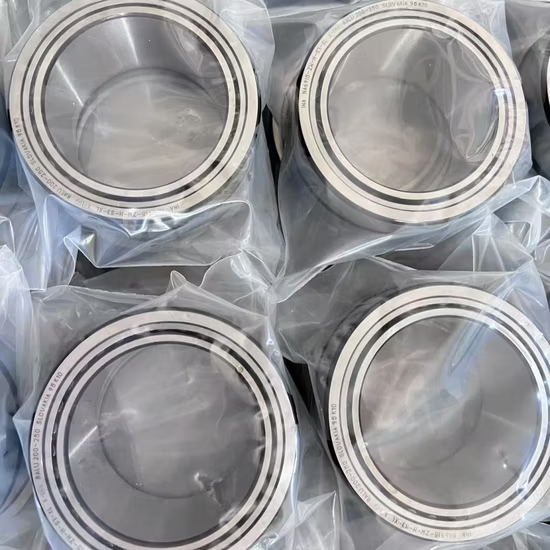
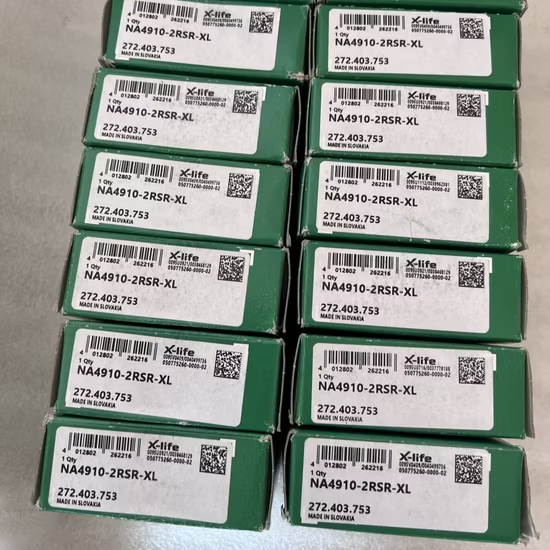
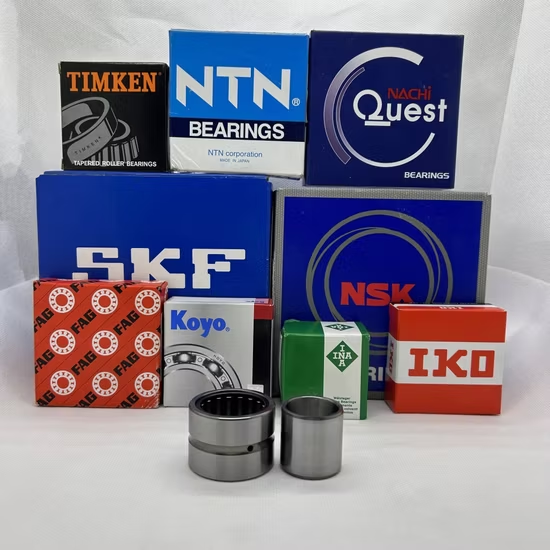
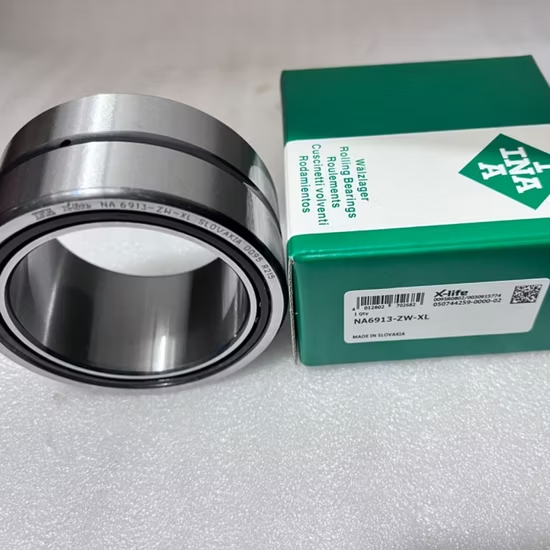
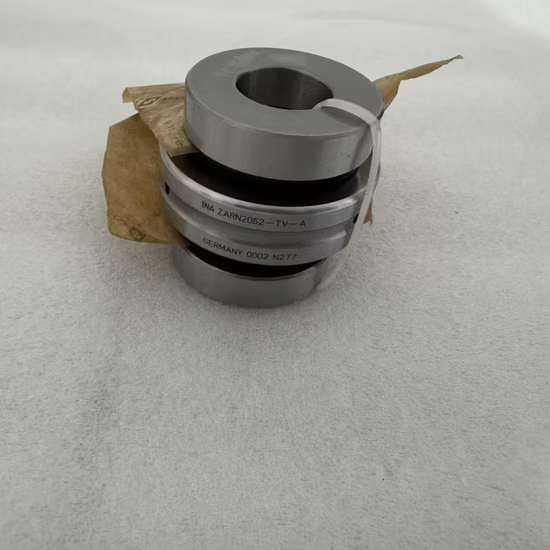
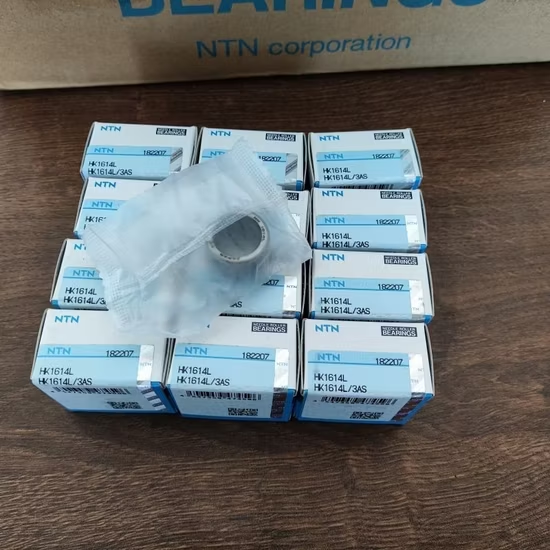
K Series Needle Roller Bearing and Cage Assembly — bearing steel construction engineered for high radial loads in compact spaces.
Traceable Batch Origins — Every needle roller and cage assembly ships with manufacturer lot documentation for full supply chain visibility.
| Parameter | Value |
|---|---|
| Product Type | Needle Roller Bearing and Cage Assembly |
| Cage | With Cage |
| Number of Rows | Multiple |
| Load Direction | Radial |
| Configuration | Available with or without inner and outer rings |
| Material | Bearing steel standard, with alternative alloys available |
| Type | Open |
| Customization | Available |
| Origin | Germany / Japan / Sweden / Malaysia / China |
| Industry | Typical Applications |
|---|---|
| Electric Motors | Rotor shaft support and high-speed armature mounts |
| Industrial Gearboxes | Planetary gear sets and intermediate shaft supports |
| Automotive Transmissions | Torque converter hubs and gear cluster journals |
| Machine Tool Spindles | High-precision rotary table supports and tailstock quills |
| Material Handling | Conveyor roller ends and forklift mast guide channels |
| Agricultural Machinery | Tractor PTO shafts and combine harvester auger drives |
Finding a reliable K series needle roller bearing and cage assembly supplier is only the first step; ignoring cage metallurgy leads to rapid field failure.
In heavy vibration environments, a poorly manufactured cage will fatigue and fracture long before the rolling elements show wear. We have seen stamped steel cages disintegrate in planetary gearboxes simply because the material lacked the necessary toughness for shock loading, turning a minor maintenance task into a catastrophic teardown . When the cage fails, the rollers skew, causing immediate seizure and severe shaft scoring.
Selecting the correct configuration requires balancing radial space with shaft hardness. As a specialized K series needle roller bearing and cage assembly supplier, we guide buyers through the trade-offs between using a full complement assembly with inner and outer rings versus a shaft-riding design. When the housing bore is hardened and ground, an open assembly without outer rings maximizes load capacity within a minimal cross-section. Conversely, if the shaft surface cannot achieve the required hardness, integrating an inner ring prevents premature wear tracks and extends the operational lifecycle of the entire drivetrain.
Open-type assemblies rely entirely on the surrounding gearbox or housing oil bath, making them highly sensitive to lubricant starvation and contamination ingress. Under high-speed conditions, the friction between the cage pockets and the needle rollers generates localized heat, which can degrade standard greases and lead to cage pocket wear . In applications with heavy shock loads or significant thermal gradients, the clearance between the rollers and the cage must be precisely controlled to prevent binding while maintaining adequate oil film thickness across the contact zones.
The standard bearing steel construction provides excellent compressive strength for high radial loads, but alternative materials are available for specialized environments. Stainless steel variants offer substantially higher resistance to moisture and chemical washdowns, making them suitable for food processing or marine applications where corrosion would quickly pit standard races. For extreme temperature applications, specialized cage materials and high-temperature alloys can be sourced to prevent dimensional instability. The choice between a stamped steel cage and a machined brass or engineered polymer cage directly dictates the assembly's ability to withstand misalignment and vibration without pocket deformation.
Deploying an assembly with the wrong cage material or improper ring configuration inevitably results in unplanned downtime and secondary damage to expensive shafts and housings. According to ISO 281 guidelines, operating a needle roller assembly outside its calculated dynamic load rating or without adequate lubrication drastically reduces the L10 life . A fractured cage not only halts production but often scatters hardened steel fragments throughout the gearbox, turning a simple bearing replacement into a complete system overhaul and voiding equipment warranties.
We focus heavily on cage pocket geometry and material integrity, knowing that a soft inner ring or brittle stamped cage will fail under real-world shock loads. Our cross-brand interchange process verifies not just the basic envelope dimensions, but the exact cage design and roller profile to ensure compatibility with your specific housing. We provide full batch traceability for every shipment, allowing you to verify the exact production lot and material origin. By reviewing your specific load, speed, and temperature parameters, we prevent the costly mistake of installing a standard assembly in an application that demands a specialized configuration or alternative alloy.
To ensure the selected assembly perfectly matches your equipment, please provide the exact operating parameters, including radial loads, rotational speeds, and ambient temperatures. If you are replacing an existing component, sharing the OEM equipment number or the dimensions of the shaft and housing bore allows our engineering team to determine the precise configuration. Detailing the environmental conditions, such as exposure to dust, moisture, or chemical washdowns, helps us recommend the most appropriate material options and cage designs for your specific application.
Q: How do I determine the exact K series designation for my equipment?
A: The exact designation depends on your specific shaft diameter, housing bore, and available radial space. By providing your equipment's operating parameters, including radial loads, speeds, and temperatures, our engineering team can calculate the required load capacity and recommend the precise configuration, whether you need an assembly with inner and outer rings or a shaft-riding design.
Q: Why does the cage material matter so much in needle roller assemblies?
A: The cage maintains roller spacing and bears significant friction and vibrational stress. In high-shock or high-vibration environments, a standard stamped steel cage may fatigue and fracture, leading to roller skewing and immediate seizure. Selecting a cage material engineered for your specific dynamic loads ensures the assembly survives the operational environment without catastrophic pocket failure.
Q: What are the common failure modes for open-type needle roller assemblies?
A: Open assemblies rely on external lubrication, making them highly susceptible to lubricant starvation and contamination ingress. Common failure modes include cage pocket wear due to inadequate oil film, surface pitting from debris entering the roller paths, and premature fatigue if the shaft or housing surfaces are not hardened to the required specifications.
Q: Can I use a standard bearing steel assembly in a corrosive environment?
A: Standard bearing steel will rapidly corrode when exposed to moisture or harsh chemicals, leading to surface pitting and premature failure. For washdown or corrosive environments, we can source stainless steel variants or specialized coatings that provide substantially higher corrosion resistance while maintaining the necessary load-carrying capacity for your application.
Q: What maintenance is required for open-type needle roller and cage assemblies?
A: Because open assemblies lack integrated seals, they require a continuous and clean supply of external lubricant from the surrounding housing or gearbox. Maintenance focuses on monitoring the oil level or grease condition, ensuring filtration systems are functioning to keep abrasive particles out of the roller paths, and checking for abnormal noise that might indicate cage wear.
Our 5-step process ensures every order is engineered, validated, and supported for optimal performance.
Technical needs assessment
Custom specifications
Free samples for $50k+
Pre-shipment inspection
On-site & predictive
Our certified engineers respond within 24 hours with detailed technical specifications, pricing, and lead time information.


