01
Consultation
Technical needs assessment


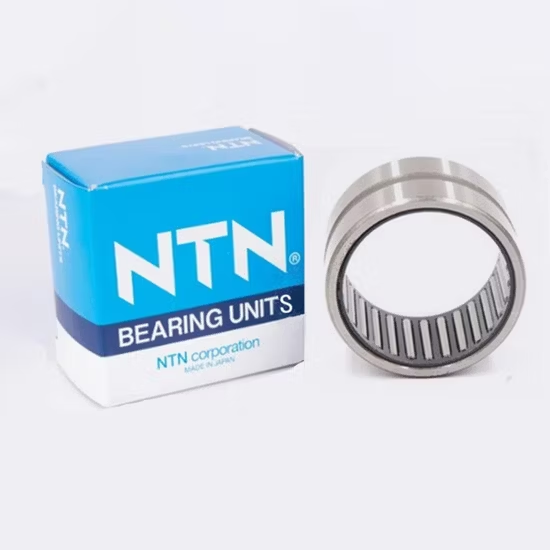
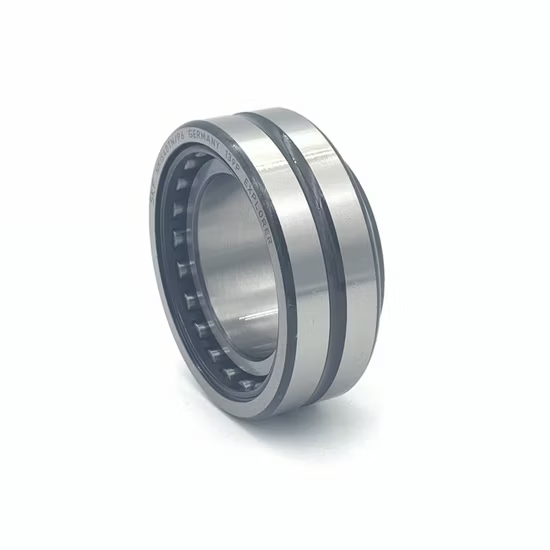
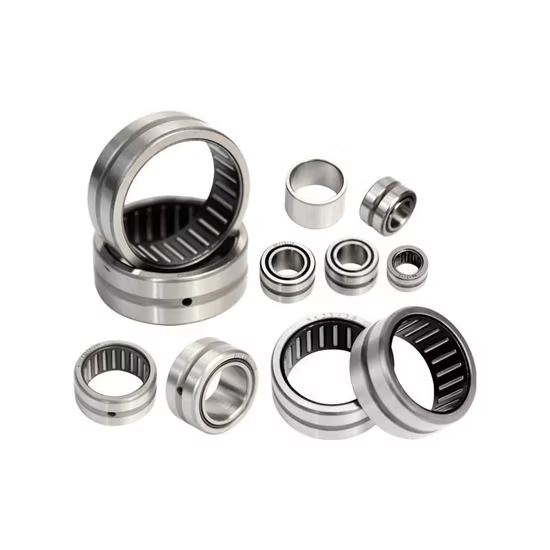
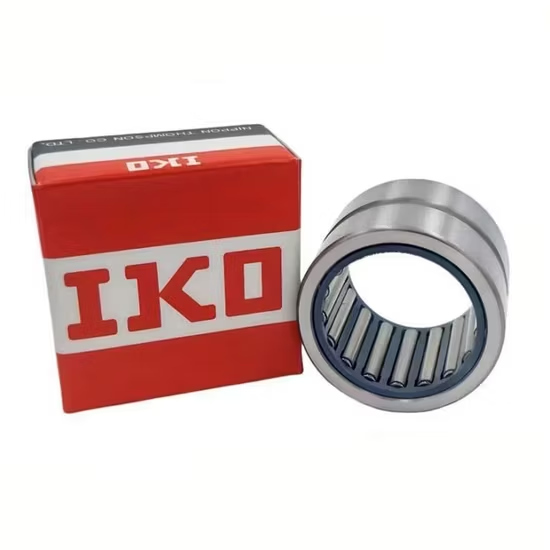
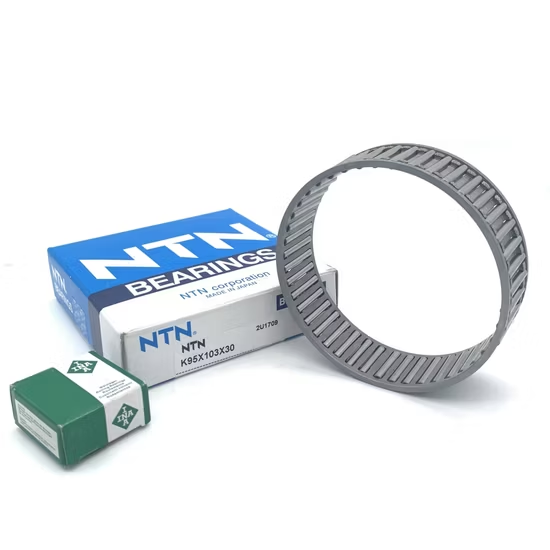
HK0509 Needle Roller Bearing — open type design requires external lubrication and proper housing seals, while bearing steel construction delivers reliable radial load capacity for compact spaces.
Scan Official App QR — verify batch authenticity directly through the manufacturer's proprietary verification tool before installation.
| Parameter | Value |
|---|---|
| Designation | HK0509 |
| Bearing Type | Needle Roller Bearing |
| Material | Bearing Steel |
| Load Direction | Radial Bearing |
| Type | Open |
| Style Options | Without Outer Ring, With Outer Ring, Without Inner Ring, With Inner Ring |
| Origin | Germany / Japan / Sweden / Malaysia / China |
| HS Code | 8482500090 |
The HK0509 designation suffix interpretation requires manufacturer catalog confirmation to verify specific internal design and cage variations.
| Industry | Typical Applications |
|---|---|
| Electric Motors | Rotor shaft support in compact drive units |
| Industrial Gearboxes | Planetary gear sets and high-speed transmission stages |
| Automotive and Heavy Vehicle Repair | Steering column joints and transmission auxiliary shafts |
| General MRO | Compact radial load arrangements in automated assembly equipment |
The cage structure dictates survival when radial space is severely limited.
Many maintenance teams assume that any basic needle roller fits the housing, ignoring how thin stamped cages deform under sudden torque spikes. I have seen counterfeit units with soft inner rings disintegrate at high speeds, jamming the shaft journal and causing catastrophic equipment lockups. Selecting the correct HK0509 needle roller bearing means prioritizing heavy-duty split cage designs that maintain roller spacing during impact events .
When radial envelope dimensions are strictly constrained, this compact arrangement delivers maximum load capacity without expanding the housing bore. Sourcing a genuine HK0509 needle roller bearing ensures the rolling elements meet exact dimensional tolerances, preventing uneven load distribution across the needle profile. Our cross-brand interchange review verifies that the internal geometry and cage material align perfectly with your specific operational demands, avoiding the thermal binding caused by mismatched clearances.
In high-speed gearboxes, friction heat rapidly degrades standard greases, leading to metal-to-metal contact between the needles and the cage pockets. An open-type design allows for customized oil-mist or circulating oil lubrication, which is critical for carrying heat away from the contact zones. If the operating temperature fluctuates significantly, selecting the appropriate radial internal clearance prevents the rollers from skewing and skidding against the raceways .
The structural integrity of the cage is the true lifeline of any compact needle arrangement. While standard stamped steel cages suffice for light, steady loads, heavy-duty split cages are mandatory when the shaft experiences frequent shock loads or vibration. The open design without integrated seals eliminates friction heat generation, shifting the sealing responsibility to the housing. This configuration demands precise alignment during installation to prevent edge loading on the needle ends, which rapidly accelerates fatigue wear.
Installing a unit with an inadequate cage design inevitably leads to roller skewing, cage pocket wear, and eventual disintegration under load. According to failure analysis frameworks, cage failure is a primary initiator of secondary damage to shafts and housings . This results in unplanned downtime, extensive secondary machining costs, and complete warranty voidance when non-genuine components are traced back to the procurement records.
Counterfeiters frequently clone basic designations while substituting soft, unhardened steel for the inner rings and needles. We supply fully traceable units where the material hardness and dimensional accuracy are verified against manufacturer specifications. Our technical team reviews cross-reference requests to ensure the internal design and cage type match your equipment's exact requirements, preventing the costly installation of base-number matches that fail prematurely in the field.
To ensure optimal performance, provide our engineering team with your specific radial load profiles, operational speeds, and housing temperature ranges. Sharing the OEM equipment number allows us to execute a precise cross-reference check, confirming the internal geometry and cage configuration. We will review your application parameters to recommend the exact clearance class and lubrication strategy required for your machinery.
Q: How can I verify the authenticity of the HK series units using official apps?
A: Scan the QR code on the packaging using the manufacturer's official mobile application. This confirms the batch and lot traceability, ensuring the internal components are genuine bearing steel rather than soft counterfeit materials that fail under high-speed radial loads.
Q: What cross-reference checks are critical beyond the basic designation?
A: You must verify the internal cage design, radial clearance class, and specific style configuration. A base number match might feature a light-duty stamped cage instead of the required heavy-duty split cage, leading to rapid pocket wear and catastrophic failure under shock loading conditions.
Q: How do I select the correct clearance for high-speed applications?
A: High speeds generate significant friction heat, causing the inner ring to expand more than the housing. Selecting a clearance class that accommodates this thermal growth prevents the needles from binding and skewing, ensuring smooth operation and preventing premature cage disintegration.
Q: What documentation proves material compliance and origin?
A: We provide a Certificate of Conformity, material test reports confirming steel hardness, and dimensional inspection reports. Country-of-origin documentation is also included to ensure full supply chain transparency and compliance with your procurement auditing standards.
Q: How do I troubleshoot premature failure in compact arrangements?
A: Inspect the failed unit for cage pocket wear, needle skewing, and shaft journal scoring. These symptoms usually indicate inadequate cage strength for the applied shock loads, lubrication starvation in open designs, or the installation of counterfeit units with unhardened rolling elements.
Our 5-step process ensures every order is engineered, validated, and supported for optimal performance.
Technical needs assessment
Custom specifications
Free samples for $50k+
Pre-shipment inspection
On-site & predictive
Our certified engineers respond within 24 hours with detailed technical specifications, pricing, and lead time information.
![Hf0306 0406 0612 0812 1012 1216/Kfr One-Way Needle Roller Bearings for Machinery [WARN] draft identifier mismatch](https://skfiso.com/wp-content/uploads/2026/09/hf0306-0406-0612-0812-1012-1216-kfr-one-way-needle-roller-bearings-for-machinery-warn-draft-identifier-mismatch-155baa.avif)

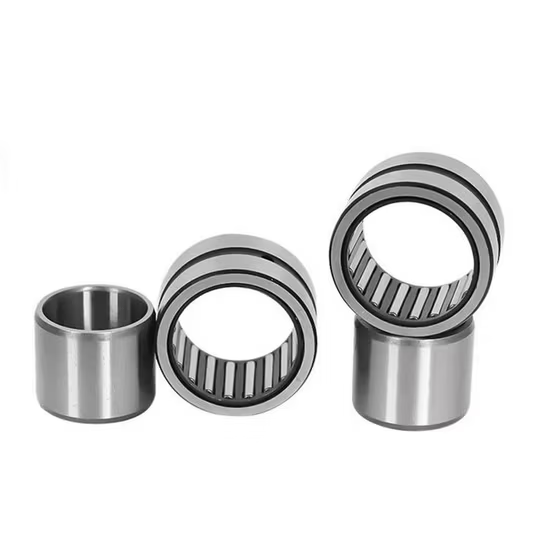
![HK2210 HK2212 HK2216 HK2220 HK2230 Needle Roller Bearing [WARN] draft identifier mismatch](https://skfiso.com/wp-content/uploads/2026/09/hk2210-hk2212-hk2216-hk2220-hk2230-needle-roller-bearing-warn-draft-identifier-mismatch-cbe937.avif)