01
Consultation
Technical needs assessment


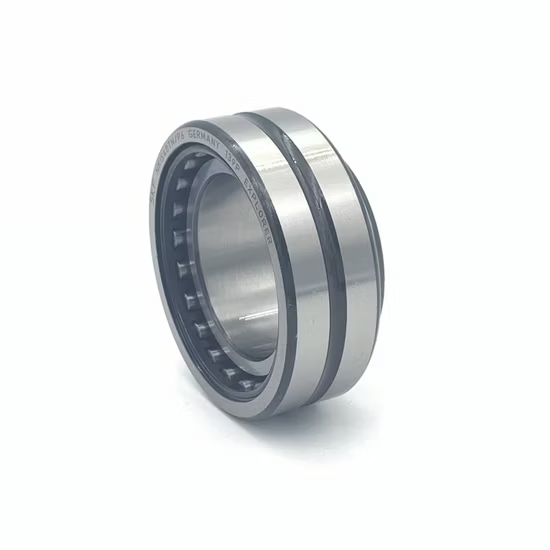


Hf1716 One-Way Needle Roller Bearing 17×23×16 mm — built with bearing steel for reliable radial load capacity in overrunning mechanisms.
Authenticity Via Official Apps — Scan the manufacturer's QR code on every Hf1716 package to instantly verify batch origin and eliminate cloned counterfeit risks.
| Parameter | Value |
|---|---|
| Designation | Hf1716 |
| Bearing Type | One-Way Needle Roller Bearing |
| Bore Diameter (d) | 17 mm |
| Outside Diameter (D) | 23 mm |
| Width (B) | 16 mm |
| Cage Design | With Cage |
| Load Direction | Radial |
| Material | Bearing Steel |
| Type | Open |
Note: The "Hf" prefix remains an unverified suffix requiring manufacturer catalog confirmation for exact internal clutch design.
| Industry | Typical Applications |
|---|---|
| Automotive & Heavy Vehicles | Starter motor overrunning clutches, alternator pulley mechanisms, and transmission indexing assemblies |
| Industrial Gearboxes | Backstop mechanisms, indexing drives, and freewheel functions in conveyor systems |
| Agricultural Machinery | PTO shaft overrunning clutches, harvesting equipment indexing, and rotary actuator drives |
Internal cage fragmentation usually precedes any visible raceway wear.
In heavy vehicle repair and agricultural PTO shafts, vibration levels frequently exceed standard radial bearing thresholds. When cross-reference errors match the base designation but overlook internal clutch spring tension or cage material, the component experiences rapid fatigue. We frequently inspect returned units where stamped steel cages were incorrectly substituted for machined brass equivalents in high-vibration environments, leading to sudden structural collapse . Sourcing a genuine Hf1716 one-way needle roller bearing ensures the internal sprag or roller geometry aligns precisely with the original equipment manufacturer's torque transmission requirements.
Automotive starter motors and indexing gearboxes demand immediate torque lock-up without slippage. This Hf1716 one-way needle roller bearing delivers reliable overrunning and backstop functions by utilizing precision-ground bearing steel rolling elements. Our technical team reviews your specific engagement frequencies to ensure the internal clutch mechanism withstands repeated shock loading without experiencing micro-welding on the ramp surfaces.
Open-type clutch mechanisms in agricultural and heavy-duty environments face severe contamination risks from dust and moisture. Without integrated seals, the lubrication strategy must rely entirely on the housing design and external grease purging cycles. High-frequency vibration in transmission assemblies can cause grease channeling, leaving the needle rollers starved of lubrication . Selecting the correct base oil viscosity for your specific operating temperature range is critical to prevent the clutch elements from skidding during the freewheeling phase.
The 17x23x16 mm envelope allows this component to fit into compact transmission housings while handling substantial radial loads. The open design facilitates direct heat dissipation into the surrounding shaft and housing, which is vital when the clutch engages frequently and generates friction heat. Bearing steel construction provides the necessary core hardness to resist brinelling under shock loads. The inclusion of a dedicated cage ensures precise roller spacing, preventing the clustering that typically causes uneven load distribution and premature ramp wear in uncaged alternatives.
Installing a component with mismatched internal clearances or incorrect sprag angles leads to partial engagement, generating excessive heat and accelerated wear. This unplanned downtime in a continuous conveyor or heavy transport vehicle often results in catastrophic damage to the surrounding gearbox housing. According to failure analysis frameworks, improper mounting or incorrect cross-referencing accounts for a significant share of premature clutch burnouts . Warranty voidance is almost guaranteed when aftermarket substitutions fail to match the exact OEM engagement torque specifications.
Mixed-brand orders often lead to coordination delays, but our authorized coverage allows you to consolidate this clutch bearing with your deep groove and spherical roller requirements in a single shipment. Cross-reference errors are common when suppliers only check the base 17x23x16 dimensions while ignoring the specific internal ramp geometry; our engineering review catches these discrepancies before quoting. Every unit ships with batch traceability directly to the manufacturer, eliminating the risk of soft inner rings found in cloned counterfeits. We provide application-based selection reviews to verify that the open design and cage configuration match your specific vibration and thermal profiles.
To ensure optimal performance, share your specific radial loads, engagement frequencies, and operating temperatures so our team can verify the L10 life and clutch torque capacity. Providing the original OEM equipment number allows us to perform a comprehensive cross-reference check, confirming that the internal ramp design and cage specifications perfectly match your application requirements.
Q: How do I verify the authenticity of this one-way needle roller bearing?
A: You can scan the QR code printed on the packaging using the manufacturer's official mobile application. This instantly confirms the batch origin and production date, protecting your equipment from counterfeit units that utilize soft inner rings and cloned visual markers which typically fail under heavy torque loads.
Q: What cross-reference checks are critical beyond the 17x23x16 dimensions?
A: Matching the outer dimensions is insufficient for clutch bearings. You must verify the internal sprag or roller geometry, the specific cage material, and the engagement torque ratings. An incorrect internal design will cause slippage or excessive friction, leading to rapid thermal degradation and catastrophic gearbox failure.
Q: How should I lubricate this open-type needle roller bearing?
A: Since the open design lacks integrated seals, lubrication depends on your housing configuration. You must apply a grease with an appropriate base oil viscosity for your operating temperature before installation. Regular external re-lubrication cycles are required to flush out contaminants and prevent the needle rollers from skidding during freewheeling.
Q: What causes premature cage failure in heavy vehicle clutch applications?
A: High-frequency vibration and shock loading in drivetrains can fracture inadequate cages. If a cross-reference error substitutes a stamped steel cage where a machined brass or reinforced polymer design was specified by the OEM, the cage will quickly fragment, causing the rollers to cluster and lock the mechanism.
Our 5-step process ensures every order is engineered, validated, and supported for optimal performance.
Technical needs assessment
Custom specifications
Free samples for $50k+
Pre-shipment inspection
On-site & predictive
Our certified engineers respond within 24 hours with detailed technical specifications, pricing, and lead time information.
![Na4906 Full Complement Needle Roller Bearing Set Wholesale Supply [WARN] draft identifier mismatch](https://skfiso.com/wp-content/uploads/2026/09/na4906-full-complement-needle-roller-bearing-set-wholesale-supply-warn-draft-identifier-mismatch-0f3d6f.avif)

