01
Consultation
Technical needs assessment

![71900 CD/P4a Angular Contact Bearing High Speed Super Precision [WARN] draft identifier mismatch - 1](https://skfiso.com/wp-content/uploads/2026/09/71900-cd-p4a-angular-contact-bearing-high-speed-super-precision-warn-draft-identifier-mismatch-b377bc.avif)
![71900 CD/P4a Angular Contact Bearing High Speed Super Precision [WARN] draft identifier mismatch - 2](https://skfiso.com/wp-content/uploads/2026/09/71900-cd-p4a-angular-contact-bearing-high-speed-super-precision-warn-draft-identifier-mismatch-7c915a.avif)
![71900 CD/P4a Angular Contact Bearing High Speed Super Precision [WARN] draft identifier mismatch - 3](https://skfiso.com/wp-content/uploads/2026/09/71900-cd-p4a-angular-contact-bearing-high-speed-super-precision-warn-draft-identifier-mismatch-a07919.avif)
![71900 CD/P4a Angular Contact Bearing High Speed Super Precision [WARN] draft identifier mismatch - 4](https://skfiso.com/wp-content/uploads/2026/09/71900-cd-p4a-angular-contact-bearing-high-speed-super-precision-warn-draft-identifier-mismatch-e827a3.avif)
![71900 CD/P4a Angular Contact Bearing High Speed Super Precision [WARN] draft identifier mismatch - 5](https://skfiso.com/wp-content/uploads/2026/09/71900-cd-p4a-angular-contact-bearing-high-speed-super-precision-warn-draft-identifier-mismatch-1e5dd9.avif)
![71900 CD/P4a Angular Contact Bearing High Speed Super Precision [WARN] draft identifier mismatch - 6](https://skfiso.com/wp-content/uploads/2026/09/71900-cd-p4a-angular-contact-bearing-high-speed-super-precision-warn-draft-identifier-mismatch-0d8133.avif)
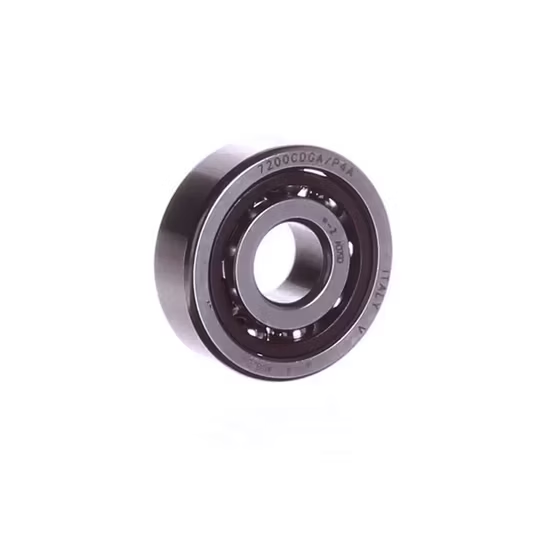
71900 CD/P4a Angular Contact Ball Bearing features a 15° contact angle to minimize friction heat and P4a precision for tight running accuracy in machine tool spindles.
Multi-Brand Authorized Sourcing — Consolidate mixed-brand spindle bearing orders through our unified distribution network without coordinating multiple suppliers.
| Parameter | Value |
|---|---|
| Designation | 71900 CD/P4a |
| Product Type | Angular Contact Ball Bearing |
| Material | Bearing Steel (available in ceramic or stainless steel variants) |
| Contact Angle | 15° (CD suffix) |
| Precision Class | P4a |
| Vibration Grade | Z1V1 / Z2V2 / Z3V3 |
| Separable Components | Unseparated |
| Customization | Application-specific cross-brand interchange |
Note: The suffix dga in the cross-reference 71900 Cdga/P4a requires manufacturer catalog confirmation for exact preload and arrangement definitions.
| Industry | Typical Applications |
|---|---|
| Machine Tool Manufacturing | High-speed milling and grinding spindle front/rear supports |
| Precision Equipment | Coordinate measuring machine rotary tables and air-bearing spindles |
| Robotics | High-torque, low-friction joint actuators requiring precise radial/axial positioning |
| Industrial Pumps | High-speed centrifugal pump shaft supports handling combined loads |
A base number match is never enough when spindle tolerances are measured in microns.
I have stood on exhibition floors in Hanover and listened to buyers who burned through budget replacing shattered spindle cartridges. The root cause was almost always a cross-reference error where the base designation matched, but the internal geometry did not. Installing a standard precision grade where a 71900 CD/P4a angular contact ball bearing is required leads to rapid thermal expansion and catastrophic raceway scoring . Procurement teams often focus on the 71900 prefix, completely overlooking the 15° contact angle and P4a running accuracy, which are non-negotiable for high-frequency machining centers.
When outfitting a high-frequency grinding head, the 71900 CD/P4a angular contact ball bearing provides the exact stiffness-to-speed ratio required. Our engineering review process ensures that the selected component matches the specific axial thrust and radial cutting forces of your machine tool. We verify that the internal geometry supports the target RPM without generating excess friction heat, leveraging our cross-brand interchange expertise to source the exact specification when lead times fluctuate.
Spindle environments demand strict control over thermal gradients and lubrication starvation. At extreme rotational speeds, inadequate clearance or the wrong contact angle causes the rolling elements to skid, generating localized heat that degrades the lubricant film. Proper oil-air or grease lubrication protocols must account for the specific cage design and unsealed configuration to prevent contamination while minimizing churning losses .
The CD suffix dictates a 15° contact angle, which is mathematically optimized for high-speed applications where radial loads dominate but axial rigidity remains critical. Compared to a 25° variant, this geometry significantly reduces centrifugal forces and gyroscopic moments on the balls. The P4a precision class guarantees exceptionally tight dimensional and running accuracy, far surpassing standard P5 grades. This exacting tolerance ensures minimal runout, which is essential for achieving mirror-finish surface qualities on machined parts.
Substituting a standard clearance or lower precision grade might look acceptable on a purchase order, but it triggers a cascade of mechanical failures on the shop floor. According to ISO 281 fatigue life calculations, even minor deviations in internal clearance under thermal load drastically reduce the operational lifespan. This results in unplanned downtime, scrapped high-value workpieces, and voided machine builder warranties . The financial impact of a halted production line always eclipses the initial component cost.
Our procurement model eliminates the guesswork from sourcing critical spindle components. First, we provide authorized coverage across all major brands, meaning your mixed-brand requirements are handled in a single, traceable order. Second, we enforce strict cross-reference alignment; we never substitute a 25° contact angle when your equipment demands the 15° CD configuration. Third, every shipment includes batch traceability verified through the manufacturer's official applications. Finally, our application-based selection review catches mismatched preload or precision suffixes before the parts ever leave our warehouse.
To ensure the selected component perfectly matches your spindle architecture, please provide the target operating speeds, combined load profiles, and expected thermal gradients. Sharing the OEM equipment number or the original manufacturer's drawing allows our engineering team to perform a rigorous cross-reference check and L10 life calculation. This technical alignment guarantees that the delivered components meet the exact dynamic requirements of your precision machinery.
Q: Why must the clearance, cage, and precision suffixes align perfectly during cross-referencing?
A: Matching only the base designation ignores critical internal geometry. A different clearance class will cause thermal binding at high RPM, while an incorrect cage material alters the speed limit. Aligning all suffixes ensures the replacement handles the exact load and thermal expansion characteristics of the original spindle design.
Q: How does P4a precision differ from standard P4 or ABEC classifications?
A: P4a represents a highly restricted subset of the P4 class, enforcing much tighter limits on running accuracy, specifically inner and outer ring axial and radial runout. This ultra-precision is mandatory for high-speed machine tool spindles where even microscopic vibrations will ruin the surface finish of the machined workpiece.
Q: What is the selection boundary between a 15° (CD) and a 25° contact angle in spindle applications?
A: A 15° contact angle is optimized for high-speed, high-radial-load environments like milling spindles, minimizing centrifugal ball forces and friction heat. A 25° angle provides higher axial rigidity, making it suitable for heavy axial thrust applications. Selecting the wrong angle compromises either the speed capability or the structural stiffness of the spindle.
Q: How should single-row bearings be configured for preload in a machine tool spindle?
A: Single-row units must be mounted in specific paired arrangements, such as back-to-back or face-to-face, to manage combined loads and provide axial rigidity in both directions. The preload force must be carefully calculated based on the spindle's operational speed and cutting forces to prevent excessive heat generation while maintaining cutting accuracy.
Our 5-step process ensures every order is engineered, validated, and supported for optimal performance.
Technical needs assessment
Custom specifications
Free samples for $50k+
Pre-shipment inspection
On-site & predictive
Our certified engineers respond within 24 hours with detailed technical specifications, pricing, and lead time information.
![7026 CD/P4a Angular Contact Bearing High Speed Super Precision [WARN] draft identifier mismatch](https://skfiso.com/wp-content/uploads/2026/09/7026-cd-p4a-angular-contact-bearing-high-speed-super-precision-warn-draft-identifier-mismatch-20c7ea.avif)