01
Consultation
Technical needs assessment


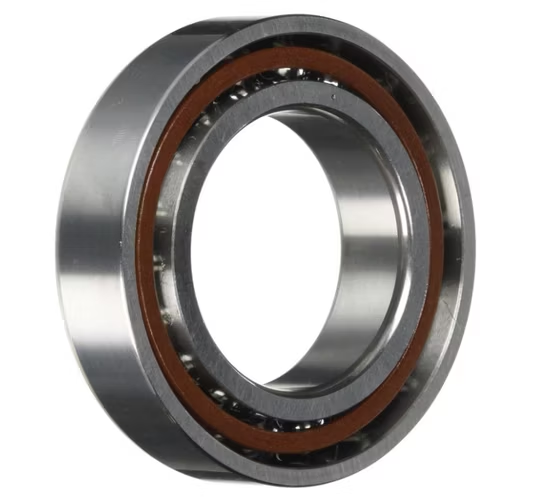
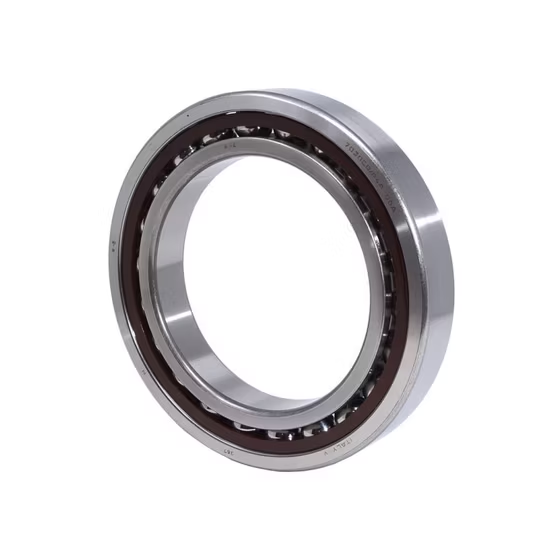
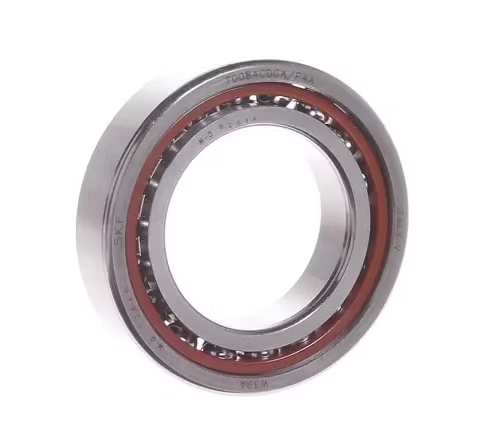
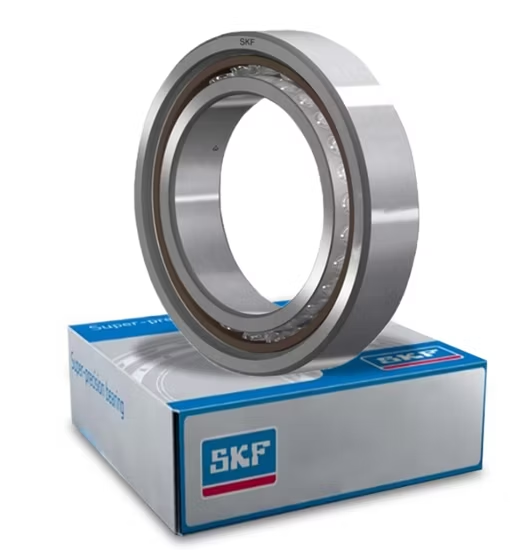
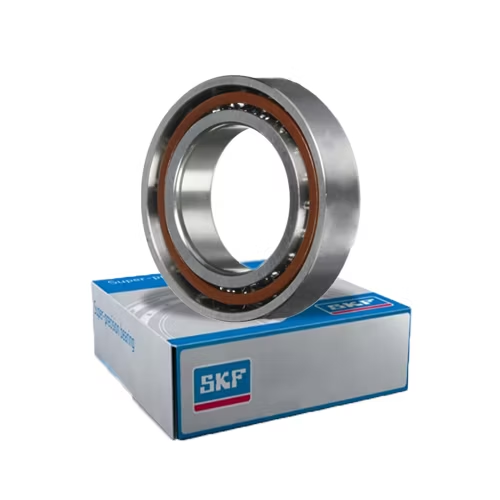
7021 CD/P4a Angular Contact Ball Bearing — engineered for high-speed machine tool spindles and precision equipment.
Multi-Brand Authorized Coverage — Source SKF, FAG, and NSK equivalents for your 7021 CD/P4a angular contact ball bearing requirements in a single consolidated shipment without juggling multiple vendors.
| Parameter | Value |
|---|---|
| Designation | 7021 CD/P4a |
| Product Type | Angular Contact Ball Bearing |
| Contact Angle | 15° (CD optimized design) |
| Precision Class | P4a (Dimensional accuracy to Class 4 with enhanced running accuracy) |
| Material | Bearing steel (available in ceramic or stainless steel variants upon request) |
| Vibration Level | Z1V1, Z2V2, Z3V3 |
| Origin | Germany / Japan / Sweden / Malaysia / China |
| HS Code | 8482102000 |
| Industry | Typical Applications |
|---|---|
| Machine Tool Manufacturing | High-speed CNC lathe and milling machine motorized spindles |
| Precision Engineering | Coordinate measuring machine rotary tables and indexing heads |
| Industrial Automation | High-speed robotic arm joint actuators and servo motors |
| Fluid Handling | High-speed centrifugal pump shaft support assemblies |
A missing precision or contact angle suffix turns a high-speed asset into a thermal time bomb.
In Qingdao, I have dismantled too many seized machine tool spindles where the maintenance team installed a standard P5 grade instead of the required P4a class, simply because the base number matched. When a 7021 CD/P4a angular contact ball bearing operates at high RPMs, even microscopic deviations in running accuracy generate excessive friction heat. This thermal expansion eliminates internal clearance, leading to catastrophic cage failure and shaft scoring . Procurement engineers often focus on the base designation while overlooking the critical suffixes that dictate thermal stability and operational lifespan.
The 7021 CD/P4a angular contact ball bearing is engineered specifically for applications where rotational velocity and radial-axial load combinations are extreme. The 15° contact angle provides the optimal balance between axial rigidity and minimizing centrifugal forces on the rolling elements. When sourcing replacements for OEM equipment, verifying this exact suffix configuration ensures the spindle maintains its designed thermal equilibrium and vibration profile under continuous high-speed cutting operations.
At elevated rotational speeds, the primary enemy is heat generation at the contact ellipse between the balls and raceways. The 15° optimized contact angle significantly reduces sliding friction compared to steeper angles, but it demands precise lubrication management. Oil-air or oil-jet lubrication systems are typically required to dissipate heat without introducing the churning losses associated with grease . Any contamination in the oil supply or incorrect viscosity will rapidly degrade the P4a running accuracy, causing vibration spikes that ruin surface finishes on machined parts.
The "CD" suffix indicates a 15° contact angle with an optimized internal geometry designed specifically for high-speed operation, featuring a smaller ball diameter or specific raceway curvature to reduce centrifugal loading. The "P4a" designation goes beyond standard ISO 492 Class 4 dimensional tolerances; the "a" signifies strictly controlled running accuracy, particularly regarding inner and outer ring radial runout. This tighter runout control is non-negotiable for machine tool spindles, where even slight eccentricity translates directly into chatter marks on the workpiece and accelerated tool wear.
Substituting a standard P4 or P5 bearing when the OEM specifies P4a often results in premature spindle rebuilds. The dimensional tolerances might appear acceptable on paper, but the relaxed running accuracy limits cause uneven load distribution across the rolling elements . This localized stress accelerates surface fatigue, leading to spalling and unplanned downtime that far exceeds the initial cost savings of a lower-grade component. Furthermore, installing a bearing with an incorrect contact angle alters the spindle's axial stiffness, compromising machining precision and voiding equipment warranties.
We prevent cross-reference errors by verifying not just the base number, but the exact clearance, cage material, and precision suffixes your spindle requires. While others might ship a generic P4 when you need P4a, our technical team reviews the application parameters to ensure the running accuracy matches the OEM specification. We provide authorized coverage across all major international brands, allowing you to consolidate mixed-brand MRO orders into a single shipment. Every unit is backed by batch traceability to the manufacturer, eliminating the risk of counterfeits with soft inner rings that plague the open market.
To ensure the 7021 CD/P4a angular contact ball bearing perfectly matches your spindle requirements, please provide the specific radial and axial loads, maximum operating RPM, and target operating temperature. If you are replacing an existing unit, sharing the OEM equipment serial number or the exact nameplate data allows our engineering team to perform a precise cross-reference check. This technical review guarantees that the contact angle, precision class, and internal geometry align strictly with your application's operational demands.
Q: What is the specific difference between P4 and P4a precision classes?
A: While both meet ISO 492 Class 4 dimensional tolerances, the P4a designation enforces strictly tighter limits on running accuracy, specifically inner and outer ring radial runout. This enhanced running accuracy is critical for high-speed spindles to minimize vibration and ensure superior surface finishes during precision machining operations.
Q: Why must the CD suffix be maintained during cross-referencing?
A: The CD suffix denotes a 15° contact angle with an optimized internal design for high-speed operation. Substituting a standard C suffix or a steeper 25° AC angle alters the axial stiffness, friction heat generation, and load distribution, which can lead to thermal seizure or premature fatigue failure in high-RPM spindle applications.
Q: How do you verify the authenticity of high-precision bearings?
A: We supply authorized products with complete batch traceability. Buyers can verify authenticity by scanning the QR code on the packaging using the manufacturer's official mobile application, alongside reviewing the provided Certificate of Conformity and dimensional inspection reports confirming the P4a tolerances.
Q: Can this bearing be used in a paired arrangement for increased rigidity?
A: The base 7021 CD/P4a is a single bearing. For paired arrangements like back-to-back or face-to-face, specific universal matching and preload suffixes must be designated at the time of order. Please provide your spindle stiffness requirements so we can supply the correctly matched and preloaded sets.
Our 5-step process ensures every order is engineered, validated, and supported for optimal performance.
Technical needs assessment
Custom specifications
Free samples for $50k+
Pre-shipment inspection
On-site & predictive
Our certified engineers respond within 24 hours with detailed technical specifications, pricing, and lead time information.
![71800 CD/P4 Angular Contact Bearing High Speed Super Precision P4 [WARN] draft identifier mismatch](https://skfiso.com/wp-content/uploads/2026/09/71800-cd-p4-angular-contact-bearing-high-speed-super-precision-p4-warn-draft-identifier-mismatch-eb7ebb.avif)
![71803 CD/P4 Angular Contact Ball Bearing High Speed Super Precision [WARN] draft identifier mismatch](https://skfiso.com/wp-content/uploads/2026/09/71803-cd-p4-angular-contact-ball-bearing-high-speed-super-precision-warn-draft-identifier-mismatch-3e3798.avif)