01
Consultation
Technical needs assessment



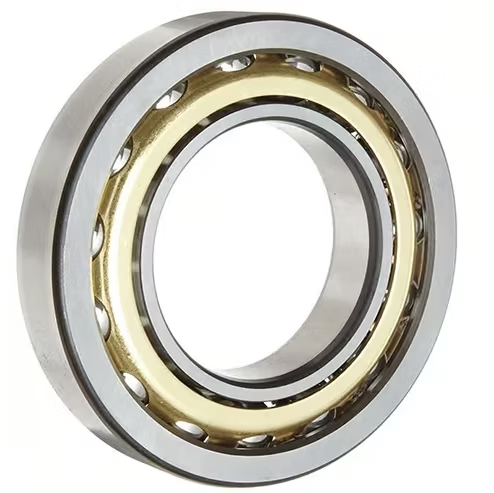
7213 Becbm Angular Contact Ball Bearing — features a 40° contact angle for combined loads, universal matching with medium axial clearance, and a machined brass cage for high-vibration stability.
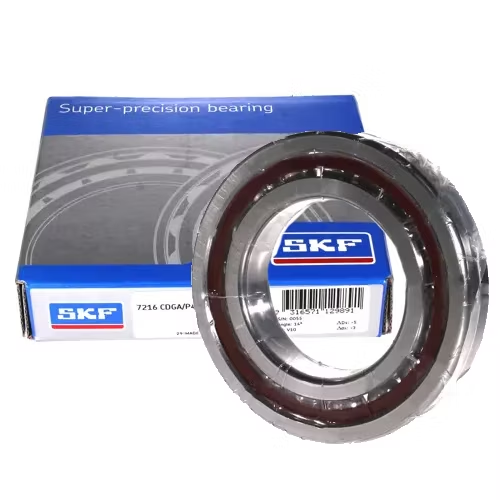
Authenticity via official app — Every 7213 Becbm angular contact ball bearing shipped includes a scannable QR code linking directly to the manufacturer's verification database.
| Parameter | Value |
|---|---|
| Designation | 7213 Becbm |
| Bearing Type | Angular Contact Ball Bearing |
| Bore Diameter (d) | 65 mm |
| Outside Diameter (D) | 120 mm |
| Width (B) | 23 mm |
| Contact Angle | 40° |
| Cage Material | Machined brass |
| Arrangement | Universal matching with medium axial clearance |
| Material | Bearing steel |
| Precision Class | Standard |
| Clearance Class | Medium axial clearance (CB) |
| Origin | Germany / Japan / Sweden / Malaysia / China |
| Industry | Typical Applications |
|---|---|
| Machine Tool Manufacturing | High-speed spindle rear support configurations |
| Industrial Pump Production | Heavy-duty centrifugal pump thrust handling |
| Robotics and Automation | Precision joint actuation mechanisms |
Procurement errors occur when buyers ignore suffix variations.
Sourcing teams frequently approve replacements based solely on the base numeric sequence, overlooking critical internal geometry differences. I have personally inspected spindle assemblies in the Yangtze River Delta where a standard clearance substitute was forced into a high-precision setup, resulting in immediate thermal binding and catastrophic accuracy loss during high-speed operation . When the 7213 Becbm angular contact ball bearing is specified, the internal contact angle and cage mass are precisely calculated for specific axial loads. Substituting it with a mismatched variant introduces unpredictable axial play that destroys machining tolerances.
The 7213 Becbm angular contact ball bearing utilizes a 40° contact angle specifically optimized for applications experiencing significant axial thrust alongside radial loads. This geometry ensures that the load line transfers effectively through the bearing cross-section, preventing raceway edge loading during heavy cutting operations. By supplying cross-referenced equivalents that maintain this exact angular profile, we ensure the equipment retains its original thrust capacity without requiring mechanical housing modifications.
High-speed spindle environments generate substantial friction heat, which directly impacts internal clearance and lubricant viscosity. The machined brass cage provides superior thermal conductivity and structural rigidity compared to polyamide alternatives, maintaining stability when temperatures fluctuate rapidly . Proper oil-air or grease lubrication must be carefully matched to the cage design to prevent churning losses, while the non-contacting shields or open design variants allow for customized sealing solutions that balance contamination exclusion with friction minimization.
The suffix sequence dictates the operational boundaries of the component. The BE designation confirms the optimized 40° contact angle for heavy axial loads. CB indicates universal matching with medium axial clearance, allowing the bearing to be paired in back-to-back or face-to-face configurations to achieve a specific preload when mounted together. Finally, the M suffix specifies a machined brass cage, which is essential for maintaining structural integrity under high-speed vibrations and sudden load reversals where stamped steel or polymer cages might suffer fatigue or thermal degradation.
Installing a bearing with incorrect internal clearance or cage material inevitably leads to unplanned downtime and premature failure. A polyamide cage substituted in a high-temperature spindle application will rapidly degrade, causing rolling element skidding and severe raceway damage. Similarly, ignoring the universal matching parameters results in uneven load distribution across paired bearings, accelerating fatigue and voiding equipment warranties . These failures cascade into catastrophic damage to the spindle housing, turning a simple component replacement into a massive repair project.
Our distribution network covers all major international brands, meaning a single purchase order can fulfill mixed-brand requirements without compromising technical specifications. We specifically verify the CB clearance and M cage material during cross-referencing, preventing the common error of supplying standard clearance variants that fail under thermal expansion. Every batch is traceable to the manufacturer, and we provide application-based selection reviews to confirm that the 40° contact angle aligns perfectly with your specific load and speed parameters.
To ensure the selected configuration perfectly matches your operational demands, please provide the specific radial and axial load profiles, operating speeds, and thermal conditions of your spindle or pump assembly. Supplying the original OEM equipment number allows our engineering team to perform a comprehensive cross-reference check, verifying that the contact angle and universal matching parameters align with your housing design. This technical review guarantees that the replacement integrates flawlessly without requiring mechanical adjustments.
Q: Why must cross-referencing align the clearance and cage suffixes, not just the base number?
A: The base number only defines the physical dimensions. The suffixes dictate the internal geometry, such as the 40° contact angle and machined brass cage, which are critical for handling specific axial loads and high-speed vibrations. Ignoring these suffixes leads to thermal binding or cage failure in the field.
Q: How does the CB universal matching suffix affect spindle installation?
A: The CB suffix indicates medium axial clearance designed for universal matching. This allows the bearings to be mounted in back-to-back or face-to-back pairs to achieve a precise preload, ensuring the spindle maintains rigidity and rotational accuracy under heavy cutting loads.
Q: What are the operational boundaries for the machined brass cage compared to polyamide?
A: The machined brass cage offers superior structural rigidity and thermal conductivity, making it suitable for high-speed operations and environments with elevated temperatures or heavy vibrations where polyamide cages might suffer from thermal degradation or fatigue.
Q: How can we verify the authenticity of the supplied bearings?
A: Every bearing is supplied with batch traceability documentation and a scannable QR code. Procurement teams can use the manufacturer's official mobile application to instantly verify the origin, production date, and technical specifications of the specific unit.
Q: Can you supply cross-reference equivalents from other major brands?
A: Yes, we provide authorized distribution across all major international brands. Our technical team ensures that any cross-reference matches not only the base dimensions but also the exact contact angle, cage material, and universal matching clearance parameters.
Our 5-step process ensures every order is engineered, validated, and supported for optimal performance.
Technical needs assessment
Custom specifications
Free samples for $50k+
Pre-shipment inspection
On-site & predictive
Our certified engineers respond within 24 hours with detailed technical specifications, pricing, and lead time information.