01
Consultation
Technical needs assessment



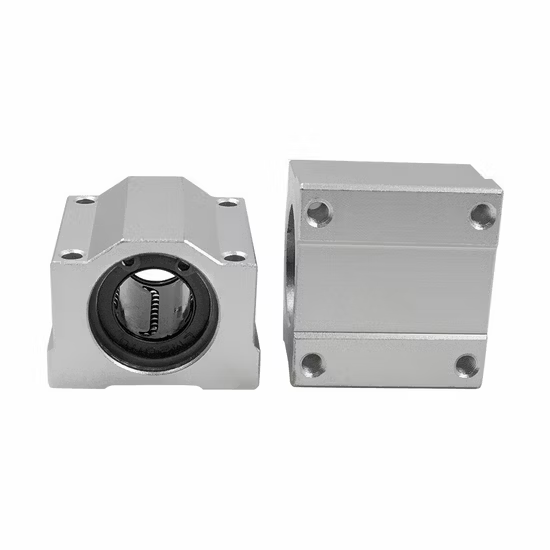
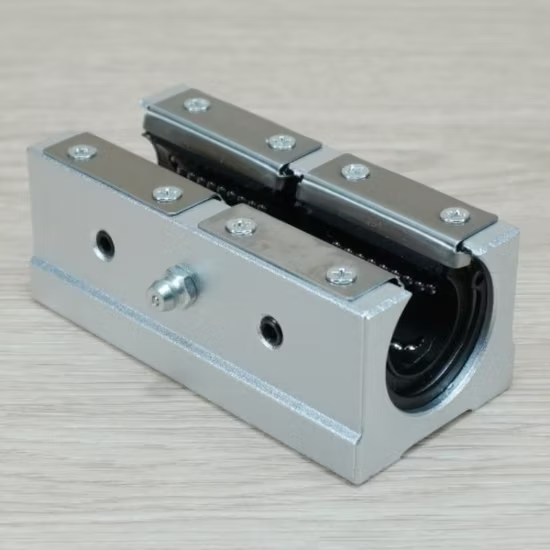

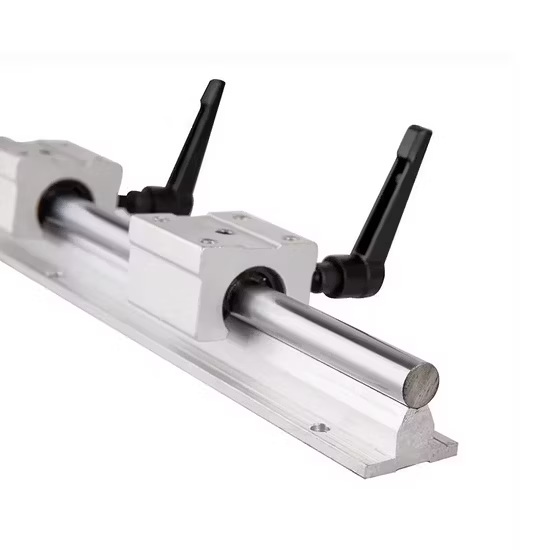
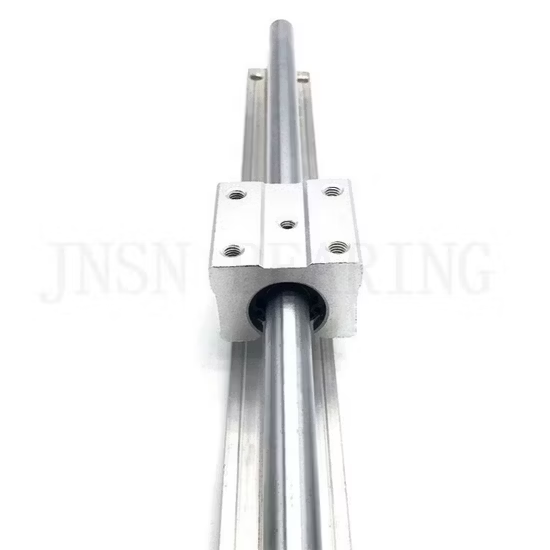
SC10UU SC12LUU SC12UU SC16LUU Linear Motion Bearings — featuring polished bearing steel construction for high-speed automation applications.
Cross-Reference Alignment — verifying seal formats and length suffixes prevents catastrophic binding in high-speed automation.
| Parameter | Value |
|---|---|
| Designation | SC10UU SC12LUU SC12UU SC16LUU |
| Product Type | Linear Motion Bearing |
| Material Options | Available in bearing steel or stainless steel variants |
| Profile Type | Hollow Profile |
| Surface Treatment | Polished |
| Precision Rating | P0, P6, P5, P4, P2 |
| Seal Type | UU (Standard wipers both sides), LUU (Long type wipers both sides) |
| Feature | High Speed, Low Noise, High Corrosion Resistance |
| Customization | Custom Length |
| Certification | CE, ISO 9001:2000, ISO 9001:2008, RoHS |
| Industry | Typical Applications |
|---|---|
| Industrial Automation | Multi-axis CNC router gantries, pick-and-place robot arms |
| Medical Equipment | CT scanner patient tables, automated liquid handling systems |
| Food Processing | Washdown conveyor diverters, hygienic packaging sealers |
Base dimensions mean nothing if the length and seal configurations fail to match the dynamic load profile.
Procurement teams often source linear sliders by matching the inner diameter alone, ignoring the critical differences between standard and long-type carriages. In high-speed reciprocating applications, this oversight leads to rapid carriage disintegration and severe guide shaft scoring. I have seen entire automated assembly lines halted because a standard carriage was forced into a high-moment load zone where only an extended version could maintain stability .
Selecting the correct SC10UU SC12LUU SC12UU SC16LUU linear motion bearing requires analyzing the moment loads acting on the carriage. Standard units handle pure radial loads well, but extended versions provide the necessary leverage to resist pitching and yawing forces during rapid directional changes. Our technical review process ensures the selected carriage length aligns perfectly with your specific dynamic load calculations.
High-speed reciprocation generates significant friction heat, while food and medical environments demand rigorous washdown protocols. Standard carbon steel carriages will corrode quickly under caustic cleaning agents, whereas sealed units must balance wiper friction against contaminant exclusion. Selecting the appropriate material variant and seal configuration ensures the slider survives both thermal expansion and chemical exposure without premature degradation .
The UU suffix designates a standard-length carriage equipped with dual-side wiper seals, optimized for compact spaces and moderate loads. Conversely, the LUU suffix indicates a long-type carriage, effectively doubling the load-bearing surface area and drastically improving rigidity against moment loads. Both configurations utilize specialized wipers to retain internal lubrication while scraping off microscopic debris, a critical feature for maintaining smooth travel in dusty or particulate-heavy environments.
Installing a standard carriage in a high-moment application causes uneven load distribution across the rolling elements, leading to localized spalling and sudden carriage seizure. This unplanned downtime cascades through the production schedule, often resulting in catastrophic damage to the precision ground guide shaft. Following ISO 15243 failure classification frameworks, these premature failures are almost always traced back to fundamental sizing and suffix selection errors rather than manufacturing defects .
We do not just ship part numbers; we verify the exact suffix requirements for your specific load profile. Mixed-brand orders are consolidated seamlessly, ensuring every carriage and shaft combination arrives with full batch traceability. Our cross-reference checks go beyond basic inner diameters, strictly aligning the UU or LUU length suffixes and seal types to prevent field failures. We provide application-based selection reviews covering speed, load, and mounting constraints to guarantee optimal performance.
Share your specific radial and axial load profiles, travel speeds, and operating temperatures so our engineering team can validate the L10 life calculations. Provide your OEM equipment numbers or existing carriage dimensions for precise cross-reference verification. Supplying details about environmental exposure allows us to recommend the optimal material variant and seal configuration for your application.
Q: What is the practical difference in load capacity between the UU and LUU suffixes?
A: The LUU suffix designates a long-type carriage with an extended load-bearing surface, offering substantially higher resistance to moment loads and pitching forces compared to the standard UU version. This makes the LUU variant essential for applications involving heavy overhung loads or rapid directional changes where carriage rigidity is critical.
Q: How do I select the right precision class for high-speed automation?
A: Higher precision classes like P4 or P2 ensure tighter dimensional tolerances, resulting in smoother travel and reduced vibration at high speeds. For standard material handling, P0 or P6 is usually sufficient. We review your specific speed and smoothness requirements to recommend the most cost-effective precision rating without over-engineering the solution.
Q: Can these linear sliders withstand frequent chemical washdowns?
A: Yes, when configured with the stainless steel material variant and appropriate corrosion-resistant treatments, these sliders perform exceptionally well in washdown environments. The high corrosion resistance ensures the carriages and wipers maintain their structural integrity and sealing effectiveness despite frequent exposure to caustic cleaning agents.
Q: How do I prevent the carriage from binding during installation?
A: Binding usually occurs due to shaft misalignment or debris trapped under the wiper seals. Ensure the guide shaft is perfectly parallel and thoroughly cleaned before sliding the carriage on. Avoid using excessive force; if resistance is felt, check for microscopic dents on the shaft or debris that could damage the internal rolling elements.
Q: What information is needed to cross-reference an existing failed carriage?
A: Please provide the exact designation stamped on the old carriage, including any length or seal suffixes, along with the shaft diameter and carriage length. If the original part number is worn off, sharing the OEM equipment model number allows our technical team to accurately identify the required replacement specifications.
Our 5-step process ensures every order is engineered, validated, and supported for optimal performance.
Technical needs assessment
Custom specifications
Free samples for $50k+
Pre-shipment inspection
On-site & predictive
Our certified engineers respond within 24 hours with detailed technical specifications, pricing, and lead time information.