01
Consultation
Technical needs assessment
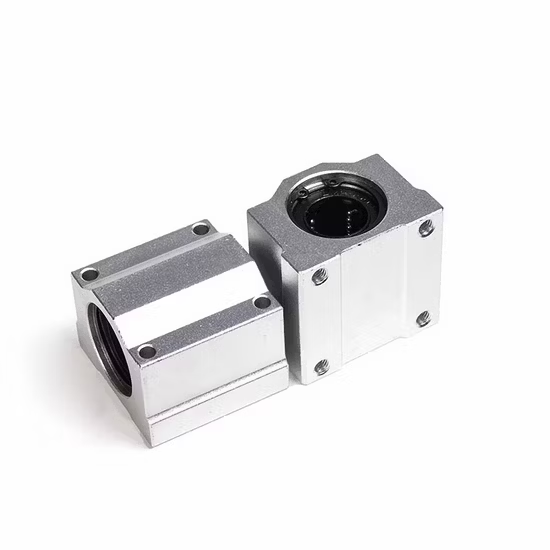


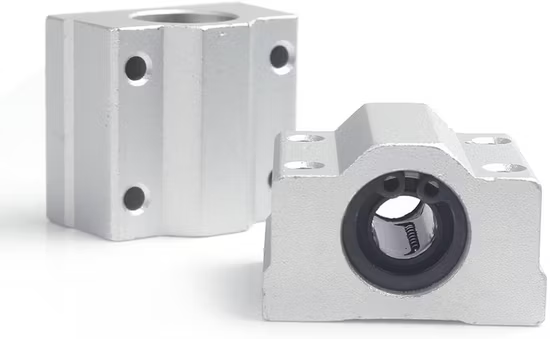


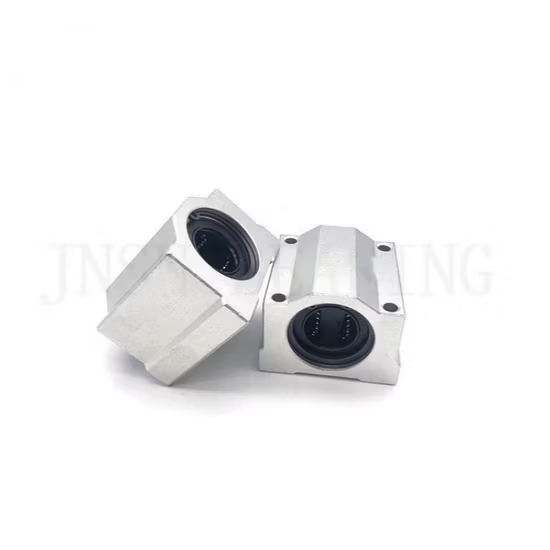
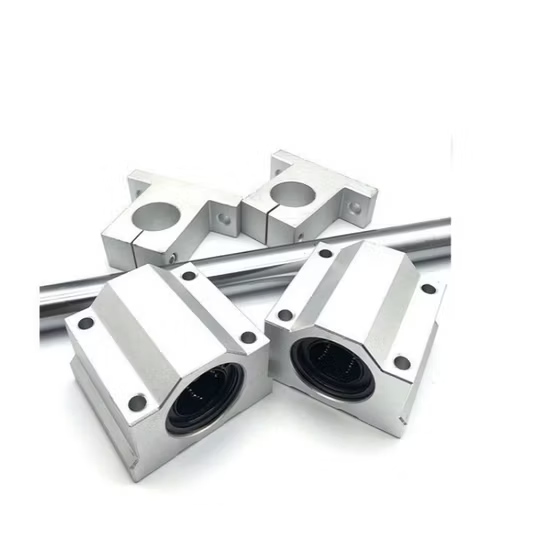
SBR10UU Linear Slide Block — polished stainless steel construction delivers high corrosion resistance for food processing and industrial automation.
Cross-Reference Alignment Verified — Every SBR10UU linear slide block supplier quotation we issue aligns profile geometry, precision class, and seal configuration, preventing mismatched linear guide assemblies.
| Parameter | Value |
|---|---|
| Designation | SBR10UU |
| Product Type | Linear Slide Block |
| Material Options | Available in stainless steel or standard bearing steel variants |
| Surface Treatment | Polished |
| Profile Type | Hollow Profile |
| Precision Rating | P0, P6, P5, P4, P2 |
| Corrosion Resistance | High Corrosion Resistance |
| Operational Features | High Speed, Low Voice |
| Length | Custom Length |
| Certification | CE, ISO 9001:2000, ISO 9001:2008, RoHS |
Note: The SBR, 10, and UU designations require manufacturer catalog confirmation for exact dimensional interchange.
| Industry | Typical Applications |
|---|---|
| Industrial Automation | High-speed Cartesian robot gantries and automated assembly transfer stations |
| Food Processing | Washdown-intensive conveyor sorting systems and hygienic packaging lines |
| Medical Equipment | Precision linear actuators in automated diagnostic machinery and imaging beds |
| Electronics Manufacturing | Cleanroom-compatible pick-and-place machines and automated optical inspection rigs |
Premature carriage failure usually stems from ignored parallelism tolerances rather than material fatigue.
Procurement teams frequently source linear components based solely on the base number, overlooking the严苛 straightness and preload requirements of the mating rail. When a carriage is forced onto a misaligned rail, the internal recirculating balls experience severe edge loading. This generates localized friction spikes that destroy the raceway finish long before the calculated L10 life is reached . As a reliable SBR10UU linear slide block supplier, we see this mismatch constantly in high-speed automation where minor installation errors translate into catastrophic vibration.
Selecting the correct linear carriage requires evaluating the specific moment loads and travel speeds of the automation equipment. The SBR10UU linear slide block supplier catalog provides options across multiple precision grades, allowing engineers to match the exact positional repeatability required by the machine tool or robotic arm. We cross-reference the carriage internal geometry against the rail profile to ensure the recirculating ball pathways align perfectly, eliminating the binding that plagues poorly matched linear systems.
In food processing or cleanroom environments, the linear motion system faces aggressive chemical washdowns and strict particulate limits. Stainless steel variants provide the necessary corrosion resistance, while the polished surface treatment prevents contaminant adhesion. At higher travel speeds, friction within the ball recirculation circuit generates heat, which can alter the internal clearance and cause thermal binding. Proper selection of the seal type—balancing contact friction against ingress protection—is critical to maintaining smooth operation without excessive maintenance intervals .
The hollow profile design significantly reduces the overall moving mass, which is essential for high-acceleration pick-and-place applications where minimizing inertia improves cycle times. Precision ratings ranging from P0 to P2 dictate the dimensional tolerance of the carriage housing and the uniformity of the ball grooves. Higher precision classes ensure that the load is distributed evenly across all recirculating balls, preventing the localized stress concentrations that lead to premature spalling and the low-voice operation required in sensitive medical or electronics manufacturing environments.
Forcing a linear block onto a poorly prepared mounting surface introduces unintended preload, drastically increasing friction and accelerating wear. This unplanned downtime disrupts production schedules and voids manufacturer warranties. According to ISO 15243 frameworks, abnormal wear patterns and raceway smearing are direct consequences of installation-induced misalignment rather than inherent product defects . Recognizing these hidden costs shifts the focus from initial purchase price to total cost of ownership and system reliability.
We do not simply ship the requested part number; we verify the application parameters. If your automated gantry operates under high moment loads, we check whether the standard carriage length provides sufficient rigidity or if an extended version is required. We ensure that the cross-reference matches the exact internal ball diameter and seal friction characteristics, not just the outer dimensions. Our technical team reviews your load and speed data to confirm that the selected precision class and material variant will survive the specific operating environment without thermal binding.
To ensure accurate selection and cross-referencing, please provide the specific radial and axial loads, maximum travel speed, and operating temperature range. If you are replacing an existing component, share the OEM equipment number and the exact rail profile dimensions. This data allows our engineering team to verify the L10 life calculation and confirm that the seal friction and preload configuration match your automation requirements perfectly.
Q: How do we determine the correct precision class for our automated assembly line?
A: The required precision class depends on the positional repeatability demanded by your end-effector. While standard grades suffice for general material handling, high-speed pick-and-place machines or optical inspection rigs typically require tighter tolerances to prevent micro-vibrations. Share your specific accuracy requirements and travel speed, and our engineering team will recommend the optimal grade to balance performance and cost.
Q: What is the selection boundary between stainless steel and standard bearing steel for linear guides?
A: Standard bearing steel offers higher load capacity and is ideal for dry, controlled environments like general packaging machinery. Stainless steel variants are mandatory for food processing, medical equipment, or any application involving frequent washdowns, high humidity, or corrosive chemicals. We evaluate your specific environmental exposure to recommend the material that ensures long-term corrosion resistance without compromising structural rigidity.
Q: How do you handle cross-referencing when the original linear carriage is discontinued?
A: We analyze the original equipment manufacturer's specifications, focusing on the internal ball diameter, carriage footprint, and seal configuration. Rather than just matching the base designation, we verify the dynamic load rating and moment capacity against your actual application parameters. This ensures the alternative SBR10UU linear slide block supplier option integrates seamlessly without requiring modifications to the existing rail or mounting brackets.
Q: What are the common failure modes of linear blocks in high-speed applications, and how can we prevent them?
A: High-speed operation often leads to thermal binding or recirculation tube wear due to inadequate lubrication or excessive friction. Preventing these issues requires matching the seal type to the contamination level and ensuring the preload is correctly specified for the operating temperature. Regular maintenance intervals and selecting carriages designed for high-speed, low-voice operation significantly extend the service life of the linear motion system.
Our 5-step process ensures every order is engineered, validated, and supported for optimal performance.
Technical needs assessment
Custom specifications
Free samples for $50k+
Pre-shipment inspection
On-site & predictive
Our certified engineers respond within 24 hours with detailed technical specifications, pricing, and lead time information.