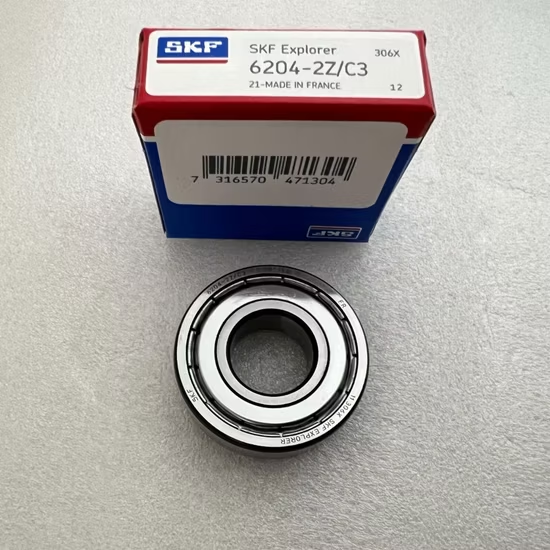
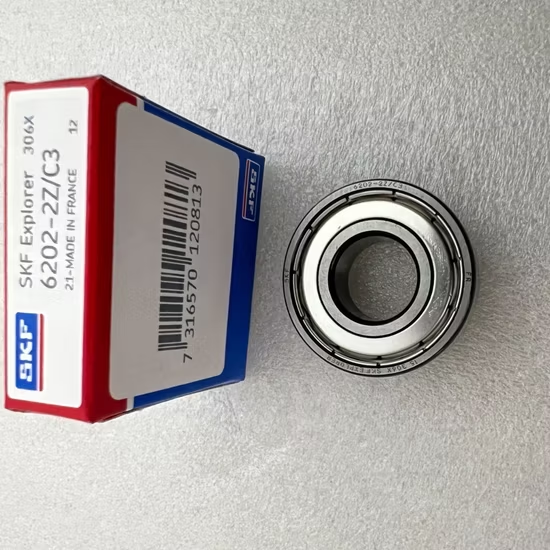
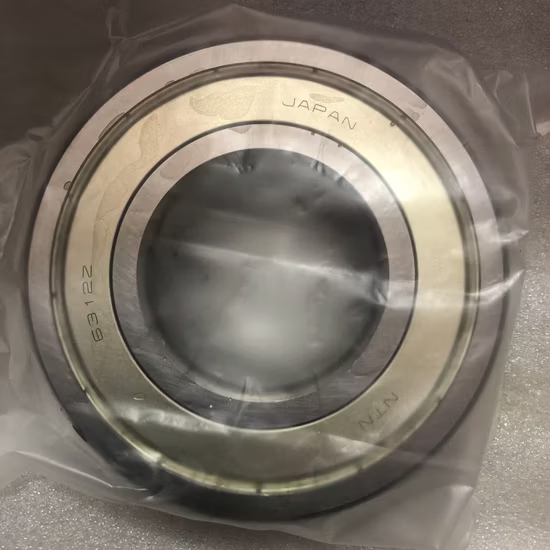
01
Consultation
Technical needs assessment
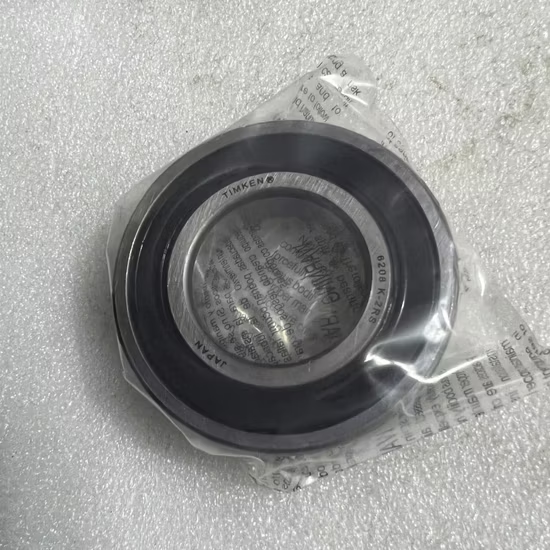


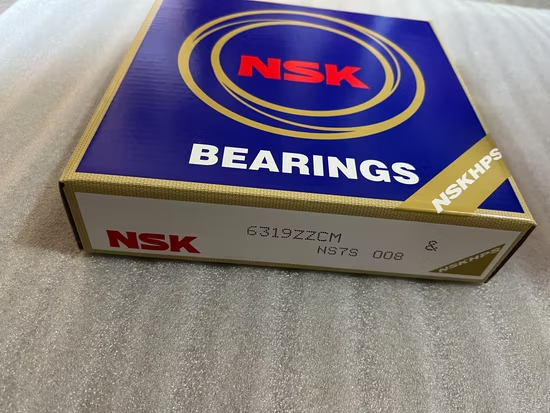

S6307 S6308 Stainless Steel Deep Groove Ball Bearing P6 C3 — engineered for corrosive and washdown environments.
Verify authenticity instantly via the official app QR verification channel for every traceable batch.
Cross-Reference Suffix Alignment — We verify base designation, C3 clearance, and 2RS seal configurations across brands to prevent thermal binding in washdown environments.
| Parameter | Value |
|---|---|
| Designation | S6307 S6308 |
| Bearing Type | Deep Groove Ball Bearing |
| Bore Diameter (d) | 35 mm / 40 mm |
| Outside Diameter (D) | 80 mm / 90 mm |
| Width (B) | 21 mm / 23 mm |
| Material | Stainless Steel |
| Precision Class | P6 (ISO 492) |
| Clearance Class | C3 (ISO 5753-1) |
| Seal or Shield Type | 2RS / ZZ / Open |
| Cage Material | Stainless Steel / PTFE |
| Quality Level | Z1V1 to Z4V4 |
| Certification | ISO 9001, RoHS |
| Origin | Germany / Japan / Sweden / Malaysia / China |
| Industry | Typical Applications |
|---|---|
| Food and Beverage | Conveyor drive rollers, bottling line filler valves, pasteurizer chain guides |
| Pharmaceutical | Blister packaging rotary tables, cleanroom agitator shafts, tablet press drives |
| Marine and Offshore | Deck winch sheaves, seawater pump impeller shafts, steering gear linkages |
| Chemical Processing | Centrifugal pump shafts, dosing pump drives, mixing vessel agitator bearings |
Stainless steel construction prevents corrosion, but incorrect internal clearance causes catastrophic thermal seizure.
In my years troubleshooting on the workshop floor in Ningbo, I have seen countless stainless steel bearings fail prematurely simply because the internal geometry was ignored. A batch of S6308 units once seized solid inside a high-temperature food processing motor. The basic designation matched, but the supplier shipped standard CN clearance instead of the required C3. When the shaft expanded under thermal load, the radial play vanished, leading to immediate cage failure . Selecting the right S6307 S6308 stainless steel deep groove ball bearing requires looking far beyond the basic part number to ensure the internal design survives the actual operating environment.
Washdown protocols in food and pharmaceutical facilities expose equipment to aggressive chemical detergents and high-pressure water jets. Standard bearing steel rusts rapidly under these conditions, contaminating the product line. The S6307 S6308 stainless steel deep groove ball bearing provides the necessary metallurgical resistance to weak acids, alkalis, and constant moisture. By matching the material to the specific chemical exposure, procurement engineers can eliminate rust-induced spalling and maintain strict hygiene standards without constant replacement cycles.
Equipment in pasteurization or sterilization zones experiences significant temperature fluctuations that directly impact internal bearing geometry. A standard clearance bearing will bind as the inner ring expands faster than the outer ring. The C3 clearance specification in these models provides the critical thermal expansion buffer needed to maintain a protective lubricant film at elevated temperatures. Simultaneously, the choice between 2RS contact rubber seals and ZZ steel shields dictates survival against high-pressure washdowns. While ZZ shields offer lower friction, 2RS seals are mandatory to prevent water and detergent ingress from emulsifying the grease .
The prefix and suffix combination defines the operational limits of the component. The "S" prefix confirms the martensitic stainless steel construction, essential for corrosion resistance but inherently carrying lower dynamic load ratings than chrome steel. The "63" series indicates a medium-wide cross-section, balancing radial load capacity with speed limitations. P6 precision ensures tighter dimensional tolerances and smoother running accuracy compared to standard P0, which is vital for minimizing vibration in high-speed packaging machinery. Finally, verifying the exact seal suffix—whether 2RS for full contact sealing or ZZ for non-contact shielding—prevents the most common field failures related to lubrication washout.
Purchasing a bearing based solely on the base designation is a frequent trap that leads to severe operational disruptions. Installing a standard clearance unit in a high-heat application results in thermal binding, destroying the shaft and housing. Conversely, using ZZ shields in a high-pressure washdown environment allows water to penetrate the raceway, causing rapid grease emulsification and corrosion pitting. These failures trigger unplanned downtime, void equipment warranties, and cause catastrophic damage to adjacent drive components .
Sourcing these specific configurations requires rigorous supply chain validation. We provide authorized coverage across major international brands, ensuring that a single order can fulfill mixed-brand requirements without compromising authenticity. Our cross-reference process strictly aligns the base number, C3 clearance, and seal type, preventing the dangerous substitution of CN clearance or P0 precision. Every shipment includes batch traceability to the manufacturer, supported by official app QR verification to eliminate counterfeit products with soft inner rings. We also conduct application-based selection reviews, evaluating your specific load, speed, and temperature parameters to confirm the chosen suffix combination is technically sound.
To ensure the selected configuration perfectly matches your operational demands, please provide detailed application parameters. Sharing radial and axial load profiles, operating speeds, ambient temperature ranges, and specific washdown chemical concentrations allows our engineering team to validate the L10 life and confirm the optimal seal and clearance combination. If you are replacing existing components, providing the exact OEM equipment numbers enables us to perform a rigorous cross-reference check, ensuring the internal design and suffix alignment match the original equipment manufacturer's specifications.
Q: What is the primary difference in load capacity between stainless steel and standard bearing steel?
A: Stainless steel variants like the S6307 S6308 offer substantially lower dynamic and static load ratings compared to standard chrome steel due to the material's inherent metallurgical properties. They are specifically engineered for corrosive or washdown environments where standard steel would rapidly fail, rather than for heavy-load applications.
Q: How do I choose between 2RS rubber seals and ZZ steel shields for washdown applications?
A: For high-pressure water jets and aggressive chemical detergents, 2RS contact rubber seals are mandatory to prevent fluid ingress and grease emulsification. ZZ steel shields are suitable only for dry, dusty environments or splash zones where lower friction is prioritized over absolute fluid exclusion.
Q: Why is C3 clearance critical in high-temperature sterilization or pasteurization equipment?
A: At elevated temperatures, the inner ring expands faster than the outer ring and housing. C3 clearance provides the necessary thermal expansion buffer to prevent the bearing from binding and seizing under heat. Standard CN clearance would eliminate the internal play, leading to rapid thermal failure.
Q: How can I verify the authenticity of stainless steel bearings to avoid counterfeit products?
A: Always request a material test report validating the stainless steel composition and demand batch traceability documentation. Genuine products feature verifiable QR codes that link directly to the manufacturer's official database, exposing counterfeit units that utilize soft inner rings and cloned labels.
Q: What internal design suffixes must be aligned when cross-referencing these models across different brands?
A: Beyond the base designation, you must strictly align the clearance class (C3), precision grade (P6), and seal type (2RS or ZZ). Overlooking these suffixes results in receiving a bearing with completely different internal geometry and contamination protection, causing immediate field failure.
Our 5-step process ensures every order is engineered, validated, and supported for optimal performance.
Technical needs assessment
Custom specifications
Free samples for $50k+
Pre-shipment inspection
On-site & predictive
Our certified engineers respond within 24 hours with detailed technical specifications, pricing, and lead time information.