01
Consultation
Technical needs assessment



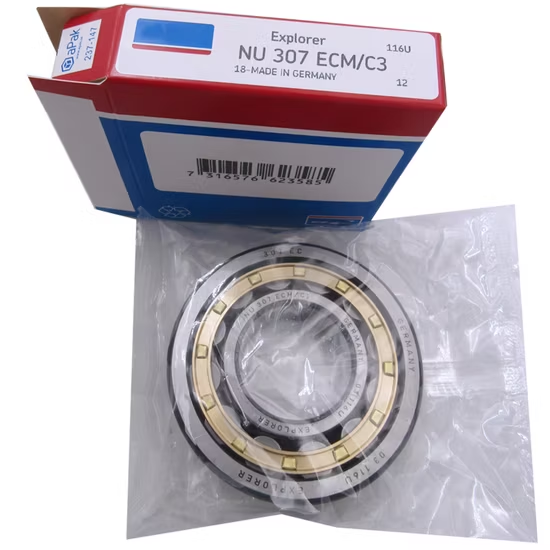


N210 E Cylindrical Roller Bearing 50 mm Bore — outer ring without flanges allows axial displacement, while optimized roller geometry maximizes radial load capacity.
Official App QR Verification — Every N210 E cylindrical roller bearing we dispatch includes a scannable code linking directly to the manufacturer's authenticity database.
| Parameter | Value |
|---|---|
| Designation | N210 E |
| Bearing Type | Cylindrical Roller Bearing |
| Bore Diameter (d) | 50 mm |
| Cage Material | Brass |
| Number of Rows | Single |
| Separated | Yes |
| Internal Design | Enhanced (E suffix) |
| Outer Ring Flanges | Without flanges (N prefix) |
| Industry | Typical Applications |
|---|---|
| Industrial Gearboxes | High-speed input shafts and intermediate gear stages |
| Electric Motors | Rotor shaft support in medium-sized traction motors |
| Machine Tool Spindles | Secondary support in heavy-duty milling spindles |
Overlooking the E suffix and brass cage specification during cross-referencing leads to rapid cage disintegration under high-speed vibration.
Procurement teams often approve substitutes that share the basic N210 designation but omit the enhanced internal geometry. In my years on the grinding shop floor, I witnessed an equivalent N-series bearing fail catastrophically because the replacement used a stamped steel cage instead of the required brass retainer. This mismatch causes severe thermal binding and premature fatigue, turning a routine replacement into an unplanned shutdown .
The N210 E cylindrical roller bearing excels in environments requiring high radial load capacity and precise alignment. By verifying the exact cage material and internal geometry against the OEM blueprint, we ensure the component handles the specific vibration profiles of industrial gearboxes. Our technical review prevents the installation of under-specified alternatives that compromise the entire drivetrain.
Heavy-duty gearboxes subject single-row cylindrical roller bearings to intense radial forces and fluctuating thermal cycles. As operating temperatures rise, inadequate internal clearance leads to thermal binding, while high-speed shaft rotation demands a cage material that resists centrifugal deformation. Proper lubrication flow is equally critical to prevent localized overheating at the roller-raceway contact points .
The "E" suffix signifies an optimized roller and raceway geometry, substantially increasing the dynamic load rating and fatigue life compared to standard designs. Paired with a machined brass cage, this configuration provides superior structural stability and wear resistance in high-vibration environments, unlike stamped steel alternatives that may fracture under shock loads. Furthermore, the "N" prefix indicates an outer ring without flanges, allowing for axial displacement in one direction to accommodate shaft thermal expansion.
Installing a basic N210 without the enhanced internal design or the correct brass cage inevitably results in premature failure. The roller ends and cage pockets experience accelerated wear, eventually leading to cage disintegration and secondary damage to the shaft and housing. Such catastrophic damage not only voids equipment warranties but also triggers extensive unplanned downtime across the production line.
We maintain authorized distribution channels to guarantee that every N210 E cylindrical roller bearing features the correct brass cage and optimized internal geometry. Our cross-reference protocol strictly aligns the base designation, cage material, and internal design suffixes to eliminate field failures. We provide complete batch traceability, ensuring procurement engineers receive genuine components backed by comprehensive factory documentation.
To guarantee optimal performance, share your specific radial loads, operating speeds, and thermal profiles with our engineering team. We will conduct a comprehensive L10 life calculation and verify that the internal clearance class perfectly matches your gearbox housing tolerances. Providing the exact OEM equipment number also allows us to execute a precise cross-reference validation.
Q: What is the core difference between N-type and NU-type cylindrical roller bearings regarding axial displacement?
A: An N-type bearing, like the N210 E, has flanges on the inner ring but none on the outer ring, allowing the shaft to move axially relative to the housing in one direction. Conversely, an NU-type features flanges on the outer ring and none on the inner ring, serving a similar axial displacement function but with reversed component separation during mounting.
Q: How do you ensure the replacement model perfectly matches the brass cage and E suffix design?
A: Our technical team executes a strict three-point cross-reference alignment. We verify not only the base N210 designation but also explicitly confirm the machined brass cage material and the enhanced internal geometry suffix. This prevents the installation of standard-design substitutes that would fail under high-speed vibration.
Q: Where is the selection boundary between brass cages and stamped steel cages in high-speed gearboxes?
A: Machined brass cages are mandatory for high-speed, high-vibration applications due to their superior structural rigidity and resistance to centrifugal forces. Stamped steel cages are generally restricted to moderate-speed, lower-load environments where weight reduction is prioritized over extreme shock-load stability and long-term wear resistance.
Q: How does the separable design of this bearing benefit interference fit installations?
A: The separable nature allows the inner ring to be mounted independently onto the shaft, typically using induction heating for a tight interference fit. The outer ring can then be easily pressed into the housing, eliminating the need to force the entire assembled bearing through tight tolerances, which protects the rolling elements and raceways from brinelling damage.
Q: How can buyers avoid refurbished or counterfeit bearings using official verification tools?
A: Buyers should utilize the manufacturer's official mobile app to scan the QR code printed on the bearing's packaging or outer ring. This directly queries the brand's central database to confirm the batch origin and authenticity, effectively exposing cloned codes or soft inner rings typical of counterfeit products.
Our 5-step process ensures every order is engineered, validated, and supported for optimal performance.
Technical needs assessment
Custom specifications
Free samples for $50k+
Pre-shipment inspection
On-site & predictive
Our certified engineers respond within 24 hours with detailed technical specifications, pricing, and lead time information.


