01
Consultation
Technical needs assessment


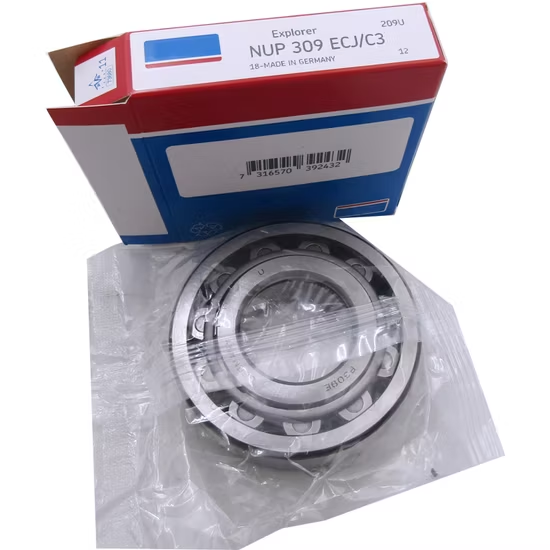


Nj310/Nj311/Nj312/Nj313/Nj314/Nj315/Nj316/Nj317/Nj318/Nj319 Cylindrical Roller Bearings — engineered with an NJ configuration featuring two outer ring flanges and one inner ring flange to support high radial and单向 axial loads. The separated design and brass cage construction ensure structural stability during heavy-duty operations while simplifying assembly.
Cross-Reference Triple Alignment — We verify the base number, clearance class, and cage material simultaneously to prevent thermal binding or cage fragmentation in heavy-duty gearboxes.
| Parameter | Value |
|---|---|
| Designation | Nj310/Nj311/Nj312/Nj313/Nj314/Nj315/Nj316/Nj317/Nj318/Nj319 |
| Bearing Type | Cylindrical Roller Bearing |
| Outer Dimension | Medium and Large (120-190mm) |
| Cage Material | Brass (other materials available upon request) |
| Separated | Separated |
| Feature | Low Noise, High Speed, Long Service Life |
| Origin | Germany / Japan / Sweden / Malaysia / China |
| HS Code | 8482500090 |
| Load Direction | Radial |
| Industry | Typical Applications |
|---|---|
| Industrial Gearboxes | Helical and planetary gear reducer shafts |
| Machine Tool Spindles | Main spindle radial support and auxiliary drives |
| Mining and Crushing | Jaw crusher eccentric shafts and vibrating screens |
Matching the basic designation without verifying the cage suffix is a direct path to catastrophic field failure.
I have spent years on workshop floors in Ningbo, witnessing the aftermath of procurement decisions that relied solely on base numbers. A batch of cylindrical roller bearings was once installed in a high-vibration crushing application using only the basic designation match. The stamped steel cages shattered under the dynamic loads, causing immediate unplanned downtime and severe shaft scoring. When sourcing a Nj310-Nj319 cylindrical roller bearing, ignoring the internal design suffixes means you might receive a standard clearance unit where a C3 was required for thermal expansion, or a polyamide cage where a machined brass cage was necessary to withstand the operating temperatures .
Selecting the correct Nj310-Nj319 cylindrical roller bearing requires looking past the outer dimensions and focusing on the internal geometry and cage design. Our technical team reviews your specific load profiles and speed requirements to ensure the selected unit features the appropriate brass cage configuration for high-vibration environments. We cross-reference the OEM equipment numbers to guarantee that the separation design and flange arrangements perfectly match your maintenance protocols and assembly constraints.
Heavy-duty industrial gearboxes and mining crushers subject bearings to immense radial loads combined with severe shock and vibration. In these environments, the operating temperature fluctuates significantly, making the correct internal clearance critical to accommodate thermal expansion of the shaft and housing. Lubrication reliability is equally vital; oil bath or circulating oil systems must maintain a sufficient film thickness to protect the roller-raceway contacts from metal-to-metal wear. Furthermore, the external environment often introduces abrasive dust and moisture, demanding robust sealing solutions at the housing level to prevent lubricant contamination .
The NJ design features two integral flanges on the outer ring and one integral flange on the inner ring, allowing the bearing to accommodate high radial loads while restricting axial displacement in one direction. The separated design means the inner ring can be mounted independently on the shaft, which drastically simplifies the assembly process in tight gearbox housings. For the medium and large sizes in this series, a machined brass cage is often specified because it provides superior structural stability and wear resistance under heavy loads and high-speed conditions compared to pressed steel alternatives. The brass material also maintains its integrity when operating at elevated temperatures or when subjected to marginal lubrication conditions.
Installing a bearing with an incorrect clearance class or an incompatible cage material inevitably leads to premature failure and catastrophic damage to adjacent components. If a standard clearance unit is used in an application requiring extra clearance for thermal expansion, the rollers will bind, generating excessive heat and destroying the raceways. Similarly, using a cage material that cannot withstand the specific vibration frequencies of a vibrating screen will result in cage fracture, which subsequently jams the rolling elements. These failures void equipment warranties and trigger massive financial losses through extended production halts and complex machinery rebuilds.
We provide authorized coverage across all major international brands, meaning a single purchase order can fulfill mixed-brand requirements without coordinating multiple vendors. Every Nj310-Nj319 cylindrical roller bearing we supply comes with batch traceability directly to the manufacturer, eliminating the risk of counterfeit parts with soft inner rings. Our cross-reference process strictly aligns the base designation, clearance class, and cage material, preventing the subtle mismatches that cause field failures. We also conduct an application-based selection review, evaluating your specific load, speed, and temperature parameters to confirm the suitability of the proposed suffix configuration before shipment.
To ensure accurate selection and cross-referencing, please provide the specific radial and axial load values, operating speeds, and expected temperature ranges for your application. Sharing the exact OEM equipment number or the complete designation currently installed allows our engineering team to verify the required clearance and cage suffixes. We will use this data to perform an L10 life calculation and recommend the optimal configuration for your machinery.
Q: Why must clearance and cage suffixes align with the base designation during cross-referencing?
A: Matching only the base number ignores critical internal design variations. A standard clearance bearing installed where extra clearance is needed will thermally bind, while an incompatible cage material may fracture under high vibration. Aligning all three parameters ensures the replacement bearing survives the specific thermal and dynamic demands of your equipment.
Q: How can I verify the authenticity of the received bearings?
A: Every unit we supply features batch traceability and can be verified using the respective brand's official mobile application. By scanning the QR code or entering the batch number, you can confirm the manufacturing origin and ensure the product is not a counterfeit with compromised metallurgical properties or cloned packaging.
Q: What are the performance differences between brass and pressed steel cages in heavy gearboxes?
A: Machined brass cages offer superior structural stability, wear resistance, and damping characteristics under heavy loads and high vibration compared to pressed steel cages. They are less prone to fatigue fracture in harsh operating conditions and maintain their geometric integrity better when subjected to elevated temperatures or marginal lubrication scenarios.
Q: How do I choose between standard CN and C3 clearance for electric motors?
A: Standard CN clearance is typically suitable for general-purpose motors operating at normal ambient temperatures. However, C3 clearance is required for motors that run at higher speeds, operate in elevated ambient temperatures, or feature interference fits on both the inner and outer rings, as it accommodates the thermal expansion and mounting stresses without causing internal preload.
Our 5-step process ensures every order is engineered, validated, and supported for optimal performance.
Technical needs assessment
Custom specifications
Free samples for $50k+
Pre-shipment inspection
On-site & predictive
Our certified engineers respond within 24 hours with detailed technical specifications, pricing, and lead time information.


