01
Consultation
Technical needs assessment


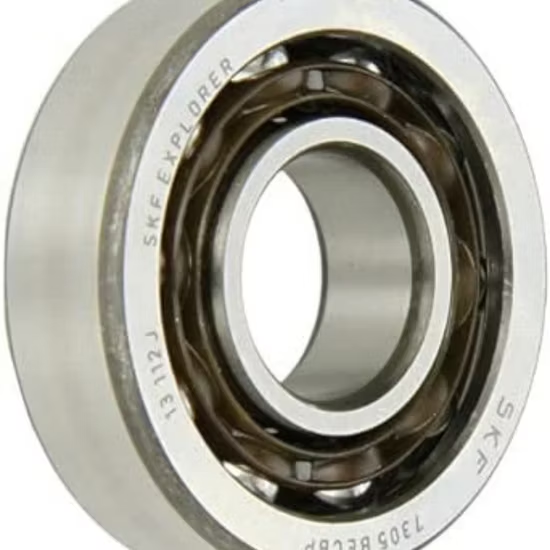


71809 CD/P4 Angular Contact Ball Bearing — engineered for high-speed precision applications.
Multi-Brand Authorized Coverage — Source SKF, FAG, and NSK equivalents for the 71809 CD/P4 angular contact ball bearing in a single consolidated shipment without juggling multiple vendors.
| Parameter | Value |
|---|---|
| Designation | 71809 CD/P4 |
| Bearing Type | Angular Contact Ball Bearing |
| Material | Bearing Steel |
| Precision Class | P4 |
| Contact Angle | 15° (CD) |
| Vibration Level | Z1V1, Z2V2, Z3V3 |
| Origin | Germany, Japan, Sweden, Malaysia, China |
Cross-reference equivalent: 71809 Cdga/P4.
| Industry | Typical Applications |
|---|---|
| Machine Tool Manufacturing | High-speed motorized spindle front and rear support nodes |
| Precision Equipment | Optical measuring instrument rotary tables and indexing heads |
| Robotics | High-accuracy joint actuators requiring minimal axial play |
A matching base designation does not guarantee spindle survival if precision and contact angle suffixes are ignored.
Early in my career transitioning from procurement to sales in Shenzhen, I watched a machining center's high-speed spindle thermally bind and seize within minutes of startup. The maintenance team had replaced the original bearings with standard-grade units that shared the exact same base numbers. They completely overlooked the critical P4 precision and 15° contact angle requirements. In high-speed applications, this oversight eliminates the necessary running accuracy and generates excessive friction heat . When sourcing a 71809 CD/P4 angular contact ball bearing, ignoring the suffix string is an invitation for catastrophic downtime.
Precision spindle assemblies demand extreme rotational accuracy and minimal vibration. The 71809 CD/P4 angular contact ball bearing is engineered specifically for these high-speed, high-rigidity environments. By strictly verifying the P4 tolerance class and the optimized 15° contact geometry during the procurement phase, we ensure the replacement units deliver the exact axial stiffness and thermal stability your machine tool requires.
Inside a motorized spindle, rotational speeds generate immense centrifugal forces on the rolling elements, while cutting operations introduce complex combined loads. As the shaft heats up, thermal expansion alters the internal clearance dynamically. If the contact angle or precision grade is mismatched, the bearing cannot accommodate these shifting geometric tolerances, leading to rapid temperature spikes and lubricant breakdown . Proper oil-air or oil-jet lubrication is mandatory here to manage the friction heat inherent in high-speed angular contact designs.
The "P4" designation indicates a dimensional and running accuracy that far exceeds standard commercial grades, ensuring the spindle rotates with minimal radial and axial runout. This tight tolerance is non-negotiable for achieving fine surface finishes on machined parts. Meanwhile, the "CD" suffix specifies a 15° contact angle. Compared to higher-angle variants, this 15° geometry significantly reduces friction heat generation and centrifugal ball slip at elevated RPMs. Together, these suffixes define a bearing optimized for speed rather than heavy axial thrust, making correct interpretation vital for application success.
Replacing a specified P4 unit with a cheaper P5 or P0 alternative might save money on the initial purchase order, but it inevitably triggers unplanned downtime. The resulting loss of machining accuracy ruins expensive workpieces and forces emergency teardowns. According to failure analysis frameworks, operating a precision bearing outside its designed geometric tolerances accelerates fatigue and causes premature cage failure . The financial impact of a scrapped spindle shaft and halted production lines always dwarfs the cost of the correct precision component.
We do not just ship boxes; we engineer the cross-reference. While others might match the "71809" base number and ignore the rest, our technical team strictly validates the CD and P4 suffixes against your OEM documentation to prevent thermal binding. We provide authorized distribution across all major international brands, meaning you can consolidate your SKF, FAG, or NSK requirements into one traceable order. Every shipment includes batch verification to eliminate the risk of counterfeit units with soft inner rings that plague the open market. Furthermore, our application-based selection review ensures the internal design perfectly aligns with your specific spindle speed and load profile.
To ensure the 71809 CD/P4 angular contact ball bearing perfectly matches your application, please provide your spindle's maximum operating RPM, expected radial and axial loads, and target operating temperature. If you are replacing an existing unit, share the exact OEM equipment number or the full designation string printed on the original bearing box. Our engineering team will use these parameters to verify the L10 life calculation and confirm the cross-reference alignment before finalizing the quotation.
Q: Why is it dangerous to ignore the CD and P4 suffixes when cross-referencing?
A: The base number only defines the physical envelope dimensions. The P4 suffix guarantees the tight running accuracy required for high-speed spindles, while the CD suffix dictates the 15° contact angle for optimal thermal management. Ignoring these leads to severe friction heat and rapid seizure under high RPMs.
Q: How does the 15° contact angle (CD) perform compared to higher angles?
A: A 15° contact angle generates significantly less friction heat and reduces centrifugal ball slip at high rotational speeds. While higher angles offer more axial load capacity, the CD design is specifically optimized for the extreme speed and rigidity requirements of precision machine tool spindles.
Q: What is the practical difference between P4 and standard precision classes?
A: P4 precision ensures much tighter tolerances for bore, outer diameter, and running accuracy compared to standard grades. This minimizes vibration and radial runout, which is absolutely critical for achieving fine surface finishes and preventing premature fatigue in high-speed precision equipment.
Q: How can I verify the authenticity of the received P4 bearings?
A: Every genuine unit we supply features batch traceability and a unique QR code. You can scan this code using the manufacturer's official mobile application to instantly verify the production origin, precision class, and authenticity, completely eliminating the risk of counterfeit parts.
Our 5-step process ensures every order is engineered, validated, and supported for optimal performance.
Technical needs assessment
Custom specifications
Free samples for $50k+
Pre-shipment inspection
On-site & predictive
Our certified engineers respond within 24 hours with detailed technical specifications, pricing, and lead time information.

![7206 Becbm Angular Contact Ball Bearing High Speed Precision [WARN] draft identifier mismatch](https://skfiso.com/wp-content/uploads/2026/09/7206-becbm-angular-contact-ball-bearing-high-speed-precision-warn-draft-identifier-mismatch-0db82c.avif)

