01
Consultation
Technical needs assessment



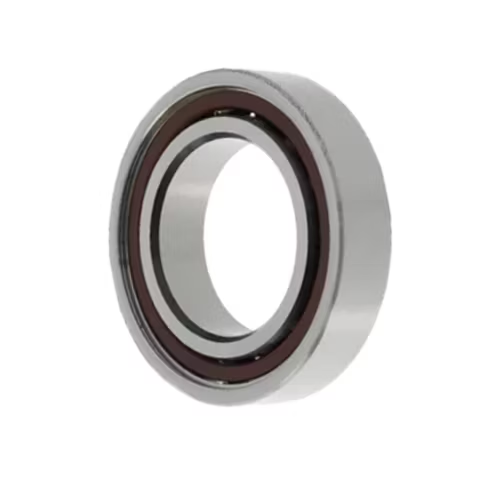
71805 CD/P4 Angular Contact Ball Bearing P4 Precision — featuring a 15° contact angle for minimized friction heat and P4 class accuracy for machine tool spindles.
Multi-brand authorized coverage — Consolidate mixed SKF, FAG, and NSK spindle bearing requirements into a single traceable shipment without juggling multiple vendors.
| Parameter | Value |
|---|---|
| Designation | 71805 CD/P4 |
| Bearing Type | Angular Contact Ball Bearing |
| Material | Bearing Steel |
| Precision Class | P4 |
| Contact Angle | 15° (CD suffix) |
| Separated | Unseparated |
| Vibration Level | Z1V1 / Z2V2 / Z3V3 |
| Origin | Germany / Japan / Sweden / Malaysia / China |
Note: The cross-reference variant 71805 Cdga/P4 contains an unverified suffix combination that requires specific manufacturer catalog confirmation before interchange.
| Industry | Typical Applications |
|---|---|
| Machine Tool Manufacturing | High-speed CNC milling spindle nose arrangements |
| Precision Equipment | Coordinate measuring machine rotary tables |
| Robotics | High-accuracy articulated joint actuators |
| Industrial Pumps | High-speed centrifugal pump shaft support |
Base numbers match, but ignoring the contact angle and precision suffix destroys the spindle.
In my early years working the grinding floor before moving to the Chilean copper mine spare parts center, I watched a brand-new CNC milling spindle seize up during commissioning. The purchasing team ordered standard P0 grade replacements because the base number matched. Without the strict dimensional tolerances and the specific 15° contact angle geometry required for high-speed rigidity, the internal friction generated massive heat. The thermal expansion eliminated the internal clearance, leading to catastrophic cage failure within hours. Sourcing a genuine 71805 CD/P4 angular contact ball bearing requires exact suffix alignment, not just a visual match on the first five digits .
When configuring a spindle for fine milling or precision grinding, the cutting forces demand extreme radial and axial rigidity without generating excessive friction heat. The 71805 CD/P4 angular contact ball bearing delivers this balance through its optimized 15° contact angle. This specific geometry allows the rolling elements to manage combined loads efficiently while minimizing the centrifugal forces and gyroscopic sliding that plague higher-angle variants at elevated RPMs. By supplying exact cross-brand interchange equivalents, we ensure the replacement maintains the original equipment manufacturer's thermal and rigidity profile.
High-speed spindles operate in a delicate thermal equilibrium where ambient temperature shifts and continuous cutting loads directly impact internal clearance. If the precision class falls short, microscopic dimensional deviations cause uneven load distribution across the rolling elements, accelerating lubricant degradation. Oil-air or oil-jet lubrication systems typically used in these applications require the bearing to have exceptionally smooth raceway finishes to prevent oil film breakdown. Any contamination from poor sealing or incorrect assembly torque will immediately spike the operating temperature, compromising the dimensional stability of the machined parts .
The "CD" suffix signifies the 15° optimized contact angle design, which is fundamentally different from the 25° (AC) or 40° (B) variants used in heavy-duty pump applications. This 15° profile is engineered specifically to reduce friction heat at high rotational speeds. The "P4" designation dictates the precision class, ensuring that the bore, outside diameter, and running accuracy adhere to extremely tight tolerances defined by international standards. This level of precision is non-negotiable for machine tool spindles, where even a micron of radial runout translates into visible chatter marks on the finished workpiece. Standard P0 or P5 grades simply lack the geometric consistency to maintain the required oil film thickness at high velocities.
Installing a standard clearance or lower-precision bearing in a high-speed spindle inevitably leads to unplanned downtime and scrapped production batches. When the internal geometry fails to maintain the designed contact angle under load, the resulting vibration causes premature fatigue spalling on the raceways. According to failure analysis frameworks, this localized stress concentration rapidly degrades the cage material, eventually leading to total spindle lockup. The financial impact extends far beyond the bearing replacement cost, encompassing the loss of the expensive spindle shaft, damaged tooling, and weeks of halted production .
We eliminate the risk of cross-reference errors by verifying the full designation, ensuring the 15° contact angle and P4 precision class are perfectly matched across different manufacturers. Our authorized distribution network allows us to source genuine 71805 series bearings with complete batch traceability, preventing the infiltration of counterfeits with soft inner rings that fail under spindle loads. We provide exact interchange solutions that account for the specific cage materials and precision suffixes, rather than just swapping base numbers. Every shipment includes comprehensive documentation, giving your maintenance team absolute confidence in the authenticity and operational readiness of the components.
To ensure the selected component perfectly matches your spindle rebuild requirements, please provide the specific radial and axial cutting loads, maximum operational RPM, and the target operating temperature range. Sharing the original OEM equipment number or the exact housing dimensions allows our technical team to perform a comprehensive cross-reference check and L10 life calculation. This data enables us to confirm the optimal preload arrangement and lubrication strategy for your specific high-speed machining environment.
Q: What do the "CD" and "P4" suffixes mean for 71805 angular contact bearings?
A: The "CD" suffix indicates a 15° optimized contact angle, designed to minimize friction heat during high-speed operation compared to higher-angle variants. The "P4" designation specifies a high-precision class with extremely tight tolerances for bore, outside diameter, and running accuracy, which is mandatory for maintaining rigidity and minimizing vibration in machine tool spindles.
Q: How to verify authenticity and batch traceability for precision bearings?
A: Genuine precision components must be procured through authorized channels and accompanied by a Certificate of Conformity. You can verify authenticity by scanning the manufacturer's QR code using their official mobile application, which links the specific batch and lot number directly to the original production facility, ensuring the bearing steel and machining tolerances meet exact specifications.
Q: Why must clearance, cage, and precision suffixes align during cross-brand interchange?
A: Matching only the base number while ignoring suffixes often results in installing a standard P0 grade or incorrect contact angle, leading to thermal binding and premature cage failure. True cross-brand interchange requires exact alignment of the 15° geometry, precision class, and internal design to ensure the replacement handles the specific high-speed loads and thermal expansion of the original spindle.
Q: What are the mounting and alignment requirements for P4 precision spindle bearings?
A: Mounting P4 bearings demands exceptionally clean environments and precise shaft and housing tolerances to prevent outer ring distortion. Technicians must use controlled induction heating for the inner ring and strictly avoid impact forces. Proper alignment ensures the 15° contact angle functions correctly, preventing uneven load distribution that would otherwise generate excessive heat and destroy the high-speed lubricant film.
Our 5-step process ensures every order is engineered, validated, and supported for optimal performance.
Technical needs assessment
Custom specifications
Free samples for $50k+
Pre-shipment inspection
On-site & predictive
Our certified engineers respond within 24 hours with detailed technical specifications, pricing, and lead time information.
![7206 Becbm Angular Contact Ball Bearing High Speed Precision [WARN] draft identifier mismatch](https://skfiso.com/wp-content/uploads/2026/09/7206-becbm-angular-contact-ball-bearing-high-speed-precision-warn-draft-identifier-mismatch-0db82c.avif)