01
Consultation
Technical needs assessment


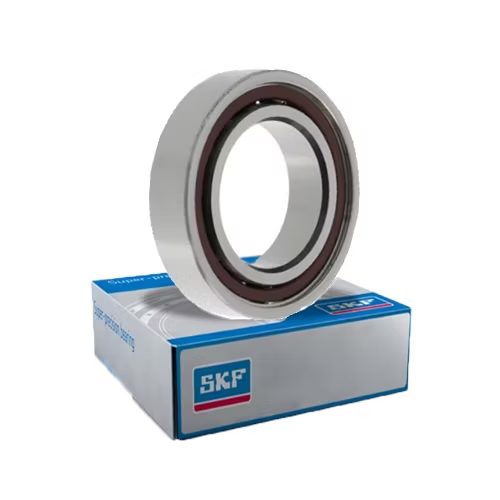
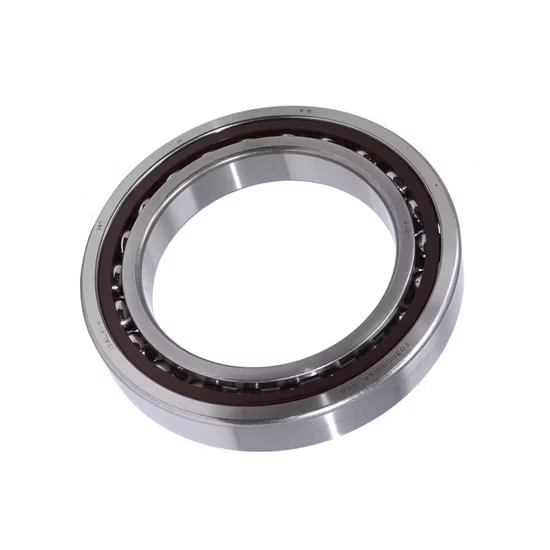
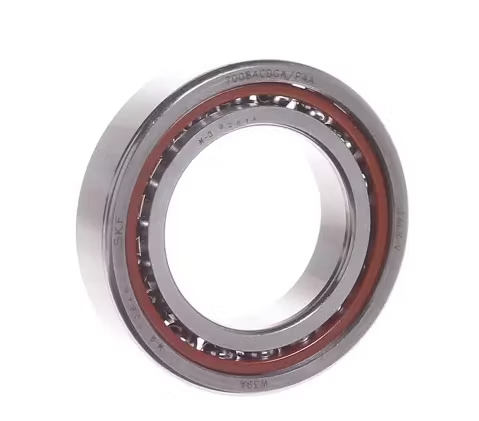
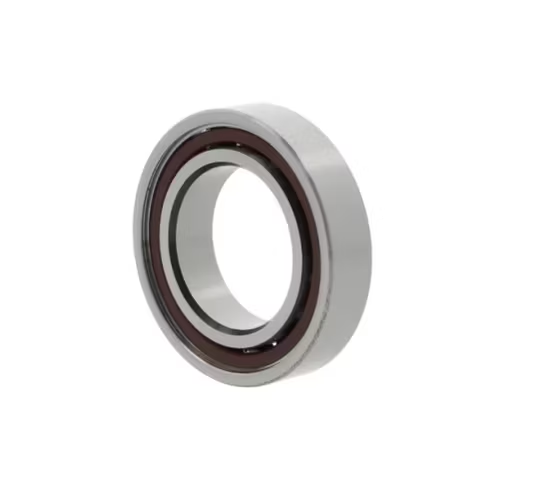
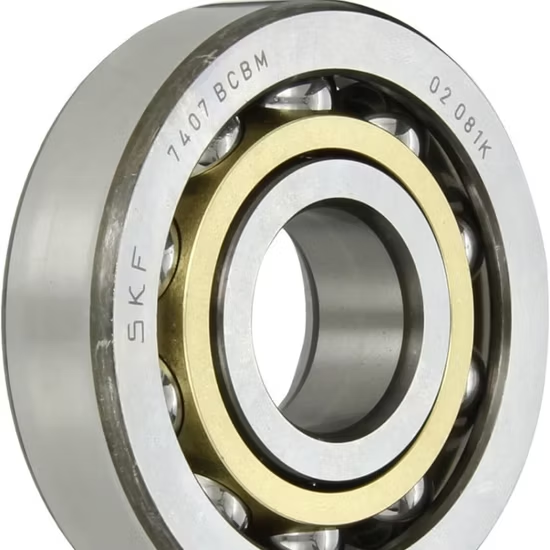
7017 CD/P4a Angular Contact Ball Bearing features a 15° contact angle to minimize friction heat and P4a precision for strict running accuracy.
Precision Suffix Alignment — Cross-referencing the 7017 CD/P4a angular contact ball bearing requires matching the 15° contact angle, P4a running accuracy, and universal preload simultaneously to prevent thermal binding in high-speed spindles.
| Parameter | Value |
|---|---|
| Designation | 7017 CD/P4a |
| Bearing Type | Angular Contact Ball Bearing |
| Bore Diameter (d) | 85 mm |
| Outside Diameter (D) | 130 mm |
| Width (B) | 22 mm |
| Contact Angle | 15° (CD suffix) |
| Precision Class | P4a (ISO 492 Class 4 with enhanced running accuracy) |
| Arrangement | Universal matching available (e.g., GA light preload variant) |
| Material | Bearing Steel (martensitic stainless or ceramic hybrid variants available) |
| Cage Material | Options include machined brass, pressed steel, or polyamide |
| Seal or Shield Type | Open design for external oil-air or oil-jet lubrication systems |
| Vibration Level | Available in Z1V1, Z2V2, or Z3V3 classifications |
| Origin | Sourced from authorized facilities in Germany, Japan, Sweden, Malaysia, or China |
| Industry | Typical Applications |
|---|---|
| Machine Tool Manufacturing | High-speed milling spindle front and rear supports, precision grinding wheel heads |
| Industrial Robotics | High-torque rotary actuator joints, precision rotary index tables |
| Fluid Machinery | High-speed centrifugal pump shaft supports, turbo-compressor rotor bearings |
| Semiconductor Equipment | Wafer inspection stage rotary drives, cleanroom vacuum pump spindles |
Matching the base dimension is only the first step; ignoring the precision and contact angle suffixes turns a precision assembly into a thermal failure point.
Procurement teams often clear a basic 7017 designation through customs and inventory checks, only to find the machine tool spindle seizing during high-speed run-in. A standard P5 grade cannot sustain the rotational velocity required for modern machining centers, and substituting a 25° contact angle where a 15° design is specified alters the axial stiffness profile entirely. I have seen entire shipments held at ports because the commercial invoice omitted the P4a running accuracy code, forcing workshop managers to halt assembly lines while waiting for corrected certificates. The 7017 CD/P4a angular contact ball bearing demands strict adherence to every suffix character to guarantee the dimensional and running accuracy the spindle designer originally calculated .
Modern machining centers demand extreme rotational speeds combined with rigid axial support to maintain tight tolerances during heavy cuts. The 15° contact angle inherent in the CD design minimizes internal friction and heat generation, which is critical when the spindle operates near its kinematic limits. By supplying the 7017 CD/P4a angular contact ball bearing with verified batch traceability, we ensure that the exact preload and clearance parameters specified by the OEM are maintained throughout the supply chain, preventing the microscopic deviations that cause chatter marks on finished metal surfaces.
At elevated rotational speeds, the inner ring expands faster than the housing, rapidly consuming internal clearance and generating excessive friction heat. This thermal growth necessitates precise preload control, often achieved through universal matching configurations like the GA light preload variant, to maintain stiffness without overloading the rolling elements. Lubrication strategy is equally critical; open bearings in this precision class rely on continuous oil-air or oil-jet systems to carry away heat and flush out microscopic wear debris. Any contamination or interruption in the oil flow quickly degrades the raceway surface, making the sealing effectiveness of the external housing and the cleanliness of the lubricant supply paramount to survival .
The CD suffix dictates a 15° contact angle, an geometry specifically optimized for high-speed applications where minimizing centrifugal forces and friction heat takes precedence over maximum axial load capacity. This angle ensures the bearing runs cooler, preserving the lubricant film thickness under extreme RPMs. The P4a designation goes beyond standard ISO 492 Class 4 dimensional tolerances; the "a" signifies strictly controlled running accuracy, specifically limiting inner and outer ring radial runout. This tight runout control is what prevents vibration transfer from the bearing into the cutting tool, ensuring superior surface finish on the machined parts. When sourcing the variant 7017 Cdga/P4a, the GA suffix indicates universal flush matching with a light preload, allowing technicians to mount the bearings in back-to-back or face-to-face arrangements without needing custom ground spacers.
Installing a bearing that matches the base bore and diameter but lacks the correct precision or contact angle suffix inevitably leads to premature failure and unplanned downtime. A standard precision bearing installed in a P4a-designed spindle will generate excessive vibration, accelerating cage wear and causing catastrophic damage to the spindle housing and tooling. Furthermore, using an incorrect preload arrangement destroys the axial stiffness required for heavy milling operations, resulting in scrapped parts and voided machine warranties. These failures rarely occur immediately; they manifest as gradual thermal drift and dimensional inaccuracies that evade detection until a massive batch of components is rejected .
Mixed-brand orders often result in mismatched tolerances when distributors fail to align the contact angle and precision suffixes across different manufacturers. We verify that the 15° angle and P4a running accuracy are strictly maintained, regardless of whether the physical product originates from SKF, FAG, or NSK production facilities. Counterfeit bearings frequently feature cloned QR codes and soft inner rings that pass visual checks but fail under thermal stress; our batch traceability links directly to the manufacturer's heat treatment records. Cross-reference errors often overlook the GA preload designation, leading to thermal binding in the field; our engineering review catches these discrepancies before the quotation is finalized. We also provide application-based selection reviews to ensure the specified vibration level and cage material align with your specific oil-air lubrication parameters.
To ensure the 7017 CD/P4a angular contact ball bearing perfectly matches your spindle design, provide your specific radial and axial load profiles, maximum operating RPM, and target operating temperature. Sharing the OEM equipment number or original spindle drawing allows our technical team to perform a rigorous cross-reference check, verifying that the 15° contact angle and P4a running accuracy align with the manufacturer's original specifications. If your application requires a specific universal matching preload like the GA configuration, detailing your required axial stiffness will help us confirm the exact variant needed for your assembly.
Q: Why must the CD, P4a, and GA suffixes be matched simultaneously during cross-referencing?
A: Matching only the base 7017 number ignores critical internal geometry. The CD ensures the correct 15° contact angle for high-speed thermal stability, P4a guarantees the strict running accuracy needed to prevent spindle vibration, and GA defines the universal light preload. Missing any suffix alters the stiffness and thermal profile, leading to rapid failure.
Q: What is the practical difference between standard P4 and the P4a precision class?
A: While both fall under ISO 492 Class 4 dimensional tolerances, the P4a designation imposes significantly tighter limits on radial and axial running accuracy. This enhanced running accuracy minimizes non-repetitive runout, which is critical for machine tool spindles where even microscopic vibrations can cause visible chatter marks on the finished workpiece surface.
Q: How does the 15° contact angle in the CD design benefit high-speed applications?
A: A 15° contact angle reduces the internal sliding friction and centrifugal forces acting on the rolling elements compared to steeper angles like 25° or 40°. This geometry generates considerably less heat at extreme rotational speeds, helping to maintain the lubricant film thickness and preventing the thermal expansion that causes spindle seizure.
Q: What does the GA suffix mean for spindle assembly and preload control?
A: The GA suffix indicates a universal matching arrangement with a light preload. This allows the bearings to be mounted in any configuration, such as back-to-back or face-to-face, directly out of the box without requiring custom-ground spacing collars. It simplifies assembly while providing the precise axial stiffness needed for high-speed milling operations.
Our 5-step process ensures every order is engineered, validated, and supported for optimal performance.
Technical needs assessment
Custom specifications
Free samples for $50k+
Pre-shipment inspection
On-site & predictive
Our certified engineers respond within 24 hours with detailed technical specifications, pricing, and lead time information.