01
Consultation
Technical needs assessment

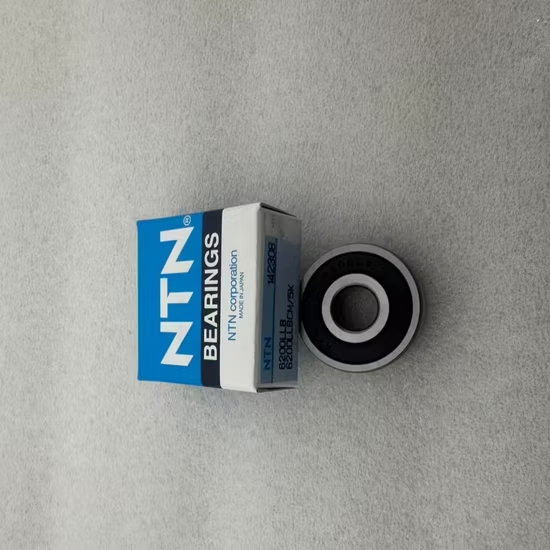

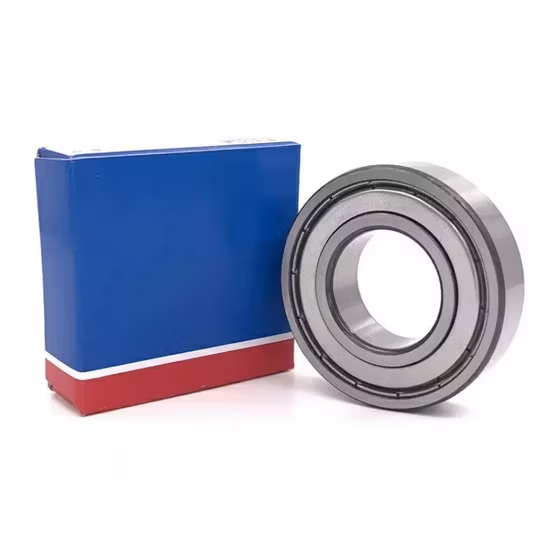

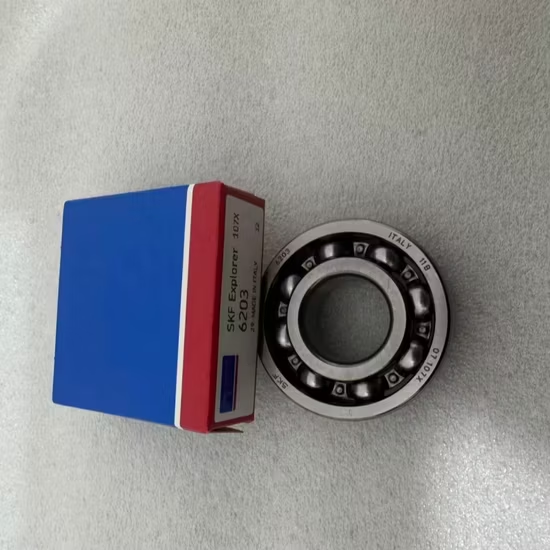

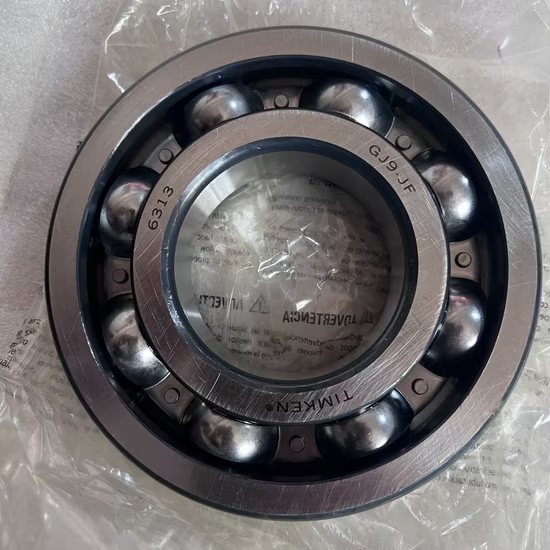
6200-6205 Stainless Steel Deep Groove Ball Bearing C3 P6 — engineered with 420/440/304 stainless steel for corrosion resistance in food-grade and high-temperature environments.
Unified brand sourcing — Procure SKF, FAG, or NSK equivalents for your mixed-brand maintenance schedules without juggling multiple suppliers for these deep groove models.
| Parameter | Value |
|---|---|
| Designation | 6200-6205 |
| Bearing Type | Deep Groove Ball Bearing |
| Material | Available in 420, 440, or 304 stainless steel variants |
| Seal or Shield Type | Open, rubber seals, or iron shields |
| Clearance Class | C3 |
| Precision Class | P6 |
| Noise and Vibration Level | Z1V1 through Z4V4 |
| Lubrication | Grease lubricated |
| Operating Temperature | High temperature |
| Origin | Germany, Japan, Sweden, Malaysia, or China |
| Industry | Typical Applications |
|---|---|
| Food & Beverage Processing | Commercial oven convection fan shafts and dishwasher pump motors |
| Commercial Kitchen Equipment | High-humidity prep station conveyors and exhaust blower assemblies |
| Material Handling | Washdown-environment packaging lines and food-grade sorting belts |
| General Industrial | Chemical-resistant electric motor drives and fluid transfer pumps |
Thermal expansion destroys standard internal clearances long before the steel actually corrodes.
I have watched standard bearings lock up solid next to industrial ovens because the internal clearance collapsed under intense heat. When maintenance teams install standard clearance units in high-heat food processing zones, the rolling elements wedge against the raceway as the metal expands. The resulting friction generates even more heat, leading to sudden cage failure and catastrophic line stoppages . Selecting the correct 6200-6205 stainless steel deep groove ball bearing prevents this exact thermal binding scenario.
Not every food processing zone demands the same metallurgy. We supply this series in 420, 440, and 304 stainless steel variants so you can align the material with your specific corrosion and load profile. Martensitic grades handle higher radial loads on conveyor drive shafts, while austenitic options provide superior resistance to aggressive caustic cleaning chemicals used in daily washdowns.
Commercial kitchens and food processing plants subject rotating equipment to brutal thermal cycling and constant moisture exposure. Standard lubricants wash out quickly, and insufficient sealing allows steam and particulate matter to infiltrate the raceway. High-temperature grease formulations paired with appropriate rubber or iron shields maintain a stable lubricating film. This prevents the emulsion of grease and water that typically destroys bearing internals in humid environments .
The C3 designation provides greater than normal radial internal clearance, which is absolutely critical for accommodating the thermal expansion of the shaft and housing in heated zones. Without this extra internal space, the bearing will preload itself to destruction as temperatures rise. Meanwhile, the P6 precision class ensures tight geometric tolerances, minimizing vibration and heat generation at operational speeds. Selecting Z-group vibration levels further guarantees smooth, quiet rotation for noise-sensitive commercial environments.
Replacing a seized bearing involves far more than the component cost. Unplanned downtime in a continuous food processing line halts production, spoils temperature-sensitive inventory, and triggers emergency maintenance overtime. Furthermore, using non-compliant materials in food-grade zones risks regulatory violations and product contamination. Following ISO 15243 failure analysis protocols reveals that a massive share of premature failures stem directly from ignoring clearance and precision suffixes during procurement .
We do not just ship boxes; we verify that the C3 clearance and P6 precision match your exact application requirements. Cross-referencing base numbers often misses critical suffix variations, leading to field failures when a standard clearance unit is shipped instead of a C3. Our engineering team reviews your load, speed, and temperature parameters to ensure the selected 6200-6205 stainless steel deep groove ball bearing survives the actual operating environment. We also consolidate mixed-brand requirements, eliminating the administrative burden of managing multiple vendors for a single maintenance overhaul.
Provide your exact radial and axial loads, operational speeds, and maximum ambient temperatures so our team can verify the L10 life calculation for your specific setup. If you are replacing an existing OEM component, share the equipment nameplate data or original part numbers for a precise cross-reference check. Supplying these parameters ensures we supply a bearing engineered to survive your specific thermal and mechanical reality.
Q: How do I choose between 420, 440, and 304 stainless steel for my application?
A: Martensitic grades like 420 and 440 offer higher hardness and load capacity, making them ideal for drive shafts and heavy conveyors. Austenitic 304 provides superior resistance to caustic washdown chemicals and acidic food byproducts. Share your specific cleaning protocols and load requirements with our engineering team to select the optimal metallurgy.
Q: Why is C3 clearance strictly required for high-temperature installations?
A: As operating temperatures rise, the inner ring expands faster than the outer ring, reducing internal clearance. A standard clearance bearing will tighten, generate excessive friction, and eventually seize. The C3 designation provides the necessary thermal expansion allowance to maintain a safe operational gap between the rolling elements and raceway.
Q: What cross-reference errors occur most frequently with these designations?
A: Procurement teams often match the base 6200-6205 number but overlook the C3 clearance, P6 precision, or specific Z/V vibration suffixes. Installing a standard clearance or lower precision unit in a high-speed, high-heat environment leads to rapid thermal binding and noise issues. We verify every suffix to prevent these field failures.
Q: How can I verify the authenticity of the stainless steel bearings upon delivery?
A: Every shipment includes batch traceability documentation and a scannable QR code. You can use the official brand applications on your mobile device to verify the manufacturing origin and confirm the exact specifications. This eliminates the risk of installing counterfeit bearings with soft inner rings that fail prematurely under load.
Our 5-step process ensures every order is engineered, validated, and supported for optimal performance.
Technical needs assessment
Custom specifications
Free samples for $50k+
Pre-shipment inspection
On-site & predictive
Our certified engineers respond within 24 hours with detailed technical specifications, pricing, and lead time information.