01
Consultation
Technical needs assessment



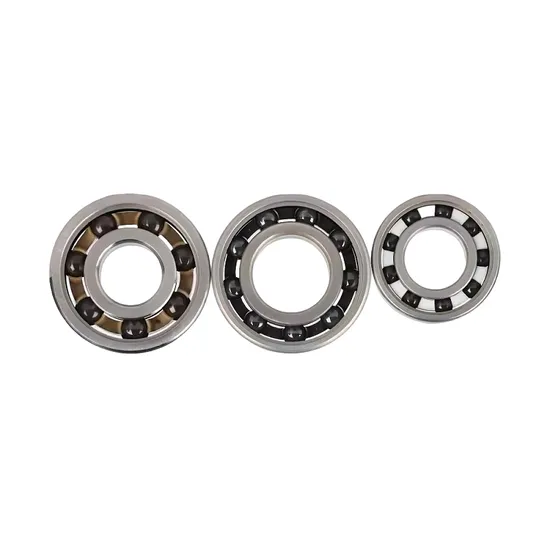
6000 6200 6300 6400 Deep Groove Ball Bearing — engineered with ceramic rolling elements for high-speed or electrically insulated applications.
Three-point cross-reference alignment — matching base numbers, internal clearances, and cage materials simultaneously to prevent thermal binding in 6000 6200 6300 6400 deep groove ball bearing applications.
| Parameter | Value |
|---|---|
| Designation | 6000 6200 6300 6400 |
| Product Type | Deep Groove Ball Bearing |
| Bearing Style | Open, Rubber Seals, Iron Seals |
| Quality Level | Z1V1, Z2V2, Z3V3, Z4V4 |
| Cage Material | Nylon Cage, Copper Cage |
| Rolling Element | Standard steel or ceramic ball variants |
| Origin | Germany, Japan, Sweden, Malaysia, China |
| Industry | Typical Applications |
|---|---|
| Electric Motors | High-speed rotor shafts requiring low-noise Z3V3 or Z4V4 grades |
| Industrial Gearboxes | Intermediate shafts subjected to combined radial and axial loads |
| Material Handling | Conveyor drive pulleys operating in dusty environments |
| Pumps | Impeller shafts requiring corrosion-resistant ceramic rolling elements |
Matching the base designation is only the first step in preventing field failures.
Procurement teams frequently source 6000 6200 6300 6400 deep groove ball bearing units based solely on the four-digit series, overlooking critical suffix variations. This粗放 approach leads to severe operational consequences. I have inspected failed units where a standard clearance bearing was forced into a high-temperature motor application, resulting in thermal binding and complete rotor seizure within days . When internal clearances, cage materials, and precision grades are ignored during cross-referencing, the physical dimensions might fit the housing, but the internal kinematics will inevitably fail under load.
Selecting the correct 6000 6200 6300 6400 deep groove ball bearing requires mapping specific suffix combinations to the operational environment. Our technical review process goes beyond basic dimensional checks. We evaluate the exact vibration and noise grade required, ensuring that a Z4V4 specification is not accidentally downgraded to a Z1V1 during substitution, which would introduce unacceptable acoustic emissions in precision electric motors.
Electric motor shafts operate at high rotational speeds, generating significant internal heat that demands appropriate internal clearance to accommodate thermal expansion. Simultaneously, the bearing must withstand environmental contamination without introducing excessive friction. Open configurations minimize friction but require pristine housing environments, whereas rubber or iron seals provide necessary exclusion zones at the cost of higher operating temperatures. Balancing these variables against the specific Z/V noise grade ensures the bearing survives the operational lifecycle .
The transition from a standard steel rolling element to a ceramic ball variant fundamentally alters the bearing's high-speed capability and electrical insulation properties. Cage material selection is equally critical; nylon cages offer excellent high-speed performance and dampen vibration, but they possess strict thermal limits. Copper cages provide superior structural rigidity and heat dissipation for heavier loads but may generate higher acoustic signatures. Understanding these trade-offs ensures the selected quality level and internal design perfectly match the equipment's mechanical demands.
Substituting a standard internal clearance for a C3 equivalent in a high-speed application often results in premature cage failure due to inadequate thermal expansion allowance. According to ISO 281 fatigue life calculations, operating a bearing outside its intended clearance band drastically reduces its operational lifespan. These misconfigurations lead to unplanned downtime, catastrophic damage to adjacent shaft components, and immediate warranty voidance by the original equipment manufacturer .
We maintain authorized distribution channels across major international brands, allowing mixed-brand orders to be fulfilled with consistent documentation. Every 6000 6200 6300 6400 deep groove ball bearing shipment includes verifiable batch traceability back to the specific manufacturing facility. Our cross-reference protocols strictly align the base designation, internal clearance, and cage material simultaneously, eliminating the risk of receiving a dimensionally correct but functionally deficient substitute.
To ensure precise application matching, please provide the specific radial and axial load profiles, operating speeds, and ambient temperature ranges. Supplying the original equipment manufacturer part numbers allows our engineering team to perform a comprehensive cross-reference check, verifying that all clearance and cage suffixes align perfectly with your operational requirements.
Q: How do Z1V1 through Z4V4 grades impact electric motor performance?
A: These classifications define the vibration and noise limits of the bearing. A Z4V4 grade indicates the strictest tolerances for running accuracy and surface finish, which is essential for high-speed electric motors to prevent excessive acoustic emissions and structural resonance during continuous operation.
Q: When should ceramic ball variants be specified over standard steel?
A: Ceramic rolling elements are typically specified for applications requiring electrical insulation to prevent stray currents from damaging the raceways, or in high-speed pump shafts where their lower density reduces centrifugal forces and extends lubrication intervals.
Q: What is the operational boundary between nylon and copper cages?
A: Nylon cages excel in high-speed, low-vibration environments but are restricted by lower thermal limits. Copper cages offer superior structural rigidity and heat dissipation for heavier loads and higher temperatures, though they may generate slightly higher acoustic signatures.
Q: How can we verify the authenticity of the received bearings?
A: Every unit is supplied with batch traceability documentation and features a QR code that can be scanned using the manufacturer's official mobile application, instantly verifying the production origin and confirming it is not a counterfeit clone.
Our 5-step process ensures every order is engineered, validated, and supported for optimal performance.
Technical needs assessment
Custom specifications
Free samples for $50k+
Pre-shipment inspection
On-site & predictive
Our certified engineers respond within 24 hours with detailed technical specifications, pricing, and lead time information.


