01
Consultation
Technical needs assessment



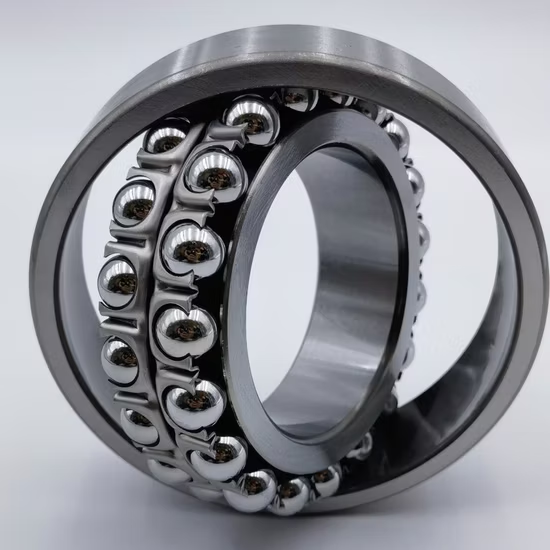

2206 2207 2208 Double Row Self-Aligning Ball Bearing — available in 30 mm, 35 mm, and 40 mm bore sizes with open, rubber seal, or iron shield configurations.
Official App Verification — Every 2206 2207 2208 double row self-aligning ball bearing ships with scannable QR codes linked directly to the manufacturer's authentication database.
| Parameter | Value |
|---|---|
| Designation | 2206 2207 2208 |
| Bearing Type | Double Row Self-Aligning Ball Bearing |
| Bore Diameter (d) | 30 mm (2206), 35 mm (2207), 40 mm (2208) |
| Seal or Shield Type | Open, Rubber Seals, Iron Seals |
| Cage Material | Pressed steel, machined brass, or polyamide variants |
| Clearance Class | CN, C3, C4 options |
| Precision Class | P0, P6, P5 |
| Material | High-carbon chromium bearing steel |
| Origin | Manufacturer's production facilities |
| Industry | Typical Applications |
|---|---|
| Electric motors | Rotor support shafts experiencing minor thermal deflection |
| Agricultural machinery | Conveyor drive rollers in harvesting equipment exposed to crop dust |
| Material handling | Belt conveyor pulley shafts subject to frame misalignment |
Matching the base designation is never enough when internal clearances and cage materials dictate survival in humid, high-load environments.
During my years stationed in Vietnam, I witnessed a catastrophic line stoppage caused by a batch of 2206 bearings. The basic numbers were correct, but the cage material lacked the thermal and moisture resistance required for the local climate, leading to rapid fracture and seizing. Counterfeit bearings with soft inner rings and cloned QR codes easily pass casual visual inspections, causing severe damage once put under load . A 2206 2207 2208 double row self-aligning ball bearing must be verified beyond its outer stamping to ensure the internal geometry and metallurgy actually match the equipment's operational demands.
The spherical outer ring raceway allows the inner ring and ball assembly to swivel, compensating for shaft deflection and housing misalignment. This self-aligning capability reduces edge stresses on the rolling elements, which is critical for long-span conveyor shafts. When executing cross-brand interchange, we strictly verify that the internal curvature and ball complement match the original equipment requirements, rather than just swapping base numbers.
Radial loads combined with minor axial displacement define the typical loading profile for these components. In agricultural and material handling environments, airborne dust and high humidity rapidly degrade standard lubricants. Selecting the correct seal type—whether rubber seals for tight moisture exclusion or iron seals for lower friction at higher speeds—directly impacts the relubrication interval. Operating beyond the thermal limit of standard bearing steel without adjusting the internal clearance leads to destructive preload .
The "22" prefix identifies the wide series double row self-aligning ball bearing, offering a broader contact surface and higher load capacity than the narrow 12 series. The suffixes 06, 07, and 08 correspond to bore diameters of 30 mm, 35 mm, and 40 mm, respectively. Selecting the appropriate cage material is equally vital; pressed steel cages handle standard speeds, while machined brass or polyamide variants are necessary for applications with high vibration or specific temperature thresholds.
Installing a standard CN clearance bearing in an application that demands C3 for thermal expansion results in internal binding and premature fatigue. Similarly, ignoring seal suffixes in dusty environments allows particulate ingress, acting as a grinding paste that destroys the raceway. These misconfigurations lead to unplanned downtime, catastrophic damage to adjacent housing components, and immediate warranty voidance .
We provide authorized coverage across all major brands, allowing a single mixed-brand order to fulfill diverse maintenance needs. Every 2206 2207 2208 double row self-aligning ball bearing undergoes a strict four-point cross-reference check covering base designation, internal clearance, cage material, and seal type. Our batch traceability reaches back to the manufacturer, ensuring you receive exact replacements rather than loosely matched alternatives that fail under peak loads.
To ensure optimal lifecycle performance, please provide your specific radial and axial load profiles, operational speeds, and ambient temperature ranges. Our engineering team will utilize these parameters to conduct a rigorous L10 life calculation and verify the appropriate clearance and seal suffixes. If you are replacing existing units, sharing the exact OEM equipment number allows us to perform a comprehensive cross-reference check.
Q: How do I verify the authenticity of the 2206 2207 2208 bearings upon delivery?
A: Each bearing features a unique QR code that you can scan using the manufacturer's official mobile application. This process instantly validates the batch number, production facility, and material certification, effectively filtering out counterfeits with cloned labels or soft inner rings that bypass standard visual checks.
Q: Why must cross-referencing include clearance and seal suffixes?
A: Matching only the base number often results in installing a standard clearance bearing where a C3 is required for thermal expansion, or an open bearing in a dusty environment. We align the base designation, internal clearance, cage material, and seal type to prevent thermal binding and premature cage failure in the field.
Q: How do I choose between rubber seals, iron seals, and open types?
A: Rubber seals provide superior protection against moisture and fine dust but generate higher friction, limiting maximum speed. Iron seals offer lower friction for higher-speed applications while blocking larger debris. Open types are selected when the housing provides external lubrication and sealing mechanisms.
Q: How does the self-aligning feature affect installation tolerances?
A: The spherical outer raceway accommodates static angular misalignment between the shaft and housing, reducing edge stresses caused by frame deflection. However, it does not compensate for dynamic shaft bending under heavy loads, meaning basic housing alignment must still be maintained during installation.
Q: What information is needed to determine the correct relubrication interval?
A: We require details on the operating temperature, rotational speed, and environmental contamination levels. For open type bearings, this data allows us to calculate the exact grease volume and replenishment schedule, whereas sealed variants are typically lubricated for life and require monitoring for acoustic degradation.
Our 5-step process ensures every order is engineered, validated, and supported for optimal performance.
Technical needs assessment
Custom specifications
Free samples for $50k+
Pre-shipment inspection
On-site & predictive
Our certified engineers respond within 24 hours with detailed technical specifications, pricing, and lead time information.