01
Consultation
Technical needs assessment

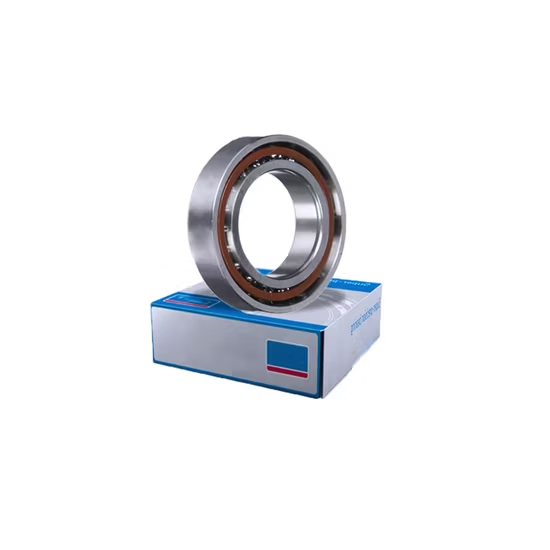
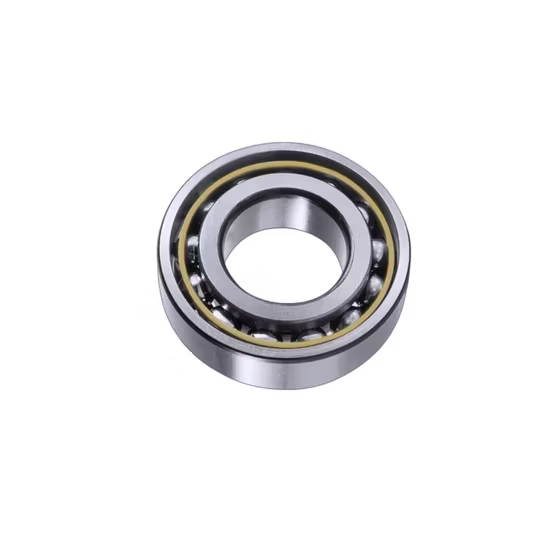
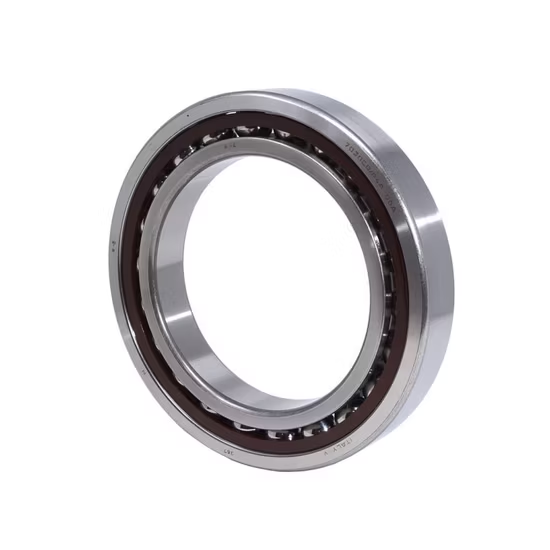
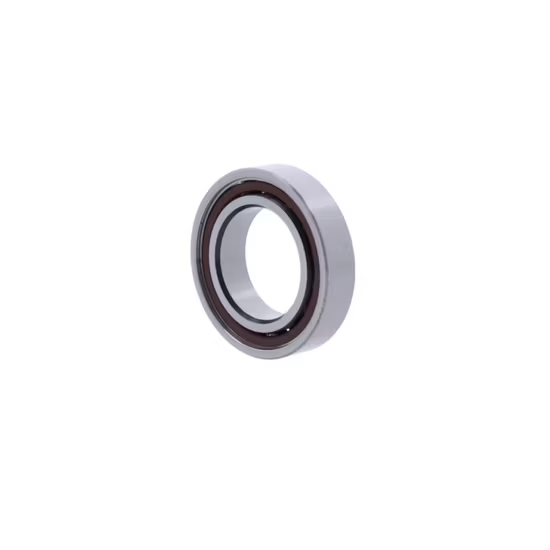
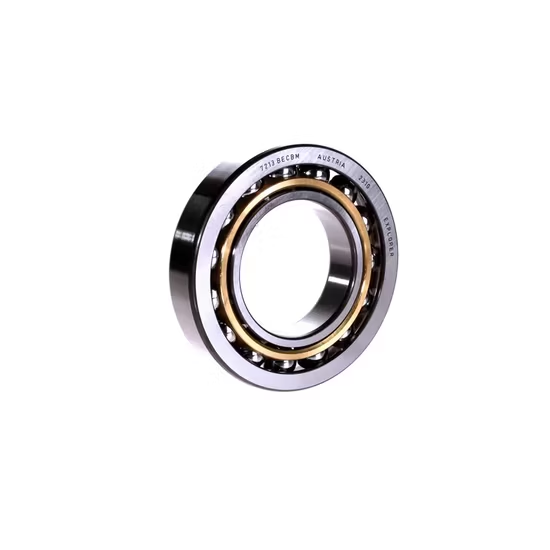
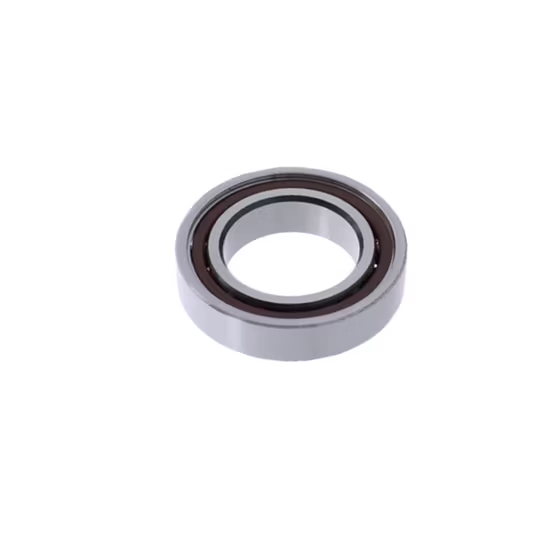
7010 CD/P4a Angular Contact Ball Bearing — featuring 15° contact angle for reduced friction heat at high rpm and P4a precision class delivering strict dimensional and running accuracy for machine tool spindles and precision equipment.
Every shipment includes full documentation package with material test reports and dimensional inspection certificates for complete quality assurance.
Unified Multi-Brand Sourcing — Procure matched sets across global manufacturers through a single authorized channel without juggling multiple vendor accounts.
| Parameter | Value |
|---|---|
| Designation | 7010 CD/P4a |
| Product Type | Angular Contact Ball Bearing |
| Contact Angle | 15° |
| Precision Class | P4a (Class 4 dimensional and running accuracy) |
| Material | Bearing Steel |
| Application | Machine tool spindles, High-speed pumps, Robotics, Precision equipment |
Cross-reference note: The variant 7010 Cdga/P4a includes an unverified suffix requiring manufacturer catalog confirmation before substitution.
| Industry | Typical Applications |
|---|---|
| Machine Tool Manufacturing | High-frequency motorized spindles, precision grinding headstocks |
| Industrial Automation | Multi-axis robotic joint actuators, high-speed pick-and-place arms |
| Fluid Power Systems | High-speed centrifugal pump shaft supports, hydraulic motor assemblies |
A 15° optimized contact angle combined with P4a precision is mandatory for preventing thermal binding in high-speed motorized spindles.
I still remember a catastrophic failure at the Hanover trade fair where a high-speed electric spindle seized completely. The root cause was a 7010 CD/P4a angular contact ball bearing incorrectly substituted with a standard CN clearance variant. As the spindle accelerated, thermal expansion eliminated the internal clearance, leading to total precision loss and surface scoring. This incident reinforced a strict rule: base designations are never enough. Procurement engineers must verify that the exact clearance, cage material, and precision suffixes align perfectly with the spindle's thermal profile to avoid devastating field failures .
Sourcing the correct 7010 CD/P4a angular contact ball bearing requires looking far beyond the basic numerical identifier. Our engineering team reviews every cross-reference request to ensure the internal geometry and tolerance classes match the original equipment manufacturer's exact specifications. We prevent the common trap where a base number matches but the critical precision suffixes differ, safeguarding your spindle's operational integrity and preventing costly thermal binding events.
High-speed spindle environments generate immense friction heat, demanding strict adherence to specified clearance classes. If a standard clearance is installed where thermal expansion requires a specialized internal gap, the rolling elements will skid and overheat. Proper oil-air or oil-jet lubrication is essential to carry away this heat without introducing excessive fluid friction. Furthermore, any contamination from degraded seals will immediately compromise the P4a running accuracy, making strict environmental sealing protocols non-negotiable during assembly .
The "CD" suffix signifies a 15° optimized contact angle design, specifically engineered to minimize friction heat while maintaining axial rigidity at elevated rotational speeds. This geometry is the industry standard for high-frequency motorized spindles where radial loads are secondary to precise axial positioning. The "P4a" designation dictates exceptionally tight dimensional and running accuracy tolerances, ensuring minimal radial and axial runout. This strict tolerance band prevents vibration-induced surface finish defects on machined parts, a critical requirement when the spindle operates continuously at peak RPMs.
Installing a bearing with incorrect internal geometry or relaxed tolerances inevitably leads to unplanned downtime and catastrophic damage to the spindle housing. When running accuracy falls short of P4a standards, the resulting vibration accelerates fatigue in adjacent components, voiding equipment warranties. According to ISO 281 framework principles, operating a precision component outside its designated thermal and load boundaries drastically reduces its calculated L10 life, transforming a minor procurement saving into a massive replacement expense .
We maintain authorized distribution channels across all major international brands, allowing you to consolidate mixed-brand spindle requirements into a single, fully traceable order. Our cross-referencing process strictly aligns the 15° contact angle and P4a precision class, ensuring we never supply a base-match bearing with the wrong internal clearance. Every shipment includes batch traceability to the manufacturer, verified via official brand applications to eliminate the risk of counterfeit components with soft inner rings. We also provide comprehensive application-based selection reviews to confirm the bearing matches your specific speed and thermal conditions.
To ensure precise technical validation, please provide your spindle's operational parameters, including maximum rotational speed, axial and radial loads, and expected thermal growth. Sharing the original equipment manufacturer's part number allows our engineers to perform a rigorous cross-reference check against the 7010 CD/P4a angular contact ball bearing specifications. This data enables us to confirm the exact clearance and precision requirements, ensuring the proposed solution perfectly matches your high-speed application.
Q: Why must clearance and precision suffixes be verified during cross-referencing?
A: Matching only the base designation often overlooks critical internal geometry. A standard clearance bearing installed in a high-speed spindle will thermally bind as the inner ring expands. Verifying the exact P4a precision and specific clearance suffixes ensures the bearing accommodates thermal growth without losing rotational accuracy or causing catastrophic seizure.
Q: How do we verify the authenticity of the supplied precision bearings?
A: We provide complete batch traceability documentation that links directly to the manufacturer. You can verify the authenticity by scanning the QR codes on the packaging using the brand's official mobile application. This process instantly identifies cloned codes commonly found on counterfeit bearings with substandard metallurgical properties.
Q: What is the operational difference between P4a and standard P4 precision?
A: The P4a classification enforces significantly tighter constraints on running accuracy and dimensional tolerances compared to standard P4 or ABEC 7 grades. This enhanced precision minimizes axial and radial runout, which is absolutely critical for maintaining surface finish quality and preventing vibration in high-frequency machine tool spindles.
Q: How does the CD suffix influence high-speed spindle performance?
A: The CD suffix designates a 15° optimized contact angle. This specific geometry reduces friction heat generation during high-speed rotation while maintaining sufficient axial rigidity. It is the preferred configuration for motorized spindles where thermal management and precise axial positioning are paramount to machining accuracy.
Our 5-step process ensures every order is engineered, validated, and supported for optimal performance.
Technical needs assessment
Custom specifications
Free samples for $50k+
Pre-shipment inspection
On-site & predictive
Our certified engineers respond within 24 hours with detailed technical specifications, pricing, and lead time information.


