01
Consultation
Technical needs assessment


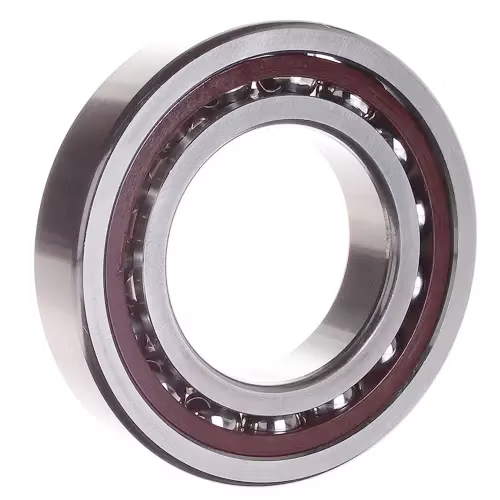
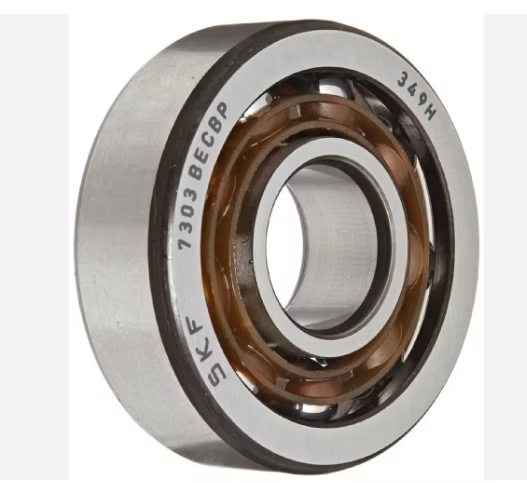
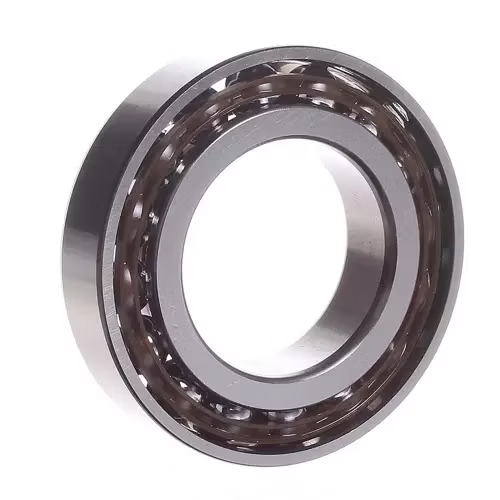
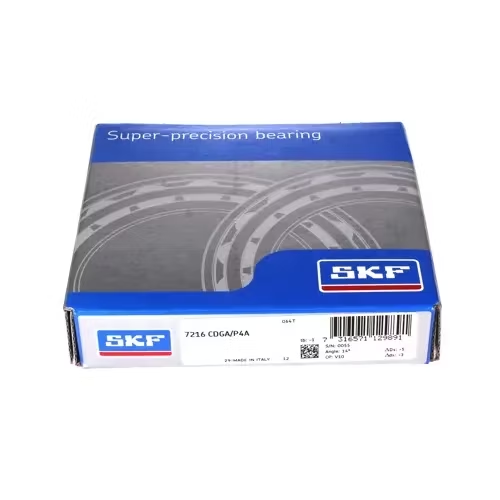
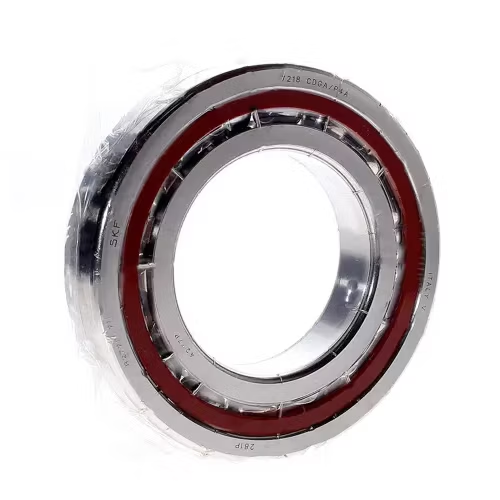
71904 CD/P4a Angular Contact Ball Bearing
Traceable Batch Origins — Every 71904 CD/P4a angular contact ball bearing ships with manufacturer lot documentation for full supply chain visibility.
| Parameter | Value |
|---|---|
| Designation | 71904 CD/P4a |
| Bearing Type | Angular Contact Ball Bearing |
| Bore Diameter (d) | 20 mm |
| Outside Diameter (D) | 37 mm |
| Width (B) | 9 mm |
| Contact Angle | 15° |
| Precision Class | P4a |
| Material | Bearing Steel |
| Seal or Shield Type | Open |
| Origin | Germany / Japan / Sweden / Malaysia / China |
| Industry | Typical Applications |
|---|---|
| Machine Tool Manufacturing | High-speed motorized spindles for CNC milling and grinding |
| Precision Engineering | Rotary tables and high-accuracy indexing heads |
| Robotics | High-speed robotic arm joints and precision actuators |
Matching the base designation without verifying the precision suffix is the fastest way to ruin a精密 spindle.
Procurement teams often approve replacements based solely on the 71904 prefix, overlooking the critical CD and P4a suffixes. When a standard precision bearing is forced into a high-speed spindle, the internal clearances and running accuracy fail to handle the thermal expansion, leading to rapid temperature spikes and severe vibration . I have personally inspected spindle teardowns where a visually identical but lower-grade bearing caused catastrophic shaft runout within weeks. Securing a genuine 71904 CD/P4a angular contact ball bearing ensures the dimensional tolerances strictly align with the original equipment manufacturer's thermal and dynamic requirements.
Sourcing the correct 71904 CD/P4a angular contact ball bearing requires looking past the basic dimensions to evaluate the actual running accuracy. Our technical review process cross-references the specific P4a tolerance class against your spindle's maximum operating speed and expected thermal growth. By verifying the exact suffix combination, we ensure the bearing's internal geometry supports the rigorous demands of continuous high-speed milling without compromising surface finish quality.
High-speed spindle operations generate immense centrifugal forces and friction heat, which directly impact the internal clearance of the bearing. As the shaft expands thermally, an open bearing configuration allows for precise external oil-air or oil-jet lubrication to manage the heat dissipation effectively. The 15° contact angle is specifically engineered to minimize friction torque while maintaining axial rigidity, preventing the excessive preload buildup that typically causes cage failure in high-RPM environments .
The CD suffix designates a 15° optimized contact angle, which generates considerably less friction heat than higher-angle variants during sustained high-speed rotation. This specific geometry balances axial stiffness with the need for low operating temperatures in motorized spindles. Meanwhile, the P4a precision class dictates exceptionally tight dimensional and running accuracy limits, far exceeding standard P5 or P4 grades. This strict tolerance ensures minimal radial and axial runout, which is absolutely non-negotiable for achieving mirror finishes in precision grinding applications.
Installing a bearing that matches the base number but lacks the P4a precision rating inevitably leads to unplanned downtime and scrapped workpieces. The slight deviations in running accuracy cause uneven load distribution across the rolling elements, accelerating fatigue and resulting in premature failure . Furthermore, substituting the 15° contact angle with a 25° variant alters the axial stiffness profile, potentially voiding the machine tool warranty and causing catastrophic damage to the spindle housing during heavy cutting operations.
We eliminate the risk of receiving counterfeits with soft inner rings by supplying only authorized inventory with strict cross-reference alignment. For the 71904 CD/P4a angular contact ball bearing, we specifically verify that the P4a precision and 15° contact angle suffixes match perfectly, rather than just supplying a generic 71904. Our mixed-brand authorization allows us to fulfill complex MRO requirements in a single shipment while providing full batch traceability. Every unit undergoes a technical selection review to confirm the suffix combination suits your specific speed and load parameters.
To ensure optimal spindle performance, please provide your specific radial and axial load profiles, maximum operating speeds, and expected thermal gradients. Supplying the original equipment manufacturer's part number allows our engineering team to perform a comprehensive cross-reference check and L10 life calculation. This technical validation guarantees the selected configuration perfectly matches your application's dynamic requirements.
Q: Why must cross-referencing match the precision suffixes rather than just the base number?
A: The base number only defines the physical dimensions. The P4a suffix guarantees the strict running accuracy required for high-speed spindles. Installing a standard precision bearing in a precision spindle causes excessive vibration, thermal binding, and premature failure due to inadequate tolerance control.
Q: What is the difference between standard P4 and P4a precision classes?
A: While both fall under the high-precision category, P4a specifies even tighter limits on running accuracy and dimensional tolerances compared to standard P4. This enhanced precision is critical for minimizing runout and ensuring superior surface finishes in high-speed machine tool applications.
Q: How does the 15° contact angle benefit high-speed spindles compared to 25° variants?
A: The 15° contact angle generates considerably less friction heat and offers lower axial stiffness than 25° variants. This reduced friction is essential for high-speed operations, preventing excessive temperature buildup and maintaining stable preload conditions within the spindle assembly.
Q: What documentation is provided to guarantee authenticity and batch traceability?
A: We provide a Certificate of Conformity, manufacturer batch traceability records, and dimensional inspection reports. Buyers can also verify the authenticity of the bearing directly through the official brand application using the provided QR codes.
Our 5-step process ensures every order is engineered, validated, and supported for optimal performance.
Technical needs assessment
Custom specifications
Free samples for $50k+
Pre-shipment inspection
On-site & predictive
Our certified engineers respond within 24 hours with detailed technical specifications, pricing, and lead time information.
![708 CD/P4a Angular Contact Ball Bearing High Speed Super Precision [WARN] draft identifier mismatch](https://skfiso.com/wp-content/uploads/2026/09/708-cd-p4a-angular-contact-ball-bearing-high-speed-super-precision-warn-draft-identifier-mismatch-e33b16.avif)
![7201 Becbp Angular Contact Ball Bearing High Speed Precision NSK Timken [WARN] draft identifier mismatch](https://skfiso.com/wp-content/uploads/2026/09/7201-becbp-angular-contact-ball-bearing-high-speed-precision-nsk-timken-warn-draft-identifier-mismatch-c9f392.avif)