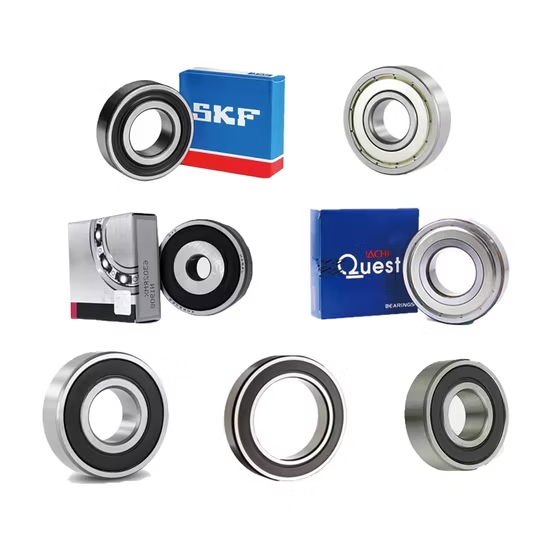
01
Consultation
Technical needs assessment

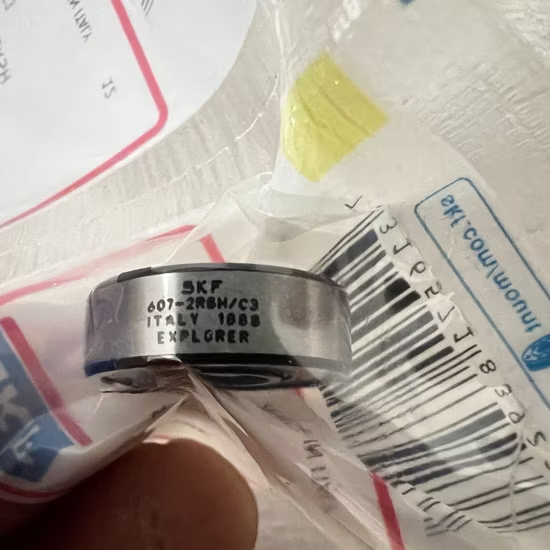


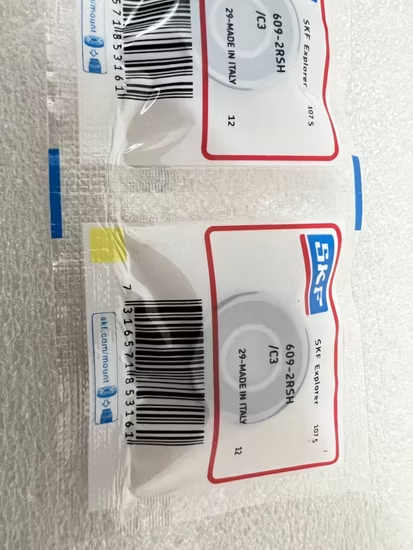
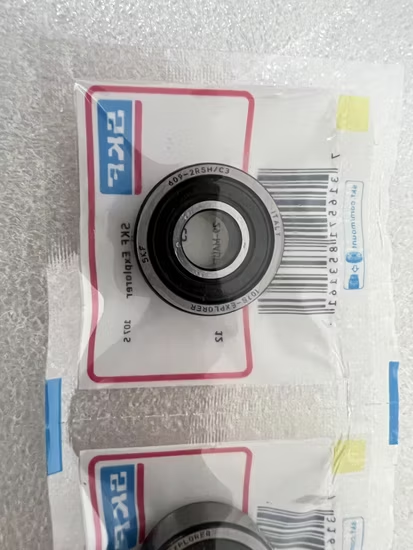

600/601/602/603/604/605/606/607/608/609 Deep Groove Ball Bearing series delivers flexible sealing options for miniature motors and precision instruments.
Cross-Reference Alignment Verified — Matching base numbers alongside exact clearance, cage, and seal suffixes prevents thermal binding in mini motors.
| Parameter | Value |
|---|---|
| Designation | 600/601/602/603/604/605/606/607/608/609 |
| Bearing Type | Deep Groove Ball Bearing |
| Seal or Shield Type | Open, 2RS (Rubber Seals), ZZ (Iron Seals) |
| Quality Level | Z1V1, Z2V2, Z3V3, Z4V4 |
| Feature | Low Noise, High Speed, Long Service Life |
| Origin | Germany, Japan, Sweden, Malaysia, China |
| HS Code | 848210 |
| Industry | Typical Applications |
|---|---|
| Electric Motors | High-speed rotor shafts, cooling fan assemblies, stator end-bell supports |
| Household Appliances | Washing machine drum pulleys, blender motor shafts, HVAC blower wheels |
| Precision Instruments | Optical encoder spindles, laboratory centrifuge drives, robotics joints |
| Small Machinery | Conveyor guide rollers, small pump impeller shafts, office equipment gears |
A standard 600 series 2RS ZZ deep groove ball bearing might look identical to the original equipment part, but ignoring internal clearance and seal friction specs leads to rapid thermal binding.
During my years supplying motor配套 in Dongguan, I witnessed countless production lines halt because a standard CN clearance was installed where a C3 was strictly required for thermal expansion. The base designation matched perfectly, yet the inner ring expanded under high-speed heat, eliminating the internal clearance and causing the bearing to seize. Relying solely on the basic model number without verifying the exact suffix combination is a frequent cause of premature cage failure in compact electric motors .
Selecting the correct 600 series 2RS ZZ deep groove ball bearing requires balancing contamination protection against rotational friction. Our technical review process ensures that the chosen seal type and Z/V noise grade align perfectly with the specific acoustic and environmental demands of your electric motor or precision appliance, preventing warranty claims caused by acoustic failures or dust ingress.
In compact motor applications, high rotational speeds generate significant internal heat. If a contact rubber seal (2RS) is used in an environment exceeding its thermal limit, the lip friction accelerates wear and degrades the grease. Conversely, non-contact iron shields (ZZ) offer lower friction for higher speeds but provide less protection against fine moisture. Understanding the exact operating temperature and contamination level dictates whether the slight friction penalty of a rubber seal is justified over the higher speed capability of a steel shield .
The Z1V1 through Z4V4 quality levels indicate strict acoustic and vibration inspection grades, crucial for household appliances and precision instruments where operational noise is a primary quality metric. Furthermore, the distinction between 2RS and ZZ suffixes is not merely cosmetic; it defines the friction profile and maintenance interval. While the base 600-609 series shares a deep groove geometry optimized for radial loads and moderate axial thrust, the specific seal configuration and internal clearance class must be explicitly matched to the motor's thermal expansion characteristics to avoid catastrophic locking.
Installing a miniature bearing with incorrect internal clearance or mismatched seal friction results in unplanned downtime and catastrophic damage to the surrounding motor windings. When thermal binding occurs, the sudden spike in friction can melt the lubricant and destroy the cage, often voiding the equipment manufacturer's warranty. Adhering to ISO 281 guidelines for dynamic load and life calculations requires accurate input data, which is impossible if the substituted bearing lacks the precise internal geometry of the original specification .
Sourcing the 600 series 2RS ZZ deep groove ball bearing through our authorized channels eliminates the risk of receiving counterfeits with soft inner rings that fail under minimal load. We verify cross-references by checking the exact clearance and seal suffixes, not just the base 60x number, ensuring thermal compatibility. Every shipment includes batch traceability and QR verification via official brand apps, providing absolute confidence in the metallurgical integrity and dimensional accuracy of the miniature components.
To ensure optimal performance, please provide your motor's specific radial and axial loads, maximum operating temperature, and target RPM. Sharing the exact OEM equipment number allows our engineering team to perform a comprehensive cross-reference check, verifying that the internal clearance and seal friction match your application's thermal dynamics.
Q: How do I choose between 2RS rubber seals and ZZ iron shields for mini bearings?
A: Choose 2RS rubber seals when the motor operates in dusty or moist environments and requires maximum contamination protection, accepting slightly higher friction. Select ZZ iron shields for clean, high-speed applications where minimizing rotational friction and heat generation is the primary objective for the miniature bearing.
Q: What do Z1V1 to Z4V4 quality levels mean for motor noise?
A: These designations represent increasingly strict acoustic and vibration inspection grades. Z1V1 is standard for general industrial motors, while Z4V4 indicates ultra-low noise and vibration, which is mandatory for precision instruments, medical devices, and high-end household appliances where operational silence is critical.
Q: Why must clearance suffixes be matched during cross-brand interchange?
A: Base numbers often match across brands, but internal clearance dictates thermal expansion limits. Installing a standard CN clearance in a high-speed motor that requires C3 will cause the inner ring to expand and eliminate internal play, leading to thermal binding, excessive heat, and premature catastrophic failure of the miniature bearing.
Q: How can I verify the authenticity of imported 600-series bearings?
A: Always procure through authorized distributors and demand batch traceability documentation. You can verify authenticity by scanning the QR codes on the packaging using the official mobile apps provided by the bearing manufacturers, ensuring the internal components meet original metallurgical specifications.
Our 5-step process ensures every order is engineered, validated, and supported for optimal performance.
Technical needs assessment
Custom specifications
Free samples for $50k+
Pre-shipment inspection
On-site & predictive
Our certified engineers respond within 24 hours with detailed technical specifications, pricing, and lead time information.