01
Consultation
Technical needs assessment
![90364-33009 dB503303c Needle Roller Bearing Genuine Authorized [WARN] draft identifier mismatch - 1](https://skfiso.com/wp-content/uploads/2026/09/90364-33009-db503303c-needle-roller-bearing-genuine-authorized-warn-draft-identifier-mismatch-dc5fb1.avif)
![90364-33009 dB503303c Needle Roller Bearing Genuine Authorized [WARN] draft identifier mismatch - 2](https://skfiso.com/wp-content/uploads/2026/09/90364-33009-db503303c-needle-roller-bearing-genuine-authorized-warn-draft-identifier-mismatch-fbe9f9.avif)
![90364-33009 dB503303c Needle Roller Bearing Genuine Authorized [WARN] draft identifier mismatch - 3](https://skfiso.com/wp-content/uploads/2026/09/90364-33009-db503303c-needle-roller-bearing-genuine-authorized-warn-draft-identifier-mismatch-09d00c.avif)
![90364-33009 dB503303c Needle Roller Bearing Genuine Authorized [WARN] draft identifier mismatch - 4](https://skfiso.com/wp-content/uploads/2026/09/90364-33009-db503303c-needle-roller-bearing-genuine-authorized-warn-draft-identifier-mismatch-a96916.avif)
![90364-33009 dB503303c Needle Roller Bearing Genuine Authorized [WARN] draft identifier mismatch - 5](https://skfiso.com/wp-content/uploads/2026/09/90364-33009-db503303c-needle-roller-bearing-genuine-authorized-warn-draft-identifier-mismatch-44a563.avif)
![90364-33009 dB503303c Needle Roller Bearing Genuine Authorized [WARN] draft identifier mismatch - 6](https://skfiso.com/wp-content/uploads/2026/09/90364-33009-db503303c-needle-roller-bearing-genuine-authorized-warn-draft-identifier-mismatch-e3ffea.avif)
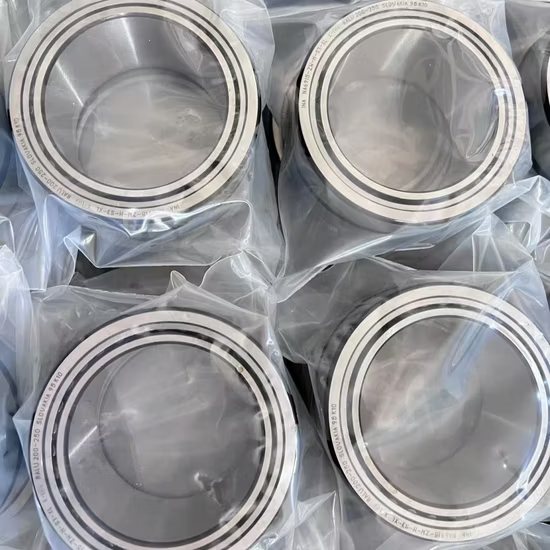
90364-33009 dB503303c Needle Roller Bearing — engineered for radial loads in engineering machinery and automotive transmissions.
Full Batch Traceability — Every 90364-33009 dB503303c needle roller bearing ships with verifiable manufacturer lot documentation to guarantee origin authenticity.
| Parameter | Value |
|---|---|
| Designation | 90364-33009 dB503303c |
| Bearing Type | Needle Roller Bearing |
| Load Direction | Radial |
| Material | Bearing Steel |
| Type | Open |
| Precision Class | P0, P5, P6 |
| Style Options | Without Outer Ring, With Outer Ring, Without Inner Ring, With Inner Ring |
| Origin | Germany, Japan, Sweden, Malaysia, China |
Note: 90364-33009 and dB503303c are unverified suffixes requiring manufacturer catalog confirmation.
| Industry | Typical Applications |
|---|---|
| Engineering Machinery | Hydraulic pump shafts, pivot joints in excavator booms |
| Automotive Transmissions | Steering column universals, manual transmission mainshafts |
| Industrial Gearboxes | Planetary gear sets, high-torque reduction shafts |
Ignoring internal design suffixes during cross-referencing is the primary cause of premature cage fracture in high-speed needle applications.
I once sourced a batch of 90364-33009 equivalents based solely on the base designation, overlooking the specific cage material and clearance suffixes. The result was catastrophic: the cages shattered under high-RPM thermal expansion, causing severe secondary damage to the transmission housings. A significant share of premature failures in compact radial spaces stems from this exact cross-reference error, where visual similarity masks critical internal design mismatches .
Selecting the correct structural variant ensures the 90364-33009 dB503303c needle roller bearing performs reliably within tight radial envelopes. We map the exact OEM equipment number to verify whether the application demands a drawn cup, a solid outer ring, or a cage-and-roller assembly without an inner ring. This precise alignment prevents the shaft from acting as an inadequate raceway, thereby protecting the host machinery from accelerated wear.
Needle rollers excel at handling heavy radial loads in restricted cross-sections, but this compact geometry leaves minimal room for thermal expansion. When operating temperatures rise, inadequate internal clearance causes the rollers to bind against the raceways, generating excessive friction and rapid lubricant degradation . Furthermore, open-type designs require meticulous external lubrication management to prevent contaminant ingress, making the choice of oil versus grease critical for maintaining the elastohydrodynamic film thickness under continuous heavy loads.
The availability of multiple structural options—ranging from assemblies without inner rings to those with solid outer rings—dictates how the bearing interacts with the shaft and housing. When an inner ring is omitted, the shaft surface must be hardened and ground to precise tolerances to serve as the inner raceway; otherwise, the soft shaft material will quickly spall under the high contact stress of the needle profiles. The bearing steel construction provides the necessary core toughness and surface hardness to resist brinelling under shock loads, while the open design facilitates direct oil flow for cooling in high-speed gearbox applications.
Failing to verify the exact suffix combination often results in unplanned downtime that far exceeds the initial component cost. If a standard clearance is installed where an expanded clearance was required for a hot-running gearbox, the resulting thermal binding can destroy the cage and score the shaft. Such catastrophic damage voids equipment warranties and necessitates complete assembly replacements, turning a minor maintenance task into a major operational disruption .
We do not simply match base numbers; we dissect the application requirements to ensure the internal geometry aligns with your operating environment. For complex OEM part numbers, we verify the cross-reference against multiple authorized brand catalogs to confirm the cage design and clearance class. Every shipment includes batch traceability, allowing your quality team to verify the origin through official brand applications. This rigorous technical vetting eliminates the risk of receiving counterfeit components with soft inner rings that pass casual visual inspections but fail under load.
To facilitate an accurate selection and L10 life calculation, please provide the specific radial loads, operating speeds, and maximum ambient temperatures. If you are replacing an existing component, sharing the exact OEM equipment number allows our engineering team to perform a comprehensive cross-reference verification. Detailing the housing material and lubrication method ensures we recommend the optimal structural variant and clearance class for your application.
Q: How do I verify the cross-reference for the 90364-33009 OEM part number?
A: The 90364-33009 designation is often an original equipment manufacturer part number rather than a standard catalog number. We cross-reference this against authorized bearing brand databases to identify the exact equivalent, ensuring that critical internal features like cage material, roller profile, and clearance class perfectly match the original equipment specifications before quoting.
Q: When should I choose a needle roller bearing without an inner ring?
A: Assemblies without an inner ring are ideal when the shaft itself can be hardened and ground to serve as the raceway, saving weight and radial space. However, if the shaft is soft or cannot be machined to the required surface finish and hardness, you must select a variant with an inner ring to prevent premature spalling and shaft damage.
Q: How can I confirm the authenticity of the delivered bearings?
A: Every bearing we supply features batch traceability and QR codes that can be scanned using the respective manufacturer's official mobile application. This digital verification confirms the production facility, manufacturing date, and material batch, effectively eliminating the risk of installing counterfeits with compromised metallurgical properties.
Q: What causes cage failure in high-speed needle roller applications?
A: Cage failure in high-speed environments typically results from inadequate lubrication, excessive thermal expansion due to incorrect internal clearance, or severe misalignment. Ensuring the correct clearance class is selected for the operating temperature range, combined with a consistent supply of clean lubricant, is essential to maintain cage stability and prevent catastrophic fracture.
Q: What are the mounting requirements for open-type needle roller bearings?
A: Open-type bearings rely entirely on the housing for lubrication and contamination protection. Before mounting, the housing must be thoroughly cleaned and pre-lubricated. During installation, care must be taken to avoid damaging the exposed needle rollers, and the external sealing system must be verified to prevent abrasive particles from entering the rolling contact zone.
Our 5-step process ensures every order is engineered, validated, and supported for optimal performance.
Technical needs assessment
Custom specifications
Free samples for $50k+
Pre-shipment inspection
On-site & predictive
Our certified engineers respond within 24 hours with detailed technical specifications, pricing, and lead time information.