01
Consultation
Technical needs assessment



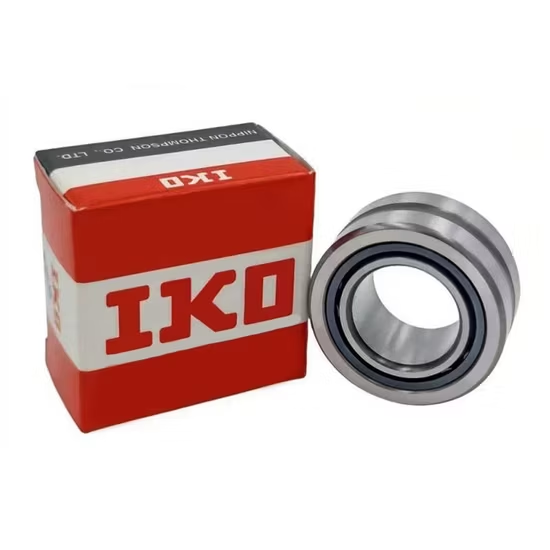

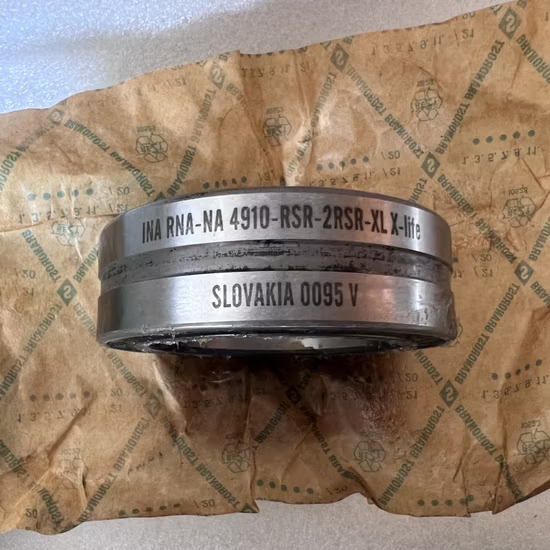
K20X26X12 Needle Roller and Cage Assembly 20×26×12 mm — engineered without inner or outer rings for compact radial applications.
Traceable Batch Origins — Every K20X26X12 assembly ships with manufacturer lot documentation verifying the exact production run and material heat number.
| Parameter | Value |
|---|---|
| Designation | K20X26X12 |
| Bearing Type | Needle Roller and Cage Assembly |
| Bore Diameter (Fw) | 20 mm |
| Outside Diameter (Ew) | 26 mm |
| Width (Bc) | 12 mm |
| Load Direction | Radial |
| Cage Material | Pressed steel or machined brass options |
| Seal or Shield Type | Open |
| Material | High-carbon bearing steel |
| Origin | Germany / Japan / Sweden / Malaysia / China |
| Industry | Typical Applications |
|---|---|
| Automotive | Transmission shafts and rocker arm pivots |
| Industrial Machinery | Planetary gear sets in heavy-duty gearboxes |
| Electric Motors | Rotor shaft support in compact motor designs |
| Agricultural | PTO driveline joints and harvester conveyor rollers |
Matching the 20x26x12 dimensions is only the first step; ignoring cage material and clearance specifications invites rapid fragmentation under cyclic shock loads.
In planetary gearboxes where vibration is constant, specifying a standard pressed steel cage instead of a machined brass alternative often leads to catastrophic cage fragmentation. I have seen assembly lines halt because cage debris jammed the gear mesh, turning a simple replacement into a complete gearbox rebuild. Procurement teams frequently cross-reference the base K20X26X12 needle roller bearing designation but overlook the internal design variations required for these harsh environments .
Sourcing the correct K20X26X12 needle roller bearing requires looking past the basic envelope dimensions to evaluate how the assembly interacts with the shaft and housing. Our technical team reviews your specific radial loads and operating speeds to ensure the selected cage design and roller profile match the actual mechanical stress, preventing premature wear in compact transmission layouts.
The open design of this assembly relies entirely on the host equipment’s oil bath or circulating system for lubrication and heat dissipation. In high-speed electric motors or automotive transmissions, inadequate oil flow leads to localized thermal spikes that degrade the lubricant film. Furthermore, tight housing envelopes restrict thermal expansion, meaning any misalignment during installation quickly translates into edge loading on the needle rollers .
The "K" prefix identifies this component as a self-contained needle roller and cage assembly, meaning it operates directly on a hardened shaft journal and within a hardened housing bore without dedicated inner or outer rings. This design maximizes the radial load capacity within the restricted 20x26x12 mm cross-section by utilizing the maximum number of rollers. The high-carbon bearing steel construction provides the necessary fatigue strength to withstand continuous radial loading, while the open configuration ensures unrestricted lubricant flow to the roller-cage contact zones.
Substituting a pressed steel cage for a machined brass variant in high-vibration applications triggers a cascade of mechanical failures. The fragmented cage debris contaminates the gearbox oil, accelerating wear on adjacent gears and bearings. This results in unplanned downtime and voids equipment warranties, as the root cause is easily identifiable during post-failure teardowns .
We maintain authorized distribution channels across major international brands, ensuring every K20X26X12 needle roller bearing is genuine and fully traceable. Our cross-reference process verifies not just the 20x26x12 base dimensions, but also aligns the cage material and precision grade with your specific application requirements. We provide comprehensive application-based selection reviews, preventing the common error of installing standard clearance assemblies in high-temperature gearboxes where thermal expansion demands specific internal clearances.
To ensure optimal performance, please provide your specific radial load profiles, operating speeds, and continuous temperature ranges for a comprehensive L10 life calculation. Sharing the OEM equipment designation allows our engineering team to perform a precise cross-reference check, verifying that the selected cage material and internal geometry perfectly match the original equipment manufacturer's specifications.
Q: How do I verify the authenticity of the K20X26X12 assembly using official traceability tools?
A: Every genuine assembly features a specific batch code or QR identifier applied by the manufacturer. By scanning this code using the brand's official mobile application, you can instantly verify the production facility, manufacturing date, and original distribution channel, ensuring the bearing steel meets exact metallurgical standards and protecting your equipment from counterfeit components.
Q: Why must cross-referencing include cage material and not just the base K20X26X12 designation?
A: The base designation only defines the 20x26x12 mm envelope dimensions. In high-vibration gearboxes, a standard pressed steel cage may fragment under cyclic shock loads, whereas a machined brass alternative provides the necessary structural integrity. Cross-referencing the cage material ensures the assembly survives the specific dynamic stresses of your application without causing secondary gear damage.
Q: What are the housing bore preparation requirements for this needle roller and cage assembly?
A: Because the K series lacks an outer ring, the housing bore itself acts as the outer raceway. The bore must be machined to precise dimensional tolerances and hardened to an adequate depth to resist indentation. Furthermore, the surface finish must be smooth enough to prevent accelerated wear on the needle rollers while retaining sufficient oil film during operation.
Q: How should I manage lubrication for this open-type needle bearing in a circulating oil system?
A: The open design requires the host equipment to supply a continuous flow of clean, filtered oil directly to the roller-cage contact zones. You must ensure the oil viscosity matches the operating temperature and speed, and that the filtration system removes particulate matter that could otherwise become trapped between the needle rollers and the cage, causing premature abrasive wear.
Q: What causes premature cage failure in compact radial applications like this 20x26x12 assembly?
A: Premature cage failure typically stems from inadequate lubrication, excessive vibration, or misalignment during installation. In compact assemblies, the cage pockets experience high sliding friction. If the oil film breaks down due to thermal spikes or contamination, the cage material degrades rapidly, leading to fragmentation and subsequent jamming of the entire gear or shaft mechanism.
Our 5-step process ensures every order is engineered, validated, and supported for optimal performance.
Technical needs assessment
Custom specifications
Free samples for $50k+
Pre-shipment inspection
On-site & predictive
Our certified engineers respond within 24 hours with detailed technical specifications, pricing, and lead time information.