01
Consultation
Technical needs assessment

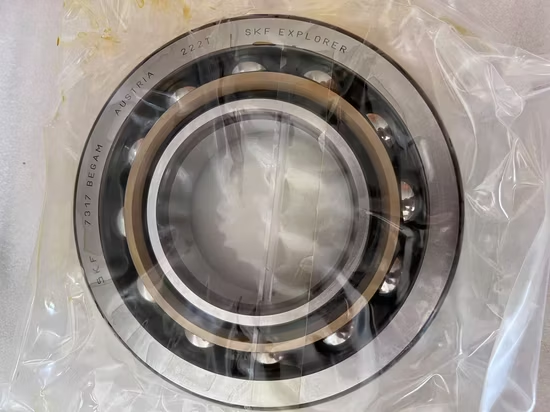
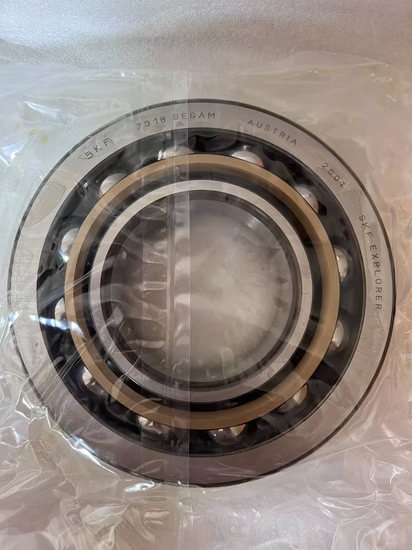
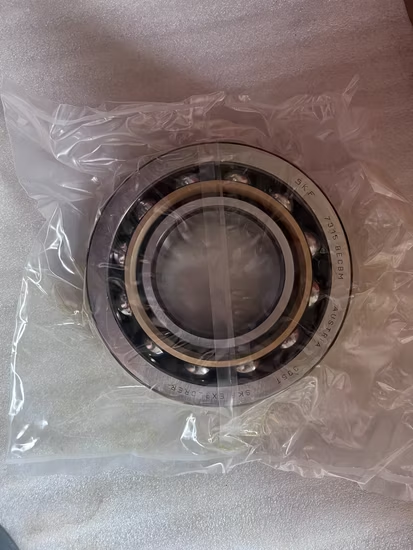


7206 7207 7208 7209 7210 Angular Contact Ball Bearings feature bearing steel construction for reliable combined radial and axial load support. Multiple vibration grades from Z1V1 to Z3V3 are available to match specific dynamic and acoustic requirements in high-speed spindles and gearboxes.
Multi-Brand Authorized Coverage — Procure mixed-brand batches of 7206 7207 7208 7209 7210 angular contact ball bearing units under a single purchase order with unified batch traceability.
| Parameter | Value |
|---|---|
| Designation | 7206 7207 7208 7209 7210 |
| Bearing Type | Angular Contact Ball Bearing |
| Number of Rows | Single |
| Load Direction | Combined Radial and Axial |
| Material | Bearing Steel |
| Cage Material | Machined Brass, Pressed Steel, or Polyamide |
| Contact Angle | 15° (C), 25° (AC), or 40° (B) |
| Vibration Grade | Z1V1, Z2V2, Z3V3 |
| Precision Class | P0, P6, P5, P4 |
| Clearance Class | CN, C2, C3, C4 |
| Seal or Shield Type | Open, Shielded (ZZ), or Sealed (2RS) |
| Origin | Germany / Japan / Sweden / Malaysia / China |
| HS Code | 8482102000 |
| Industry | Typical Applications |
|---|---|
| Machine Tools | High-speed spindle front and rear support nodes |
| Industrial Pumps | High-speed impeller shaft axial thrust compensation |
| Robotics | Joint actuators requiring precise rotational positioning |
| Electric Motors | High-RPM rotor shaft support with axial positioning |
Matching the base designation without verifying the precision grade and internal clearance is a primary cause of thermal binding in precision spindles.
In my years transitioning from quality inspection to industrial trading here in Shenzhen, I have dismantled countless failed assemblies where the 7206 7207 7208 7209 7210 angular contact ball bearing matched the OEM part number perfectly, yet the machine seized within weeks. The root cause is almost always a cross-reference error. Distributors often supply a standard P0 precision grade with CN clearance when the spindle manufacturer explicitly designed the housing for P4 precision and C3 clearance to accommodate thermal expansion at high RPMs . When the internal clearance is too tight for the operating temperature, the rolling elements skid, generating excessive friction heat that ultimately welds the cage to the inner ring.
Selecting the correct 7206 7207 7208 7209 7210 angular contact ball bearing requires looking far beyond the basic dimension series. For machine tool spindles and high-speed pumps, the interaction between the precision class and the internal clearance dictates the operational lifespan. We provide comprehensive cross-brand interchangeability that strictly aligns the base number with the required precision suffix and clearance class, ensuring the bearing performs exactly as the equipment designer intended under dynamic thermal loads.
High-speed applications generate substantial centrifugal forces and friction heat, which directly impact the internal geometry of the bearing. As temperatures rise, the inner ring expands faster than the outer ring, effectively reducing the internal clearance. If the initial clearance is not appropriately specified, this thermal growth leads to excessive preload, causing catastrophic cage failure. Furthermore, high rotational speeds demand careful consideration of the cage material and vibration grade, where a Z3V3 rating ensures minimal dynamic imbalance and reduced acoustic emissions in precision equipment .
The 7200 series is engineered specifically to handle combined radial and axial loads, with the axial capacity determined by the contact angle. A 15° contact angle (C suffix) is optimal for ultra-high-speed spindles where radial rigidity is paramount, while a 40° contact angle (B suffix) provides maximum axial thrust capacity for heavy-duty pump applications. The cage material must also be matched to the speed and load profile: machined brass cages offer superior durability under heavy loads and high vibration, whereas polyamide cages provide lower friction and quieter operation for high-speed, light-load electric motors.
Overlooking critical suffixes during procurement leads to severe operational consequences that extend far beyond the cost of a replacement part. Installing a standard clearance bearing in a high-temperature environment results in unplanned downtime, premature failure of adjacent shaft components, and catastrophic damage to the spindle housing. According to failure mode classifications, a significant share of these premature seizures is directly traceable to incorrect internal clearance selection rather than material fatigue . This misalignment voids equipment warranties and halts production lines indefinitely.
Our procurement process eliminates the risks associated with superficial cross-referencing. We verify that the contact angle, cage material, and precision grade of the replacement exactly match the original equipment requirements, preventing the common error of substituting a 25° angle for a 15° application. Every batch is traceable to the manufacturer, ensuring you receive genuine components with verified metallurgical properties rather than counterfeits with soft inner rings. We also review your specific application parameters to confirm that the selected vibration grade and clearance class will withstand your operational thermal profile.
To ensure optimal performance and longevity, please provide your specific operational parameters, including radial and axial loads, maximum operating speeds, and expected thermal gradients. Supplying the OEM equipment designation or the exact dimensional constraints allows our engineering team to perform a comprehensive cross-reference check and L10 life calculation. This technical review guarantees that the selected configuration perfectly aligns with your application's dynamic requirements.
Q: How do we ensure correct clearance and precision matching during cross-brand interchange?
A: We do not rely solely on the base designation. Our technical team cross-references the exact precision class, contact angle, and internal clearance suffixes to ensure the replacement matches the OEM specifications. This prevents the common failure of installing standard clearance bearings in high-speed spindles that require C3 clearance for thermal expansion compensation.
Q: What is the most reliable method to detect counterfeit angular contact bearings?
A: Visual inspection is insufficient against modern counterfeits with cloned QR codes and soft inner rings. We mandate official brand app QR verification and provide comprehensive batch traceability documentation. Additionally, our dimensional and running accuracy inspection reports confirm the bearings meet genuine manufacturer tolerances before they are shipped to your facility.
Q: How should we choose between Z1V1 and Z3V3 vibration grades for precision equipment?
A: The Z3V3 grade indicates the lowest vibration and noise levels, making it essential for high-speed machine tool spindles and precision robotics where acoustic emissions and dynamic imbalance must be minimized. The Z1V1 grade is generally sufficient for standard industrial gearboxes and heavy-duty pumps where extreme rotational smoothness is not the primary operational constraint.
Q: What is the functional difference between standard CN and C3 clearance in these applications?
A: Standard CN clearance is suitable for normal operating temperatures and speeds. C3 clearance provides greater internal space to accommodate the thermal expansion of the inner ring during high-speed operation. Using CN clearance in a high-speed spindle often leads to thermal binding and premature seizure as the bearing reaches its operating temperature.
Our 5-step process ensures every order is engineered, validated, and supported for optimal performance.
Technical needs assessment
Custom specifications
Free samples for $50k+
Pre-shipment inspection
On-site & predictive
Our certified engineers respond within 24 hours with detailed technical specifications, pricing, and lead time information.