01
Consultation
Technical needs assessment



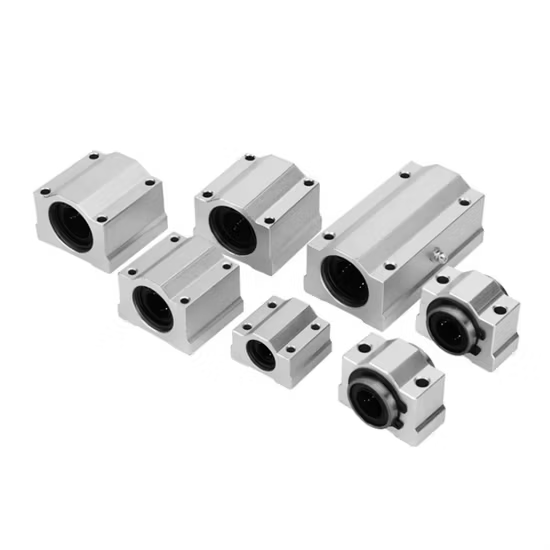
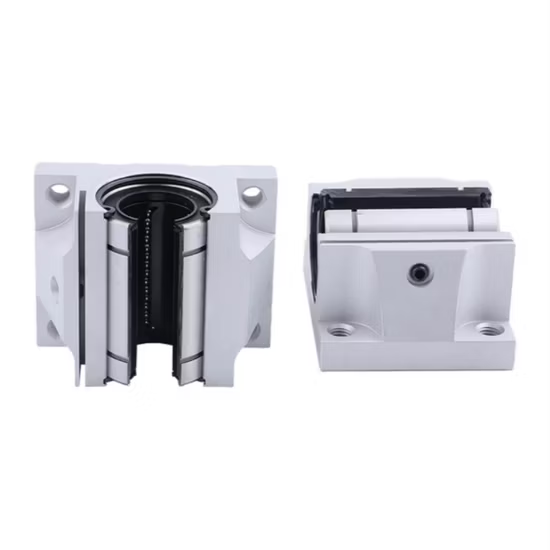
SBR16UU SBR20LUU SBR20UU SBR25LUU Linear Motion Bearings P0–P2 — stainless steel construction with polished hollow profiles ensures high corrosion resistance.
Full Batch Traceability — Every SBR16UU SBR20LUU SBR20UU SBR25LUU shipment includes verifiable manufacturer lot records to prevent counterfeit integration in critical motion systems.
| Parameter | Value |
|---|---|
| Designation | SBR16UU SBR20LUU SBR20UU SBR25LUU |
| Bearing Type | Linear Motion Bearing / Linear Slider |
| Material Options | Stainless steel variants available |
| Surface Treatment | Polished |
| Profile Type | Hollow Profile |
| Seal Type | Rubber seals on both sides (UU / LUU) |
| Precision Class Options | P0, P6, P5, P4, P2 |
| Length | Custom Length |
| Feature | High Speed, Low Voice |
| Corrosion Resistance | High Corrosion Resistance |
| Customization | Available |
| Certification | CE, CS, EPA, ISO 9001:2000, ISO 9001:2008, RoHS |
| Industry | Typical Applications |
|---|---|
| Engraving & CNC | Spindle traverse mechanisms, Z-axis drop mechanisms, precision routing carriages |
| Medical Equipment | Automated diagnostic imaging beds, sterile laboratory sample handling gantries |
| Food Processing | Washdown-intensive conveyor diverters, hygienic packaging sealing jaws |
| Industrial Automation | High-speed pick-and-place robot arms, cleanroom wafer transfer modules |
Matching the base designation without verifying the seal suffix and precision class guarantees premature carriage binding.
Procurement teams often source linear motion components by matching the basic alphanumeric code, overlooking critical internal variations. In high-cycle engraving environments, installing a standard clearance unit where a specific precision class was required leads to severe thermal binding as the carriage heats up during continuous routing operations. Furthermore, ignoring the distinction between standard and long-type sealed variants alters the load distribution across the carriage block, causing uneven wear on the hollow profile shaft. We regularly intercept orders where the base number aligns perfectly, but the internal seal design and precision tolerance completely mismatch the OEM equipment requirements, preventing catastrophic field failures before the parts ever leave our facility .
Engraving machines demand exceptional positional accuracy and smooth traversal to maintain cut quality across diverse materials. The SBR16UU SBR20LUU SBR20UU SBR25LUU stainless steel linear slider series provides the necessary rigidity and low-friction movement for these high-precision carriages. By evaluating the specific routing loads and travel speeds, we ensure the selected precision class and seal configuration perfectly align with the machine builder's tolerance requirements, eliminating micro-vibrations that ruin surface finishes.
Linear sliders in food processing or outdoor signage engraving face severe environmental challenges, including high-pressure washdowns and airborne particulate ingress. The polished surface treatment combined with high corrosion resistance material options prevents pitting that would otherwise destroy rolling element smoothness. Continuous high-speed operation generates friction heat, making the rubber seal contact pressure a critical factor; too much drag causes motor strain, while too little allows abrasive dust to degrade the internal recirculation paths, necessitating careful seal selection based on the exact contamination profile .
The suffix dictates the physical footprint and load capacity of the carriage block. The UU designation indicates a standard-length block with rubber seals on both sides, optimizing compact installation spaces while retaining debris exclusion. Conversely, the LUU suffix designates a long-type block, also fully sealed, which distributes radial and moment loads across a wider contact area on the shaft. Selecting between these requires analyzing the overhang distance of the engraving spindle; a long carriage resists pitch and yaw moments far better than a standard block, preventing chatter marks on the workpiece during heavy milling passes.
Substituting a standard precision block into a high-speed routing axis might function initially, but the accumulated positional drift eventually ruins batch tolerances. According to ISO 15243 frameworks, improper geometric matching accelerates raceway spalling and recirculation tube fatigue, leading to unplanned downtime that halts entire production lines. When the internal rolling elements lack the specified hardness or the cage geometry is compromised by poor manufacturing, the carriage seizes under peak cutting loads, causing catastrophic damage to the drive screws and voiding the machine builder's warranty .
Sourcing the SBR16UU SBR20LUU SBR20UU SBR25LUU stainless steel linear slider requires looking past the printed label to verify internal integrity. We cross-reference not just the base size, but the exact seal friction characteristics and precision grades to ensure interchangeability without performance loss. Our batch traceability protocols link every carriage block back to the manufacturer's production facilities, providing documented proof of material composition. Furthermore, our application-based selection review catches mismatched length-to-load ratios that generic catalogs overlook, ensuring your automation equipment receives components engineered for its specific dynamic profile.
To finalize the optimal configuration for your automation or engraving equipment, please provide the specific radial and moment loads, maximum traversal speeds, and operating temperature ranges. Sharing the OEM equipment number or original carriage drawings allows our engineering team to perform a precise cross-reference check, verifying that the seal friction and precision class match your exact application. We will then supply a comprehensive technical proposal detailing the L10 life calculation and confirming the availability of your required custom length parameters.
Q: What is the functional difference between UU and LUU suffixes in these linear sliders?
A: The UU suffix designates a standard-length carriage block with rubber seals on both sides, ideal for compact spaces. The LUU suffix indicates a long-type block, also fully sealed, which provides a larger load-bearing footprint. This extended length significantly improves resistance to moment loads and prevents carriage pitching during high-speed engraving operations.
Q: How do I select the right precision class for my automation equipment?
A: Selection depends on the required positional accuracy and surface finish quality. Standard P0 or P6 classes suit general transport and packaging machinery, while high-speed engraving spindles and medical imaging beds demand P5, P4, or P2 tolerances to eliminate micro-vibrations and ensure smooth, low-voice operation across the entire travel length.
Q: Why must material and seal type be verified during cross-referencing?
A: Matching only the base designation often overlooks critical internal differences. A standard steel block will rapidly corrode in food processing washdown environments where stainless steel variants are mandatory. Similarly, ignoring seal friction variations can cause motor overload or allow abrasive dust ingress, leading to premature recirculation path failure.
Q: What causes premature failure of linear sliders in engraving applications?
A: Premature failure typically stems from moment overloading, inadequate shaft support causing deflection, or contamination bypassing damaged seals. When a standard-length block is used where a long-type is required, the concentrated stress accelerates raceway spalling and cage deformation, ultimately seizing the carriage and ruining the machining tolerances.
Q: How can I ensure batch traceability for imported linear motion parts?
A: Procure exclusively through authorized channels that provide verifiable manufacturer lot records and official app QR authentication. Require dimensional inspection reports that specifically validate the ordered precision class and material composition, ensuring the components match the exact specifications required for your critical automation infrastructure.
Our 5-step process ensures every order is engineered, validated, and supported for optimal performance.
Technical needs assessment
Custom specifications
Free samples for $50k+
Pre-shipment inspection
On-site & predictive
Our certified engineers respond within 24 hours with detailed technical specifications, pricing, and lead time information.
![SBR10 SBR12 SBR16 SBR20 SBR25 Linear Guide Rail Slider Block for CNC Router [WARN] draft identifier mismatch](https://skfiso.com/wp-content/uploads/2026/09/sbr10-sbr12-sbr16-sbr20-sbr25-linear-guide-rail-slider-block-for-cnc-router-warn-draft-identifier-mismatch-a547e7.avif)