01
Consultation
Technical needs assessment

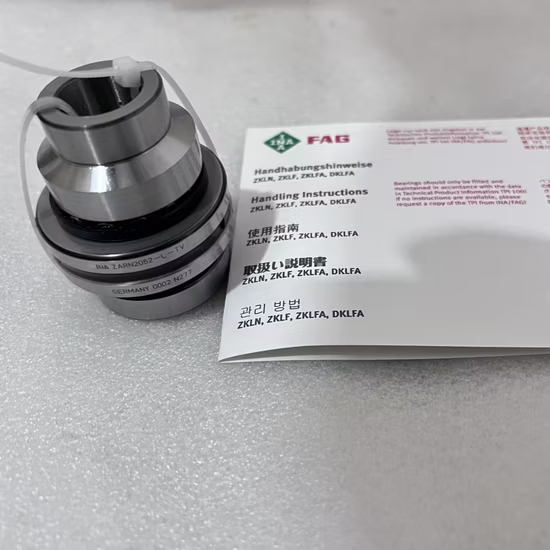
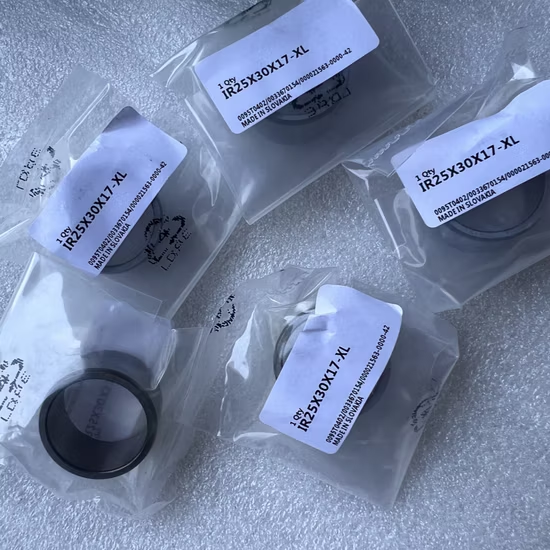
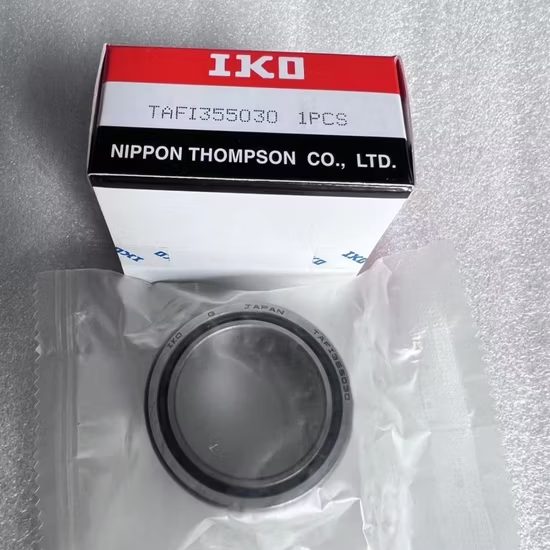
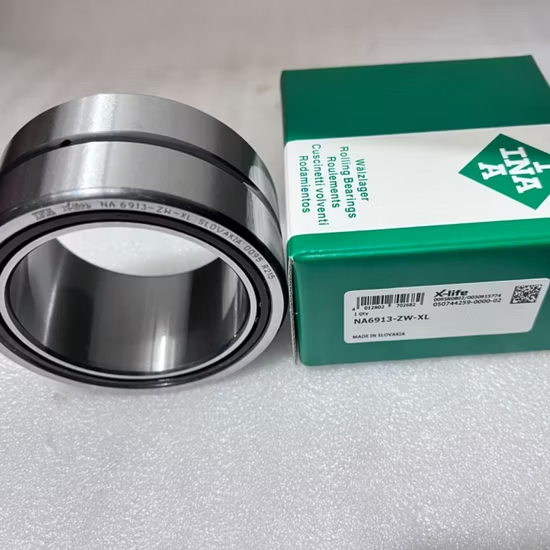


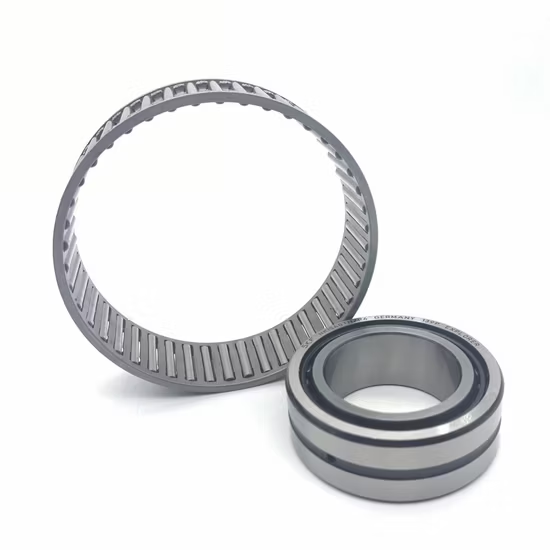
High Precision Needle Roller Bearing for Machine Tool Spindles and Industrial Gearboxes — bearing steel construction in open type with configurable inner and outer ring options for compact radial installations.
Every batch ships with full manufacturer traceability and QR verification through brand official apps for guaranteed authenticity.
Multi-Brand Authorized Coverage — Consolidate SKF, FAG, and NSK needle roller requirements into a single traceable shipment without juggling multiple vendors.
| Parameter | Value |
|---|---|
| Product Type | Needle Roller Bearing |
| Load Direction | Radial |
| Configurations | With or without inner/outer rings |
| Material | Bearing Steel |
| Type | Open |
| Origin | Germany / Japan / Sweden / Malaysia / China |
| Industry | Typical Applications |
|---|---|
| Machine Tool Manufacturing | Spindle support and rotary table indexing mechanisms |
| Industrial Power Transmission | Planetary gear sets and parallel shaft gearbox assemblies |
| Electric Motor Production | High-speed rotor shaft support in compact motor designs |
| Automotive Systems | Transmission shafts and rocker arm pivot assemblies |
| Material Handling | Conveyor roller idlers and heavy-duty lift truck mast channels |
Cage material mismatches cause catastrophic locking under high-vibration radial loads.
During my field service years in West Africa, I investigated a series of seized rotary assemblies at a cement plant. The failure analysis revealed that the open needle rollers had been fitted with stamped steel cages instead of machined brass ones, leading to rapid fatigue and cage fragmentation under intense vibration . When procurement teams bypass a qualified high precision needle roller bearing supplier to save on unit costs, they frequently receive visually identical but metallurgically inferior components that destroy the surrounding shaft and housing.
Selecting the correct configuration requires balancing the available bearing steel grades against the specific radial load profile and operational environment. Our technical team reviews your application parameters to ensure the chosen high precision needle roller bearing provides adequate fatigue resistance without unnecessary over-engineering. Whether the application demands a full complement design for maximum static capacity or a caged variant for higher rotational speeds, we match the internal geometry to your exact operational reality.
Open type configurations rely entirely on the host system’s lubrication delivery, making them highly sensitive to oil film breakdown at elevated temperatures. In compact gearboxes where thermal expansion alters shaft clearances, the absence of integrated seals reduces friction but demands rigorous contamination control from the housing design. Misjudging the operating temperature can degrade the lubricant, leading to metal-to-metal contact between the rollers and the raceways .
The decision to utilize needle rollers with or without inner rings fundamentally alters the shaft preparation and hardness requirements. When an inner ring is omitted, the shaft itself must be hardened and ground to precise tolerances to serve as the inner raceway, which saves radial space but increases manufacturing complexity. Furthermore, while standard bearing steel handles most industrial loads, alternative material options like martensitic stainless grades are available for environments with high moisture or chemical exposure, ensuring the component survives beyond standard corrosion limits.
Substituting a base designation without verifying the exact internal clearance and cage design inevitably triggers unplanned downtime and catastrophic damage to adjacent machinery. A slight deviation in roller profiling or cage pocket geometry shifts the load distribution, accelerating localized spalling and premature failure . This cascading damage often voids equipment warranties and forces complete assembly replacements rather than simple bearing swaps.
We eliminate cross-reference errors by verifying that the replacement matches the original equipment manufacturer’s exact internal geometry, not just the outer dimensions. Our application-based selection review specifically targets the high-vibration environments where stamped cages typically fail, recommending machined alternatives when justified. By consolidating multi-brand requirements, we provide full batch traceability for every component, ensuring your maintenance team receives authentic parts with verified material origins rather than untraceable market stock.
To ensure complete compatibility, please provide the specific equipment model, available radial space, and the exact operational loads and speeds. Our engineering team will evaluate these parameters alongside environmental factors such as temperature and contamination levels to determine the optimal configuration and material selection. This technical review guarantees that the proposed solution aligns perfectly with your maintenance intervals and performance expectations.
Q: How do I determine the exact needle roller bearing designation based on equipment parameters?
A: Determining the correct designation requires analyzing the radial load, rotational speed, and available envelope dimensions. You must also evaluate whether the shaft can be hardened to act as a raceway or if a separate inner ring is necessary. Provide these operational parameters to our engineering team, and we will calculate the required dynamic load rating and select the precise configuration for your application.
Q: What are the common failure modes in high-speed or high-load applications?
A: In high-speed applications, inadequate lubrication and cage instability frequently lead to roller skidding and excessive heat generation. Under heavy radial loads, surface fatigue and subsurface spalling are the primary failure mechanisms, often accelerated by misalignment or contaminated oil. Regular condition monitoring and selecting the appropriate cage material are critical to mitigating these specific failure modes.
Q: How do I choose between configurations with or without inner rings?
A: Selecting a design without an inner ring maximizes radial space and reduces weight, but it requires the shaft to be hardened and ground to exact tolerances. If the shaft cannot meet these surface finish and hardness requirements, a configuration with an inner ring must be used to provide the necessary raceway. The choice ultimately depends on your shaft manufacturing capabilities and space constraints.
Q: What documentation is required to verify the authenticity and origin of the bearings?
A: Authentic verification requires a Certificate of Conformity, batch traceability records, and a material test report confirming the steel grade. Additionally, dimensional inspection reports and country-of-origin documents should accompany the shipment. We provide QR codes for official brand app verification, ensuring every component is genuinely sourced through authorized channels.
Q: How can I find a reliable replacement when the original OEM bearing is discontinued?
A: Replacing a discontinued component requires a comprehensive cross-reference analysis that goes beyond matching the basic outer dimensions. The replacement must align with the original internal clearance, cage material, and roller profiling to maintain equipment performance. Our technical team evaluates your specific application parameters to identify an exact functional equivalent from our authorized multi-brand inventory.
Our 5-step process ensures every order is engineered, validated, and supported for optimal performance.
Technical needs assessment
Custom specifications
Free samples for $50k+
Pre-shipment inspection
On-site & predictive
Our certified engineers respond within 24 hours with detailed technical specifications, pricing, and lead time information.


![Hf0306 0406 0612 0812 1012 1216/Kfr One-Way Needle Roller Bearings for Machinery [WARN] draft identifier mismatch](https://skfiso.com/wp-content/uploads/2026/09/hf0306-0406-0612-0812-1012-1216-kfr-one-way-needle-roller-bearings-for-machinery-warn-draft-identifier-mismatch-155baa.avif)