01
Consultation
Technical needs assessment


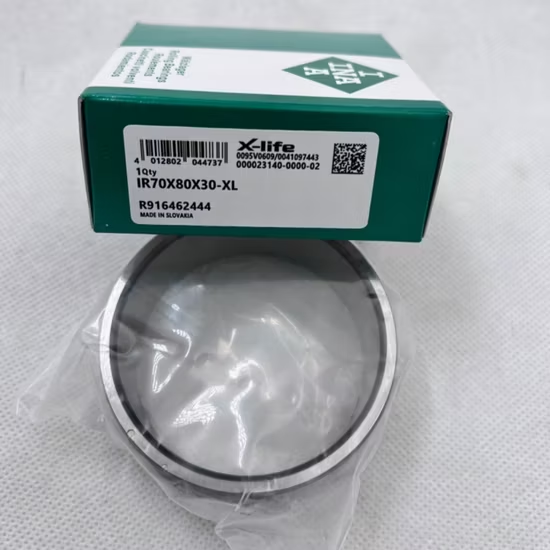
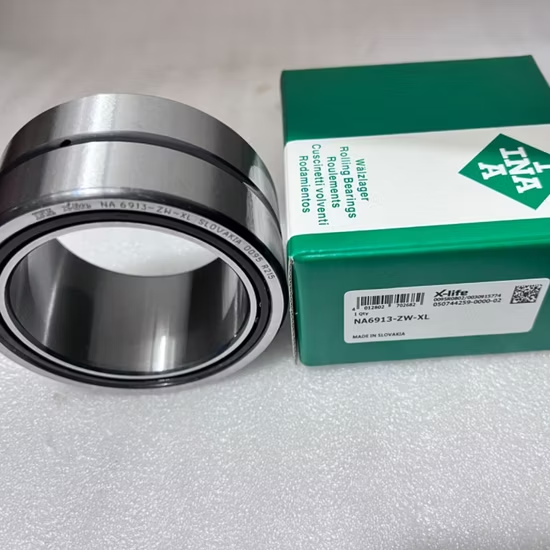
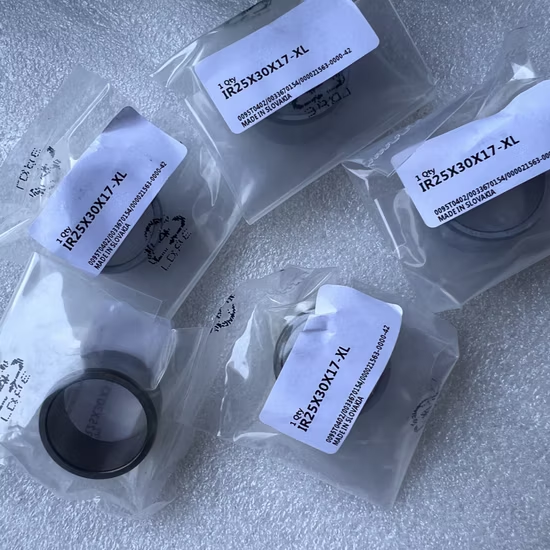
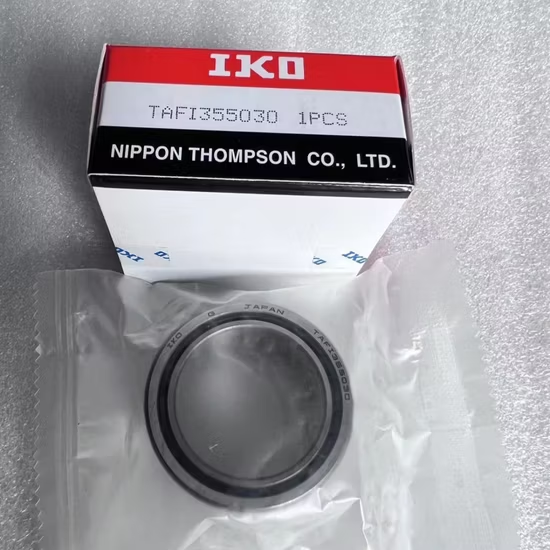
Hf1012 Hf1216 Hf1416 Needle Roller Bearings — open type configuration requires external lubrication and sealing to ensure reliable performance in transmission environments.
Multi-Brand Authorized Coverage — Source INA, NTN, and SKF equivalents for your transmission rebuilds in a single consolidated shipment without juggling multiple vendors.
| Parameter | Value |
|---|---|
| Designation | Hf1012 Hf1216 Hf1416 |
| Product Type | Needle Roller Bearing |
| Load Direction | Radial |
| Structural Style | Without Outer Ring, With Outer Ring, Without Inner Ring, With Inner Ring |
| Material Options | Bearing Steel or Stainless Steel variants |
| Seal or Shield Type | Open |
| Origin | Germany, Japan, Sweden, Malaysia, China |
| Industry | Typical Applications |
|---|---|
| Automotive and Heavy Vehicle Repair | Transmission indexing mechanisms and overrunning clutches |
| Industrial Gearboxes | Backstop clutches and high-frequency shifting elements |
| Material Handling | Conveyor drive indexing and freewheel assemblies |
Matching the bore and outer diameter is never enough for drawn cup needle clutches.
I have seen too many gearboxes in the Pearl River Delta region torn apart because a supplier provided a standard drawn cup needle roller bearing instead of a true one-way clutch, or swapped a polymer cage for a stamped steel one without checking the shifting frequency. When a cross-reference only looks at the base numbers, the internal ramp geometry and spring engagement are completely ignored. This oversight leads to catastrophic slippage under peak torque or cage disintegration during rapid indexing . Sourcing the correct Hf1012 Hf1216 Hf1416 needle roller bearing requires verifying the exact internal clutch mechanism, not just the outer dimensions.
Transmissions demand rapid engagement and disengagement. The Hf1012 Hf1216 Hf1416 needle roller bearing series relies on individual springs to maintain constant contact between the needle rollers and the shaft. We verify the specific spring stiffness and cage material against your equipment’s shifting cycles to ensure the clutch locks instantly without bouncing or slipping during high-speed transitions.
Inside a gearbox, the operating environment is harsh. The open design of these clutches means they rely entirely on the transmission’s splash lubrication or oil mist. If the oil viscosity drops at elevated temperatures, the thin film between the rollers and the ramp can collapse, causing severe wear. Furthermore, thermal expansion of the housing can alter the interference fit, potentially causing the thin drawn cup to deform and lose its locking precision.
The specific suffix combinations in this series dictate the internal clearance and structural boundaries. Because certain structural codes remain unverified in standard public catalogs, we cross-check the exact ramp angle and needle profile against the manufacturer's proprietary drawings. This ensures the replacement unit handles the exact radial load and overrunning speed required by your specific transmission housing.
Installing a standard freewheel in an application requiring a high-torque backstop inevitably leads to unplanned downtime. When the internal ramps fail to bite, the resulting backdriving can shatter downstream gear teeth. According to ISO 281 frameworks, operating a clutch beyond its designed engagement frequency drastically reduces its functional lifespan, turning a minor component replacement into a complete gearbox overhaul .
We do not just ship boxes; we validate the internal architecture. While others might ship a basic needle bearing when a one-way clutch is needed, we confirm the ramp geometry and spring configuration for every Hf1012 Hf1216 Hf1416 needle roller bearing order. Our cross-brand interchange matches the exact cage material and engagement style, ensuring your transmission shifts smoothly whether you are using a German or Japanese equivalent.
To ensure we supply the exact clutch variant for your transmission, please share the peak torque requirements and the expected shifting frequency. Providing the OEM equipment number allows our engineering team to cross-reference the specific internal ramp design and confirm the correct structural style.
Q: Why does a base-number match still cause transmission slipping?
A: A base number only defines the outer dimensions. If the internal ramp angle, spring stiffness, or cage material differs from the original design, the clutch will either fail to lock under peak torque or generate excessive heat during high-frequency overrunning, leading to rapid failure.
Q: How do bearing steel and stainless steel variants differ in this application?
A: Bearing steel offers superior surface hardness and fatigue resistance for heavy torque transmission. Stainless steel variants are selected when the gearbox environment involves corrosive fluids or washdowns, though they require careful load derating due to lower material hardness.
Q: What is the correct installation method for these drawn cup clutches?
A: You must never hammer or press directly on the outer ring. Always use a stepped mandrel that contacts only the housing bore or the specific mounting shoulder. Pressing the thin drawn cup directly will distort the ramps and cause immediate locking failure.
Q: How should these open clutches be lubricated inside a gearbox?
A: Since they lack integrated seals, they rely on the gearbox’s circulating oil. Ensure the transmission fluid reaches the clutch during operation. Using grease in a high-speed overrunning application will cause churning losses and overheating inside the needle assembly.
Our 5-step process ensures every order is engineered, validated, and supported for optimal performance.
Technical needs assessment
Custom specifications
Free samples for $50k+
Pre-shipment inspection
On-site & predictive
Our certified engineers respond within 24 hours with detailed technical specifications, pricing, and lead time information.
![Hf0306 0406 0612 0812 1012 1216/Kfr One-Way Needle Roller Bearings for Machinery [WARN] draft identifier mismatch](https://skfiso.com/wp-content/uploads/2026/09/hf0306-0406-0612-0812-1012-1216-kfr-one-way-needle-roller-bearings-for-machinery-warn-draft-identifier-mismatch-155baa.avif)


![Na4906 Full Complement Needle Roller Bearing Set Wholesale Supply [WARN] draft identifier mismatch](https://skfiso.com/wp-content/uploads/2026/09/na4906-full-complement-needle-roller-bearing-set-wholesale-supply-warn-draft-identifier-mismatch-0f3d6f.avif)