01
Consultation
Technical needs assessment

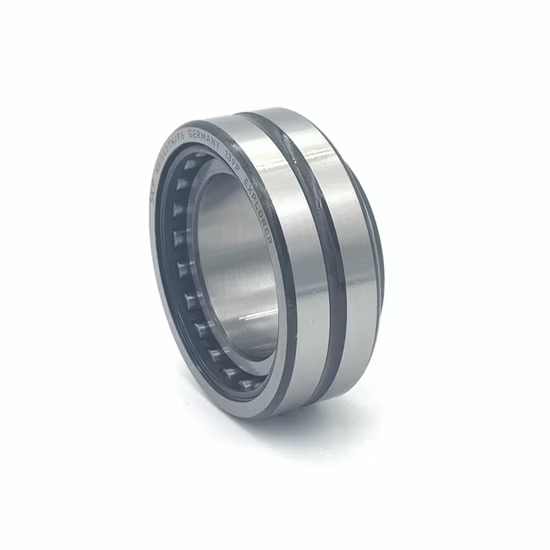

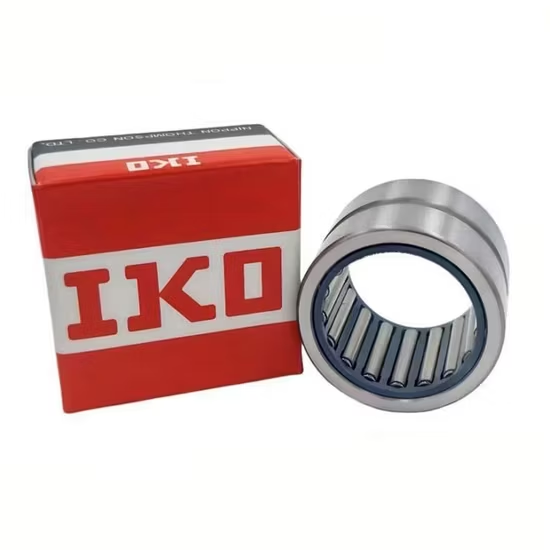
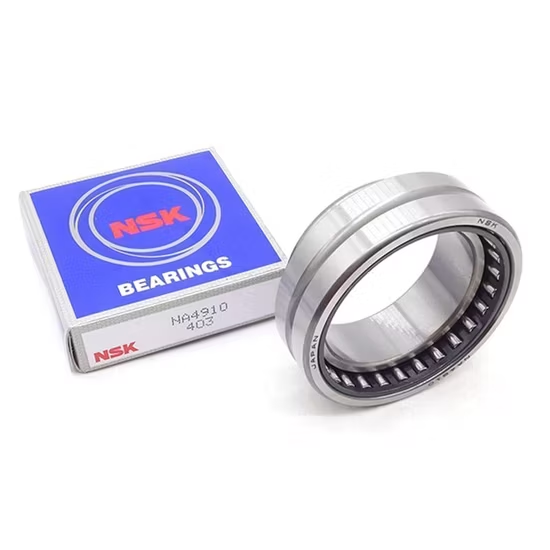

Long Cylindrical Needle Roller Bearing — bearing steel construction rated for heavy radial loads in compact spaces, open type enabling efficient lubrication flow across industrial gearbox and automotive applications.
Cross-reference verification covers clearance, cage material, and precision alignment to eliminate field mismatch risks.
Full Brand Authorization — A single mixed-brand purchase order eliminates the need to coordinate with multiple vendors for your needle roller requirements.
| Parameter | Value |
|---|---|
| Product Type | Needle Roller Bearing |
| Load Direction | Radial Bearing |
| Type | Open |
| Material Options | Bearing steel, with stainless steel variants available upon request |
| Certification | Batch traceability and material test reports |
| Customization | Cross-brand interchange and application-based selection review |
| Origin | Sourced from authorized manufacturer production facilities globally |
| Industry | Typical Applications |
|---|---|
| Industrial Gearboxes | Planetary gear sets and heavy-duty reduction stages |
| Automotive and Heavy Vehicle Repair | Commercial truck transmissions and drivetrain components |
| Machine Tool Spindles | High-precision rotary tables and indexing mechanisms |
Dimensional envelope matches do not guarantee internal structural compatibility.
In heavy-duty transmission environments, substituting a standard needle roller for a long cylindrical variant often leads to rapid cage disintegration. I have seen procurement teams source parts based solely on outer dimensions, completely overlooking the distinct roller length-to-diameter ratio and cage geometry required for specific torque loads. When the internal design fails to match the application's radial load profile, the rollers skew under stress, generating excessive heat and ultimately destroying the shaft and housing . Finding a reliable long cylindrical needle roller bearing supplier ensures that cross-referencing goes beyond basic part numbers to verify internal clearances and cage materials.
Selecting the correct geometry is critical when space is constrained but radial loads are immense. The elongated roller profile provides a substantially larger contact area compared to standard designs, distributing stress more evenly across the raceway. As a long cylindrical needle roller bearing supplier, we evaluate the specific load distribution and misalignment tolerance of your gearbox to ensure the selected profile prevents edge loading and premature spalling.
Open-type designs in tight transmission housings rely heavily on the gearbox's splash lubrication system. The elongated rollers and specific cage pockets must allow adequate oil flow to prevent thermal binding, especially when operating at elevated temperatures. If the clearance class is not matched to the thermal expansion characteristics of the surrounding housing materials, the bearing can seize during continuous high-torque operation .
While standard bearing steel provides the necessary hardness for most gear sets, certain environments demand alternative materials. We offer options including stainless steel variants for applications exposed to moisture or corrosive agents. The cage material is equally critical; machined brass cages are often specified for heavy shock loads and high vibration, whereas pressed steel cages suit higher-speed, lighter-load scenarios. Selecting the appropriate material combination ensures the bearing survives the specific dynamic forces of the equipment.
Relying on superficial cross-references often results in catastrophic damage to the host equipment. When a replacement part shares the same boundary dimensions but lacks the required internal load capacity or cage strength, the resulting failure is rarely isolated to the bearing itself. Unplanned downtime, destroyed gear teeth, and scored shafts quickly multiply the initial cost savings of a cheaper, incorrectly specified part into massive repair bills and warranty voidance .
Our procurement process focuses on eliminating the guesswork from cross-brand interchange. We verify that the internal design, cage material, and clearance match the original equipment requirements, not just the base envelope dimensions. Every shipment includes batch traceability to the manufacturer, ensuring you receive genuine bearing steel rather than counterfeit components with soft inner rings. We also provide application-based selection reviews to confirm the part is suited for your specific speed and temperature conditions.
To ensure precise fitment and optimal service life, our engineering team requires specific operational parameters. Please provide the equipment model, exact envelope dimensions, and detailed operating conditions including radial loads, rotational speeds, and ambient temperatures. Sharing information about the lubrication method and environmental exposure allows us to determine the exact designation, clearance class, and material variant required for your application.
Q: How do I determine the exact needle roller bearing designation for my equipment?
A: Provide our engineering team with the equipment model, boundary dimensions, and operating parameters such as load, speed, and temperature. We analyze these factors alongside the original OEM specifications to determine the precise designation, ensuring the internal geometry and clearance class perfectly match your application requirements.
Q: What are common failure modes for these bearings in heavy-duty gearboxes?
A: Premature failures often stem from cage disintegration due to shock loads, roller skewing from inadequate lubrication, or thermal binding caused by incorrect clearance selection. Edge loading and raceway spalling also occur when the bearing's internal load capacity is mismatched with the actual torque transmitted through the gear set.
Q: How can I verify material authenticity and avoid counterfeit parts?
A: We provide comprehensive documentation, including material test reports and batch traceability. You can verify authenticity using official brand apps via QR codes on the packaging. This ensures the bearing steel meets the required hardness and metallurgical standards, protecting your equipment from the catastrophic failures caused by soft inner rings.
Q: What are the lubrication requirements for open-type needle roller bearings?
A: Open designs rely entirely on the host equipment's lubrication system, typically oil splash or forced circulation in gearboxes. It is critical to ensure the oil viscosity and flow rate are sufficient to penetrate the elongated roller pockets, preventing metal-to-metal contact and dissipating heat generated during high-load operation.
Q: How do you handle cross-brand interchange for discontinued parts?
A: We do not rely solely on base part numbers. Our technical team cross-references the internal design, cage material, clearance, and dimensional tolerances to find an exact functional equivalent from other authorized brands. This ensures the replacement part performs identically to the original without compromising equipment reliability.
Our 5-step process ensures every order is engineered, validated, and supported for optimal performance.
Technical needs assessment
Custom specifications
Free samples for $50k+
Pre-shipment inspection
On-site & predictive
Our certified engineers respond within 24 hours with detailed technical specifications, pricing, and lead time information.
![HK202918 RS Needle Roller Bearing Hf1012 Na4904 Genuine Supplier [WARN] draft identifier mismatch](https://skfiso.com/wp-content/uploads/2026/09/hk202918-rs-needle-roller-bearing-hf1012-na4904-genuine-supplier-warn-draft-identifier-mismatch-dc5371.avif)

![90364-33009 dB503303c Needle Roller Bearing Genuine Authorized [WARN] draft identifier mismatch](https://skfiso.com/wp-content/uploads/2026/09/90364-33009-db503303c-needle-roller-bearing-genuine-authorized-warn-draft-identifier-mismatch-dc5fb1.avif)
![HK2210 HK2212 HK2216 HK2220 HK2230 Needle Roller Bearing [WARN] draft identifier mismatch](https://skfiso.com/wp-content/uploads/2026/09/hk2210-hk2212-hk2216-hk2220-hk2230-needle-roller-bearing-warn-draft-identifier-mismatch-cbe937.avif)