01
Consultation
Technical needs assessment

![Genuine NSK NTN Timken Koyo 71905 CD/P4a Angular Contact Bearing [WARN] draft identifier mismatch - 1](https://skfiso.com/wp-content/uploads/2026/09/genuine-nsk-ntn-timken-koyo-71905-cd-p4a-angular-contact-bearing-warn-draft-identifier-mismatch-700af4.avif)
![Genuine NSK NTN Timken Koyo 71905 CD/P4a Angular Contact Bearing [WARN] draft identifier mismatch - 2](https://skfiso.com/wp-content/uploads/2026/09/genuine-nsk-ntn-timken-koyo-71905-cd-p4a-angular-contact-bearing-warn-draft-identifier-mismatch-cc4140.avif)
![Genuine NSK NTN Timken Koyo 71905 CD/P4a Angular Contact Bearing [WARN] draft identifier mismatch - 3](https://skfiso.com/wp-content/uploads/2026/09/genuine-nsk-ntn-timken-koyo-71905-cd-p4a-angular-contact-bearing-warn-draft-identifier-mismatch-3b35a9.avif)
![Genuine NSK NTN Timken Koyo 71905 CD/P4a Angular Contact Bearing [WARN] draft identifier mismatch - 4](https://skfiso.com/wp-content/uploads/2026/09/genuine-nsk-ntn-timken-koyo-71905-cd-p4a-angular-contact-bearing-warn-draft-identifier-mismatch-5b633b.avif)
![Genuine NSK NTN Timken Koyo 71905 CD/P4a Angular Contact Bearing [WARN] draft identifier mismatch - 5](https://skfiso.com/wp-content/uploads/2026/09/genuine-nsk-ntn-timken-koyo-71905-cd-p4a-angular-contact-bearing-warn-draft-identifier-mismatch-efaa3d.avif)
![Genuine NSK NTN Timken Koyo 71905 CD/P4a Angular Contact Bearing [WARN] draft identifier mismatch - 6](https://skfiso.com/wp-content/uploads/2026/09/genuine-nsk-ntn-timken-koyo-71905-cd-p4a-angular-contact-bearing-warn-draft-identifier-mismatch-0d9501.avif)
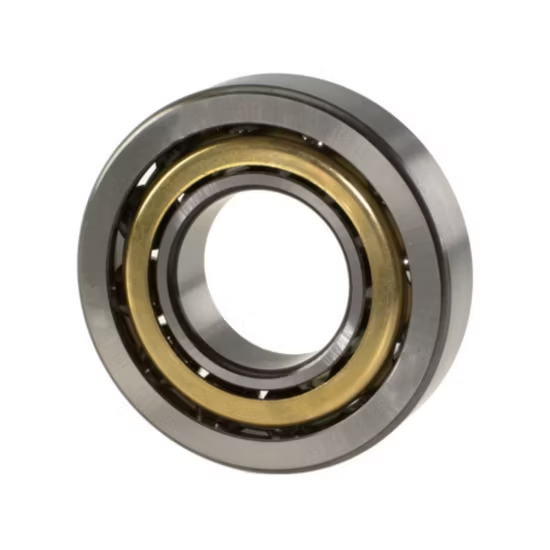
71905 CD/P4a Angular Contact Ball Bearing — featuring a 15° contact angle for high-speed operations with minimized friction heat. The P4a precision class delivers tight dimensional and enhanced running accuracy for machine tool spindles.
Multi-brand authorized coverage — Procure genuine 71905 CD/P4a angular contact ball bearings across major international brands in a single consolidated order, eliminating multi-vendor coordination.
| Parameter | Value |
|---|---|
| Designation | 71905 CD/P4a |
| Product Type | Angular Contact Ball Bearing |
| Contact Angle | 15° (CD suffix) |
| Precision Class | P4a (Class 4 dimensional, enhanced running accuracy) |
| Material | Bearing Steel |
| Vibration Levels | Z1V1, Z2V2, Z3V3 options |
| Arrangement | Single row, universally matchable |
| Certification | ISO 492 compliant |
Note: Variant designations such as 71905 Cdga/P4a include a GA suffix indicating universal matching with light preload, which is not present in the base 71905 CD/P4a identifier.
| Industry | Typical Applications |
|---|---|
| Machine Tool Manufacturing | High-speed motorized spindles, precision grinding wheel heads, CNC milling spindle cartridges |
| Precision Equipment | High-frequency robotic joint actuators, optical inspection rotary tables, coordinate measuring machine axes |
| Fluid Machinery | High-speed centrifugal pump shafts, vacuum pump rotor supports |
A matching base number guarantees nothing if the internal geometry and precision class are wrong for the spindle cartridge.
I have seen entire production lines halt because a standard P0 grade was forced into a high-speed grinding spindle that demanded P4a running accuracy. The resulting vibration destroyed the surface finish of the machined parts and burned out the spindle motor. When procurement teams focus only on the base 71905 designation, they frequently overlook the critical CD and P4a suffixes. This oversight leads to thermal binding when the 15° contact angle is swapped for a 25° variant, or catastrophic cage failure when standard dimensional tolerances are used in a high-RPM environment . Sourcing a genuine 71905 CD/P4a angular contact ball bearing requires strict verification of every suffix to ensure the internal design matches the equipment manufacturer's original thermal and dynamic requirements.
The 71905 CD/P4a angular contact ball bearing is engineered specifically for applications where rotational speed generates significant centrifugal forces and friction heat. The 15° contact angle (denoted by the CD suffix) provides an optimal balance between radial load capacity and axial rigidity while minimizing internal sliding friction. In precision grinding and milling spindles, this geometry allows the bearing to sustain high RPMs without exceeding the thermal limits of the lubricant. We review your specific speed and load parameters to confirm that this 15° optimized design aligns with your spindle's operational envelope, preventing the premature degradation common in mismatched setups.
High-speed spindles generate intense localized heat, which directly impacts internal clearance and lubricant stability. If the bearing cannot accommodate thermal expansion, the rolling elements will skid, leading to rapid cage wear and eventual seizure . Oil-air or oil-jet lubrication systems are typically required to manage these temperatures, demanding a bearing design that minimizes fluid churning losses. Furthermore, the spindle housing and shaft materials expand at different rates, meaning the bearing must maintain its dimensional stability and running accuracy under steep thermal gradients. Contamination from coolant or metal swarf also necessitates careful sealing integration at the cartridge level to protect the precision-ground raceways.
The P4a precision class indicates standard Class 4 dimensional accuracy combined with enhanced running accuracy, which is critical for minimizing non-repetitive runout in machine tool spindles. While standard P4 bearings meet strict bore and outside diameter tolerances, the P4a designation enforces tighter limits on inner and outer ring radial runout, ensuring the spindle rotates with minimal eccentricity. The CD suffix confirms the 15° contact angle, which generates considerably less friction heat than 25° (AC) or 40° (B) variants, making it the standard choice for high-speed, light-to-moderate load applications. Together, these specifications ensure the bearing maintains its geometric integrity and stiffness at elevated rotational speeds.
Installing a bearing that matches the base number but lacks the correct P4a running accuracy or CD contact angle inevitably leads to unplanned downtime. The immediate consequence is often excessive spindle vibration, which ruins the surface finish of machined components and triggers scrap rates. Over time, the incorrect internal geometry causes localized stress concentrations and thermal binding, culminating in catastrophic spindle seizure that requires a complete cartridge rebuild. According to ISO 281 frameworks, operating a bearing outside its verified geometric and precision parameters drastically reduces its calculated fatigue life, voiding equipment warranties and inflating maintenance budgets .
We maintain authorized distribution channels across all major international brands, allowing you to source the exact 71905 CD/P4a angular contact ball bearing required without compromising on origin. Our cross-reference process strictly aligns the contact angle, precision class, and internal clearance, rather than just matching the base 71905 number. Every shipment includes batch traceability to the manufacturer, verified through official brand applications to eliminate the risk of counterfeit rings with substandard hardness. We also provide application-based selection reviews to ensure the 15° geometry and P4a tolerances suit your specific spindle speeds and thermal conditions. Finally, our pre-shipment inspections confirm the running accuracy and dimensional stability before the bearings leave our facility.
To ensure the 71905 CD/P4a angular contact ball bearing integrates flawlessly into your equipment, please provide your spindle's maximum operational speed, expected radial and axial loads, and operating temperature range. Sharing the OEM equipment model number or original cartridge drawings allows our engineering team to perform a comprehensive cross-reference check and L10 life calculation. We will also evaluate your lubrication method and housing fit tolerances to confirm that the 15° contact angle and P4a running accuracy will deliver optimal thermal stability and rigidity in your specific application.
Q: Why does the P4a suffix matter more than standard P4 for machine tool spindles?
A: While both meet Class 4 dimensional tolerances, the P4a suffix guarantees enhanced running accuracy, specifically tighter limits on radial runout. In high-speed spindles, this minimizes non-repetitive vibration and ensures superior surface finishes on machined parts, preventing the chatter marks caused by standard P4 runout deviations.
Q: How does the 15° CD contact angle affect spindle thermal behavior?
A: The 15° contact angle generates considerably less internal sliding friction compared to 25° or 40° alternatives. This reduced friction minimizes heat generation at high RPMs, preventing thermal expansion that could otherwise eliminate internal clearance and cause the spindle to seize during continuous machining operations.
Q: What is the risk of using a base-number match without the CD/P4a suffixes?
A: A base-number match only confirms the physical envelope dimensions. Ignoring the CD and P4a suffixes means you might install a bearing with the wrong contact angle or loose dimensional tolerances, leading to rapid thermal binding, excessive vibration, and catastrophic cage failure under high-speed spindle loads.
Q: How can I verify the authenticity of the P4a precision grade before mounting?
A: You can verify authenticity by scanning the QR code on the packaging using the manufacturer's official application, which confirms the batch origin. Additionally, reviewing the supplied dimensional and running accuracy inspection reports ensures the specific P4a runout tolerances were met during production.
Q: Can the 71905 CD/P4a be used in back-to-back or face-to-face pairs?
A: The base 71905 CD/P4a is a single, universally matchable bearing. To use it in rigid back-to-back (DB) or face-to-face (DF) arrangements with specific preload, you must procure matched sets with the appropriate pairing and preload suffixes, rather than grouping random single bearings which lack factory-matched ring tolerances.
Our 5-step process ensures every order is engineered, validated, and supported for optimal performance.
Technical needs assessment
Custom specifications
Free samples for $50k+
Pre-shipment inspection
On-site & predictive
Our certified engineers respond within 24 hours with detailed technical specifications, pricing, and lead time information.
![7206 Becbm Angular Contact Ball Bearing High Speed Precision [WARN] draft identifier mismatch](https://skfiso.com/wp-content/uploads/2026/09/7206-becbm-angular-contact-ball-bearing-high-speed-precision-warn-draft-identifier-mismatch-0db82c.avif)