01
Consultation
Technical needs assessment


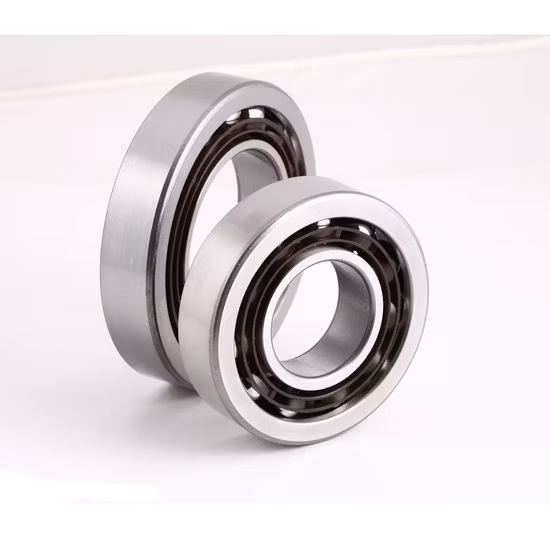

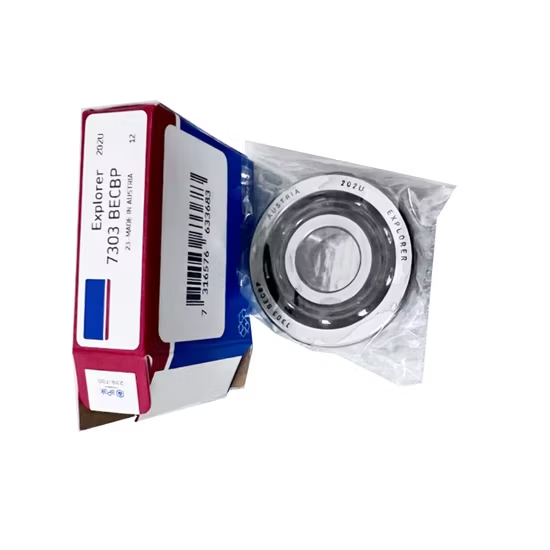

NSK NTN Timken Koyo 7207b Angular Contact Ball Bearing delivers high axial load capacity through its 40° contact angle design.
Multi-Brand Coverage — Procuring the NSK NTN Timken Koyo 7207b angular contact ball bearing from a single authorized source eliminates the coordination delays and documentation gaps typical of mixed-brand orders.
| Parameter | Value |
|---|---|
| Designation | NSK NTN Timken Koyo 7207b |
| Product Type | Angular Contact Ball Bearing |
| Contact Angle | 40° (b suffix) |
| Material | Bearing steel standard; available in stainless steel variants |
| Vibration Class | Z1V1 / Z2V2 / Z3V3 |
| Origin | Germany / Japan / Sweden / Malaysia / China |
| HS Code | 8482102000 |
| Industry | Typical Applications |
|---|---|
| Machine Tool Manufacturing | High-speed spindle assemblies requiring rigid axial positioning |
| Industrial Robotics | Joint actuators and precision articulation mechanisms |
| Fluid Handling | High-speed pump impeller shafts enduring continuous thrust |
| Precision Equipment | Optical indexing tables and automated measurement fixtures |
A 40° contact angle demands exact internal geometry alignment, not just a matching outer stamp.
In my years transitioning from the grinding workshop to technical sales across the Yangtze River Delta, I have investigated numerous spindle failures where the replacement part carried the correct base number but failed catastrophically within weeks. The root cause is almost always a cross-reference error that ignores internal design nuances. When sourcing a NSK NTN Timken Koyo 7207b angular contact ball bearing, matching the 7207 dimension series is only the first step. If the replacement lacks the specific clearance, cage material, or precision suffix required by the original equipment manufacturer, the thermal expansion during high-speed operation will eliminate the internal clearance, leading to severe thermal binding .
The defining characteristic of this designation is the b suffix, which dictates a 40° contact angle. This geometry provides substantial axial load-carrying capacity in one direction, making it ideal for pump shafts and vertical machine tool spindles where thrust loads dominate. When evaluating a NSK NTN Timken Koyo 7207b angular contact ball bearing for your application, our technical review ensures the 40° contact angle aligns perfectly with your specific axial load profile, preventing premature raceway fatigue caused by under-engineered contact geometries.
Machine tool spindles and high-speed pumps generate significant internal heat due to friction at elevated rotational speeds. This thermal dynamic directly impacts the required internal clearance and lubrication strategy. If a standard clearance is installed where a C3 clearance was specified to accommodate thermal expansion, the bearing will preload itself into failure as the shaft expands. Furthermore, the choice between oil-air lubrication and grease packing must align with the cage design and speed limits to prevent lubricant starvation or excessive churning losses .
The 40° contact angle (b suffix) fundamentally alters the load distribution compared to 15° or 25° alternatives, shifting the load path to better withstand heavy unidirectional thrust. While standard bearing steel is the default for most industrial environments, stainless steel variants are available for applications involving mild corrosion or washdown environments, though they require careful load derating due to differences in material hardness and fatigue limits. The vibration class (Z1V1 through Z3V3) indicates the strictness of the manufacturing tolerances regarding noise and vibration, which is critical for precision equipment where rotational smoothness dictates the final product quality. Selecting the correct cage material—whether pressed steel for high speeds or machined brass for heavy loads and high vibrations—ensures the rolling elements remain properly guided under dynamic operating conditions.
Relying solely on dimensional equivalence without verifying the contact angle, precision class, and internal clearance leads to unplanned downtime and catastrophic damage to surrounding spindle components. When a bearing designed for moderate speeds is forced into a high-frequency application without the appropriate cage and precision grade, the resulting vibration degrades the machine's surface finish and accelerates wear on the housing fits. These failures often void equipment warranties and result in lost production cycles that far exceed the cost of the correctly specified component .
We maintain authorized distribution channels across all major international brands, meaning your requirement for a specific NSK, NTN, Timken, or Koyo 7207b variant is fulfilled with full batch traceability. Our cross-reference process strictly aligns the 40° contact angle, clearance class, and cage material, rather than just matching the base 7207 dimension. We actively flag discrepancies when a requested substitution compromises the thermal or speed capabilities required by your specific machinery. Every shipment is backed by manufacturer documentation, ensuring the parts you install are exactly what the original equipment engineer intended.
To ensure the selected bearing perfectly matches your operational demands, please provide the specific radial and axial loads, maximum operating speed, and expected temperature range. If you are replacing an existing component, sharing the OEM equipment number or the exact suffix string from the old bearing allows our engineering team to perform a precise cross-reference and L10 life verification. Detailing the environmental conditions, such as exposure to coolant or dust, helps us determine if standard bearing steel or a stainless steel variant is the optimal choice.
Q: How do I verify the authenticity of the received bearings?
A: Every authorized bearing we supply features a unique traceability code. You can scan the QR code using the respective brand’s official mobile application to instantly verify the production batch, origin, and authenticity. This direct digital link to the manufacturer's database ensures you are installing genuine components and effectively eliminates the risk of counterfeit parts with soft inner rings.
Q: Why must clearance and cage material be checked during cross-referencing?
A: Matching the base dimension is insufficient because internal geometry dictates thermal behavior. If a standard clearance is used where thermal expansion requires a C3, the bearing will bind and overheat. Similarly, a cage material mismatch can lead to catastrophic failure at high speeds. We verify these suffixes to ensure the replacement survives the actual operating environment.
Q: How does the 40° contact angle affect spindle selection compared to 15° or 25°?
A: The 40° contact angle, designated by the b suffix, provides maximum unidirectional axial load capacity, making it ideal for heavy thrust applications like vertical pumps. In contrast, 15° or 25° angles are typically chosen for high-speed machine tool spindles where radial loads and extreme rotational speeds take precedence over heavy axial thrust.
Q: When should I choose stainless steel variants over standard bearing steel?
A: Standard bearing steel offers superior fatigue life and load capacity for general industrial use. Stainless steel variants are specified when the operating environment involves mild corrosion, washdown procedures, or specific sanitary requirements. Because stainless grades have different fatigue limits, our technical team will review your load parameters to ensure the material switch does not compromise the bearing's operational lifespan.
Our 5-step process ensures every order is engineered, validated, and supported for optimal performance.
Technical needs assessment
Custom specifications
Free samples for $50k+
Pre-shipment inspection
On-site & predictive
Our certified engineers respond within 24 hours with detailed technical specifications, pricing, and lead time information.