01
Consultation
Technical needs assessment



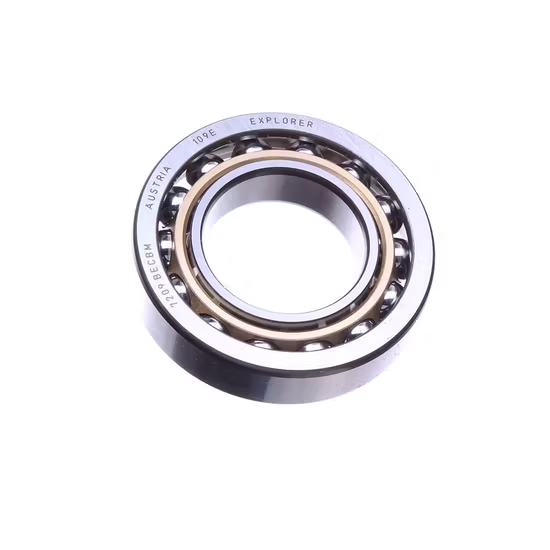
71934 CD/P4a Angular Contact Ball Bearing 170×230×28 mm features P4A precision for machine tool spindles.
Full Brand Authorized Coverage — Procure the 71934 CD/P4a angular contact ball bearing alongside mixed-brand spindle components in a single consolidated shipment.
| Parameter | Value |
|---|---|
| Designation | 71934 CD/P4a |
| Bearing Type | Angular Contact Ball Bearing |
| Bore Diameter (d) | 170 mm |
| Outside Diameter (D) | 230 mm |
| Width (B) | 28 mm |
| Contact Angle | 15° (CD suffix) |
| Precision Class | P4A (P4a suffix) |
| Material | Standard bearing steel, with ceramic rolling element or stainless steel variants available |
| Arrangement | Single Row (Universal matching variants like Cdga available) |
| Certification | ISO 492, DIN 620 |
| Origin | Germany / Japan / Sweden / Malaysia / China |
| Industry | Typical Applications |
|---|---|
| Machine Tool Manufacturing | High-speed milling spindle front and rear support nodes |
| Precision Equipment | Optical measuring instrument rotary tables and indexing heads |
| Industrial Pumps | High-speed centrifugal pump shaft thrust and radial support |
| Robotics | Articulated joint rotary actuators requiring tight axial positioning |
Suffix alignment dictates whether a precision bearing survives its first week in a high-speed spindle.
Early in my career transitioning from quality inspection to trade in the Pearl River Delta, I watched a manufacturer suffer repeated downtime because they installed a standard P0 grade bearing into a high-speed milling spindle. The base dimension matched perfectly, but the lack of P4A running accuracy caused severe vibration and thermal binding. When sourcing a 71934 CD/P4a angular contact ball bearing, overlooking the exact contact angle or precision class leads to catastrophic spindle failure, regardless of how perfectly the outer diameter fits the housing .
The 71934 CD/P4a angular contact ball bearing is engineered specifically for applications where rotational speed and axial rigidity must coexist. The CD suffix designates a 15° contact angle, which generates considerably less friction heat than higher-angle variants during continuous high-speed operation. By minimizing centrifugal forces on the rolling elements, this geometry maintains stability in machine tool spindles where thermal expansion could otherwise alter the internal clearance and compromise machining accuracy.
High-speed spindles generate intense localized heat, directly impacting internal clearance and lubrication film thickness. A 15° contact angle helps manage these thermal gradients, but the lubrication strategy must align with the open bearing design. Oil-air or oil-jet lubrication is typically required to evacuate friction heat without introducing the churning losses associated with grease. Furthermore, the absence of integrated seals means the spindle housing must provide adequate labyrinth protection to prevent coolant or metal fines from contaminating the raceways .
The P4a suffix indicates P4A precision, which mandates tighter dimensional and running accuracy than standard P4 or P5 grades, ensuring minimal radial and axial runout at high RPMs. The CD designation confirms the optimized 15° contact angle and internal raceway curvature designed for high-speed performance. While the standard 71934 CD/P4a is a single-row bearing, universal matching variants such as the 71934 Cdga/P4a are frequently cross-referenced when preloaded paired mounting arrangements are required to double the axial rigidity.
Substituting a standard precision bearing for a P4A specified component often results in unplanned downtime and premature failure. According to ISO 15243 failure mode classification frameworks, excessive vibration from poor running accuracy accelerates surface fatigue and cage wear. In precision equipment, this degradation voids machining tolerances, leading to scrapped production batches and expensive spindle rebuilds that far exceed the initial cost savings of a lower-grade bearing .
We eliminate cross-reference errors by verifying that the base designation, contact angle, and precision suffixes align simultaneously, preventing the accidental supply of a 25° angle variant. Every 71934 CD/P4a angular contact ball bearing we supply includes batch traceability to the manufacturer, verified via official brand apps to rule out cloned QR codes. Our technical team reviews your spindle load and speed parameters to confirm that the P4A tolerance and 15° geometry match your specific thermal and rigidity requirements before shipment.
To ensure the selected bearing configuration meets your exact spindle requirements, provide our engineering team with your radial and axial load profiles, maximum operating speeds, and anticipated thermal gradients. Sharing your OEM equipment numbers allows us to perform a rigorous cross-reference check, confirming that the 15° contact angle and P4A precision class perfectly match your original design specifications and L10 life expectations.
Q: What is the exact difference in running accuracy between P4 and P4A precision classes?
A: The P4A class enforces significantly tighter running accuracy and dimensional tolerances than standard P4, specifically minimizing axial and radial runout. This enhanced precision is critical for high-speed machine tool spindles, where even microscopic deviations can cause severe vibration, thermal binding, and compromised surface finish on machined parts.
Q: How to choose between CD (15°) and AC (25°) contact angles for specific spindle speeds?
A: The 15° contact angle in the CD variant is optimized for high-speed applications, generating less friction heat and centrifugal force. Conversely, a 25° angle provides higher axial rigidity for heavy cutting loads but limits maximum RPM. Selection depends on whether your spindle prioritizes extreme rotational speed or heavy axial thrust capacity.
Q: Why must clearance, cage material, and precision suffixes all align during cross-referencing?
A: Matching only the base dimension while ignoring suffixes often leads to field failures. A mismatched contact angle alters load distribution, while an incorrect precision grade induces vibration. Ensuring all suffixes align guarantees the bearing handles the specific thermal expansion, speed, and rigidity demands of your high-speed precision equipment.
Q: What are the correct mounting practices for precision angular contact bearings?
A: Mounting requires meticulous cleanliness and controlled induction heating for the inner ring to prevent thermal shock. For paired arrangements, the factory-marked V-lines must be perfectly aligned to ensure the designed preload is achieved. Improper mounting tools or misaligned pairing marks will instantly destroy the P4A running accuracy.
Q: How to verify the authenticity of the bearing using the manufacturer's official QR code app?
A: Scan the QR code on the bearing box using the specific brand's official mobile application, not a generic scanner. The app will confirm the batch number, production facility, and original designation, instantly flagging cloned labels or counterfeit products that attempt to mimic genuine high-precision spindle bearings.
Our 5-step process ensures every order is engineered, validated, and supported for optimal performance.
Technical needs assessment
Custom specifications
Free samples for $50k+
Pre-shipment inspection
On-site & predictive
Our certified engineers respond within 24 hours with detailed technical specifications, pricing, and lead time information.
![B7220-C-T-P4 Angular Contact Ball Bearing 40tac72 for Machine Tool Spindles [WARN] draft identifier mismatch](https://skfiso.com/wp-content/uploads/2026/09/b7220-c-t-p4-angular-contact-ball-bearing-40tac72-for-machine-tool-spindles-warn-draft-identifier-mismatch-3a23fe.avif)