01
Consultation
Technical needs assessment





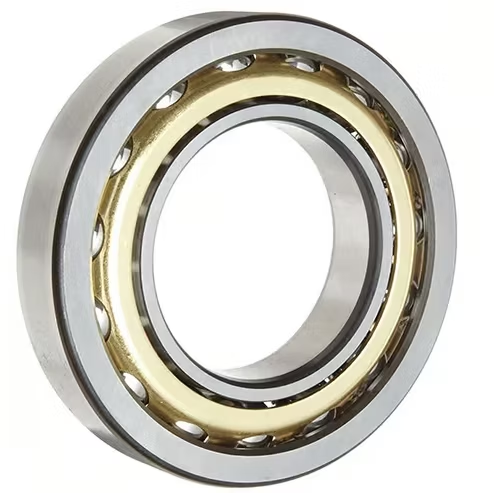
High Speed Precision Angular Contact Ball Bearing — double row bearing steel construction with 60° contact angle optimized for heavy axial thrust loads in machine tool spindles and industrial robots.
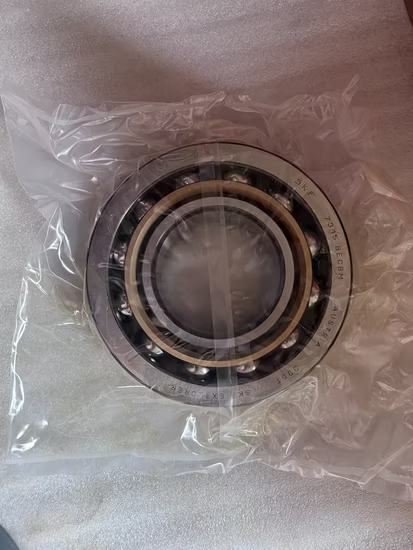
Every unit is authenticated via the brand's official QR verification app with full batch traceability to the originating factory.
Traceable Batch Origins — Every angular contact ball bearing we supply includes manufacturer lot documentation to verify its exact production run.
| Parameter | Value |
|---|---|
| Product Type | Angular Contact Ball Bearing |
| Contact Angle | 60° |
| Number of Rows | Double |
| Load Direction | Thrust Bearing |
| Material | Bearing steel (available in ceramic or stainless steel variants) |
| Separated | Unseparated |
| Vibration Grade | Z1V1, Z2V2, Z3V3 options |
| Origin | Germany, Japan, Sweden, Malaysia, China |
| Industry | Typical Applications |
|---|---|
| Industrial Robotics | Joint actuators and rotary axes requiring high rigidity |
| Metallurgical Equipment | Continuous casting guide mechanisms and roller supports |
| Machine Tool Spindles | High-frequency grinding and milling spindle supports |
Finding a reliable high speed precision angular contact ball bearing supplier is only the first step; ignoring internal geometry tolerances leads to catastrophic thermal binding.
Thermal expansion traps the rolling elements when clearance and precision classes are mismatched.
I once inspected a machining center where standard P0 grade bearings were forced into a high-speed spindle application. The vibration levels exceeded acceptable limits within weeks, causing unplanned downtime and severe surface finish defects. When procurement teams focus solely on base dimensions without verifying the exact precision suffix, the resulting friction generates excessive heat .
Industrial robot joints demand exceptional rigidity and minimal axial play during rapid directional changes. As a dedicated high speed precision angular contact ball bearing supplier, we review the specific axial loads and oscillating speeds of your robotic axes to recommend the optimal internal geometry. This ensures smooth acceleration without compromising the positional accuracy required for automated welding or assembly tasks.
A 60° contact angle is specifically engineered to handle heavy thrust loads, making it ideal for vertical spindle orientations and robotic arm pivots. However, high rotational speeds generate significant internal friction, which drastically affects the operational clearance. If the initial clearance is not carefully selected to accommodate this thermal expansion, the bearing will seize. Proper lubrication selection and precise preload arrangements are therefore critical to maintaining stability across varying temperature profiles .
Selecting the right material and vibration grade directly impacts the operational lifespan of precision equipment. While standard bearing steel provides excellent fatigue strength for most machine tool spindles, applications involving coolant exposure or high humidity may require stainless steel variants. For ultra-high-speed robotic joints, ceramic hybrid options significantly reduce centrifugal forces on the outer raceway. Furthermore, specifying Z2V2 or Z3V3 vibration limits ensures that microscopic surface irregularities are minimized, preventing resonance issues in sensitive metallurgical guide mechanisms.
Substituting a standard clearance bearing where a preloaded or specific clearance class is required inevitably leads to premature failure. In high-speed applications, this mismatch causes the cage to experience abnormal stress, eventually resulting in cage fracture and total seizure. Such catastrophic damage not only destroys the bearing but often scores the expensive spindle shaft, voiding equipment warranties and forcing extended production halts .
Mixed-brand requirements often lead to cross-reference errors where the base designation matches, but the internal design differs entirely. We prevent this by verifying the exact contact angle, cage material, and precision class across all requested brands, ensuring true interchangeability. Our batch traceability allows you to verify the origin of every double row unseparated bearing through official manufacturer applications. Additionally, we provide application-based selection reviews that account for the specific thrust loads and thermal conditions of your robotic or metallurgical equipment.
To ensure optimal performance, please provide your equipment model, available mounting space, and specific operational parameters including axial load and maximum rotational speed. Our engineering team will utilize this data to determine the exact designation, precision class, and preload arrangement required. Detailing the environmental conditions, such as exposure to metallurgical dust or coolant, allows us to recommend the most suitable material and sealing configuration.
Q: How do we determine the exact bearing designation for a new robotic joint design?
A: Share the specific axial and radial loads, maximum rotational speed, and required rigidity with our engineering team. We analyze these parameters to calculate the necessary contact angle, precision class, and preload arrangement, ensuring the selected bearing prevents deflection during high-speed robotic movements.
Q: What causes premature failure in high-speed angular contact ball bearings?
A: The most frequent cause is thermal binding due to incorrect clearance selection. When high speeds generate excessive heat, a standard clearance bearing expands and traps the rolling elements. Properly matching the clearance class to the operational temperature profile is essential to prevent catastrophic seizure.
Q: How can we verify the authenticity of the bearings upon delivery?
A: Every bearing we supply features batch traceability and can be verified using the manufacturer's official mobile application. Scanning the QR code on the packaging confirms the production facility, lot number, and original specifications, eliminating the risk of installing counterfeit components with soft inner rings.
Q: Why is exact cross-reference matching critical when switching bearing brands?
A: Base dimensions often match across brands, but internal geometries like cage design, contact angle, and precision tolerances can vary significantly. We verify these specific suffixes to ensure the replacement bearing handles the exact thrust loads and speed requirements of your machine tool spindle without causing vibration.
Our 5-step process ensures every order is engineered, validated, and supported for optimal performance.
Technical needs assessment
Custom specifications
Free samples for $50k+
Pre-shipment inspection
On-site & predictive
Our certified engineers respond within 24 hours with detailed technical specifications, pricing, and lead time information.
![B7220-C-T-P4 Angular Contact Ball Bearing 40tac72 for Machine Tool Spindles [WARN] draft identifier mismatch](https://skfiso.com/wp-content/uploads/2026/09/b7220-c-t-p4-angular-contact-ball-bearing-40tac72-for-machine-tool-spindles-warn-draft-identifier-mismatch-3a23fe.avif)
![7216 Becbm 7216 CD/P4a Angular Contact Bearing Wholesale Supplier [WARN] draft identifier mismatch](https://skfiso.com/wp-content/uploads/2026/09/7216-becbm-7216-cd-p4a-angular-contact-bearing-wholesale-supplier-warn-draft-identifier-mismatch-1cd42e.avif)