01
Consultation
Technical needs assessment



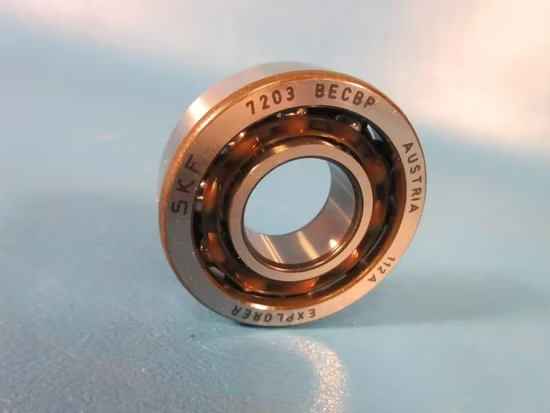

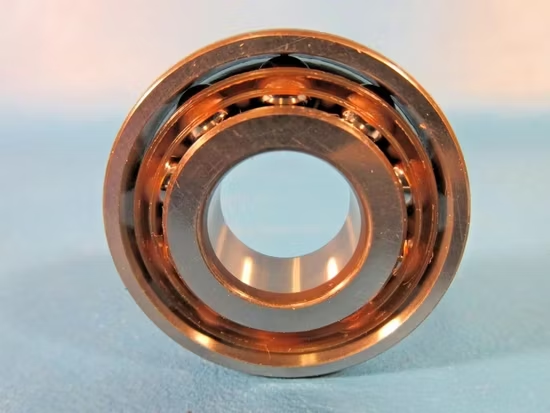
7202 CD/P4a Angular Contact Ball Bearing — engineered with a 15° contact angle for reduced friction heat and P4a class accuracy for strict running precision.
Unified authorized sourcing — One consolidated order fulfills your mixed-brand spindle requirements with full traceability across every manufacturer.
| Parameter | Value |
|---|---|
| Designation | 7202 CD/P4a |
| Bearing Type | Angular Contact Ball Bearing |
| Contact Angle | 15° optimized design (CD) |
| Precision Class | Class 4 dimensional accuracy with additional running accuracy (P4a) |
| Rows Number | Double |
| Separated | Unseparated |
| Load Direction | Thrust Bearing |
| Material | Bearing Steel |
| Vibration Level | Z1V1, Z2V2, Z3V3 |
| Origin | Germany, Japan, Sweden, Malaysia, China |
Note: Suffix variations such as Becbp or Cdga appearing in broader catalog searches are not part of this specific identifier and require separate manufacturer catalog confirmation.
| Industry | Typical Applications |
|---|---|
| Machine Tool Manufacturing | High-speed motorized spindles and precision grinding heads |
| Industrial Automation | High-speed centrifugal pumps and robotic joint actuators |
| Precision Engineering | Coordinate measuring machines and optical inspection spindles |
Precision spindles fail when procurement treats a 7202 CD/P4a angular contact ball bearing as a generic replacement part.
Thermal binding occurs when standard tolerances replace the tighter running accuracy required by the P4a class.
I have seen entire machining centers shut down on the showroom floor in Hanover because a cross-reference matched the base number but overlooked the specific running accuracy requirements. When high-speed rotation generates friction heat, inadequate dimensional control leads to cage failure or shaft seizure. Sourcing teams often focus solely on the bore and outside diameter, missing the fact that the internal geometry dictates the thermal limit of the assembly .
Selecting the right component for a motorized spindle requires looking beyond basic load ratings. The 7202 CD/P4a angular contact ball bearing provides the exact dimensional stability needed for continuous high-RPM operation. Our technical team reviews your specific speed and thermal profiles to ensure the selected precision class matches the spindle manufacturer's original design intent, preventing premature wear.
Spindle environments generate significant friction heat, which directly impacts internal clearance and lubricant viscosity. If the thermal expansion of the shaft and housing is not accounted for, the bearing can experience preload loss or excessive tightening. Oil-air or oil-mist lubrication systems are typically required to manage these temperatures without introducing the churning losses associated with grease . Contamination from coolant or metal fines further complicates the sealing requirements.
The CD suffix designates a 15° contact angle, an optimized geometry that minimizes friction heat while maintaining sufficient axial rigidity for high-speed cutting operations. The P4a designation goes beyond standard dimensional tolerances, enforcing strict running accuracy limits that are critical for minimizing vibration and ensuring superior surface finish on machined parts. Combined with Z1V1 to Z3V3 vibration controls, this configuration ensures the bearing steel races and rolling elements operate with minimal acoustic and mechanical disturbance.
Installing a component with an incorrect contact angle or relaxed precision class leads to catastrophic spindle damage. Unplanned downtime, scrapped high-value workpieces, and voided machine tool warranties are common consequences of ignoring suffix details. According to failure analysis frameworks, a significant share of premature failures stems from improper application matching rather than material defects .
Counterfeit bearings often feature soft inner rings and cloned QR codes that pass casual visual inspections but fail under spindle loads. We supply genuine products with batch traceability, ensuring the P4a running accuracy is authentic. Our cross-brand interchange expertise guarantees that clearance, cage material, and precision suffixes align perfectly with your OEM specifications. We eliminate the risk of receiving a standard P0 grade disguised as a high-precision unit.
To ensure optimal spindle performance, share your radial and axial load profiles, maximum operating speeds, and thermal constraints. Providing the OEM equipment number allows our engineering team to perform a precise cross-reference review, verifying that the contact angle and running accuracy align with the original design. This technical validation prevents costly mismatch errors during procurement.
Q: Why does a base number match still cause spindle failure?
A: Matching only the base designation ignores critical internal geometry. If the 15° contact angle or the strict P4a running accuracy is substituted with a standard tolerance or different angle, the spindle will experience thermal binding or excessive vibration, leading to rapid cage failure and unplanned downtime.
Q: What makes P4a different from standard P4 precision?
A: While standard P4 controls basic dimensional tolerances, the P4a designation enforces significantly tighter running accuracy limits. This additional control minimizes axial and radial runout during high-speed rotation, which is essential for achieving superior surface finishes in precision grinding and milling applications.
Q: How does the 15° CD contact angle affect spindle performance?
A: The 15° optimized design reduces friction and heat generation at high rotational speeds compared to steeper angles. This geometry provides the necessary axial rigidity for cutting forces while maintaining the thermal stability required to prevent preload loss in motorized spindles.
Q: How can I verify the authenticity of the P4a precision class?
A: Authenticity is confirmed through batch traceability and QR verification using the manufacturer's official app. We also provide a dimensional and running accuracy inspection report, ensuring the specific P4a tolerances are met before the bearing is shipped for spindle integration.
Our 5-step process ensures every order is engineered, validated, and supported for optimal performance.
Technical needs assessment
Custom specifications
Free samples for $50k+
Pre-shipment inspection
On-site & predictive
Our certified engineers respond within 24 hours with detailed technical specifications, pricing, and lead time information.
![B7220-C-T-P4 Angular Contact Ball Bearing 40tac72 for Machine Tool Spindles [WARN] draft identifier mismatch](https://skfiso.com/wp-content/uploads/2026/09/b7220-c-t-p4-angular-contact-ball-bearing-40tac72-for-machine-tool-spindles-warn-draft-identifier-mismatch-3a23fe.avif)