01
Consultation
Technical needs assessment

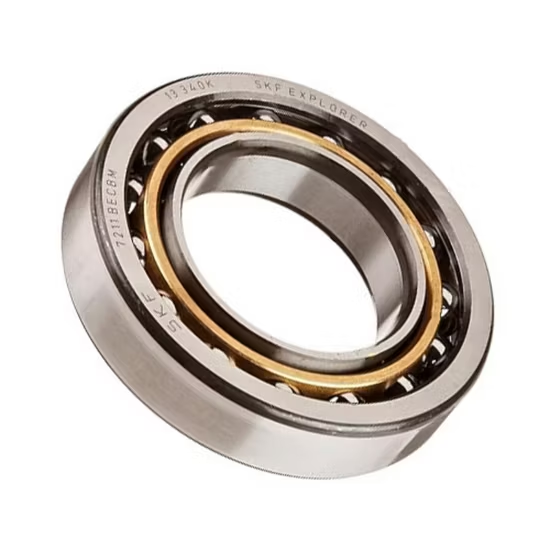
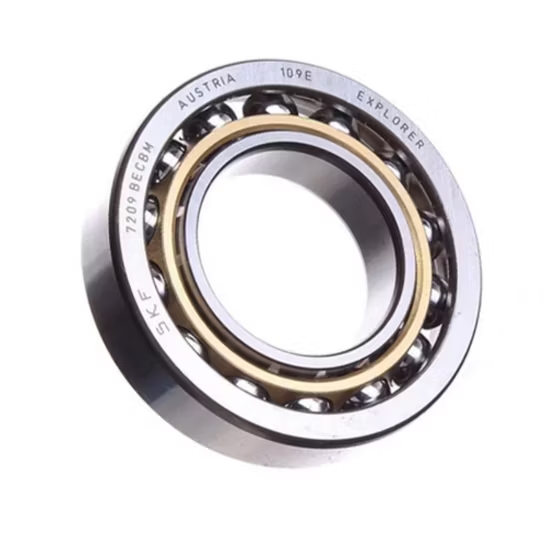

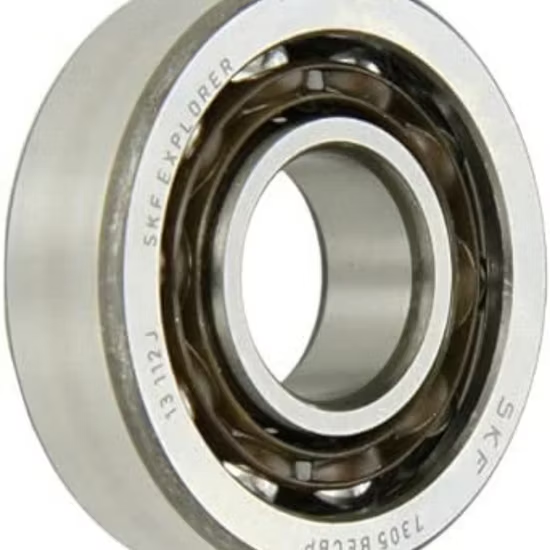
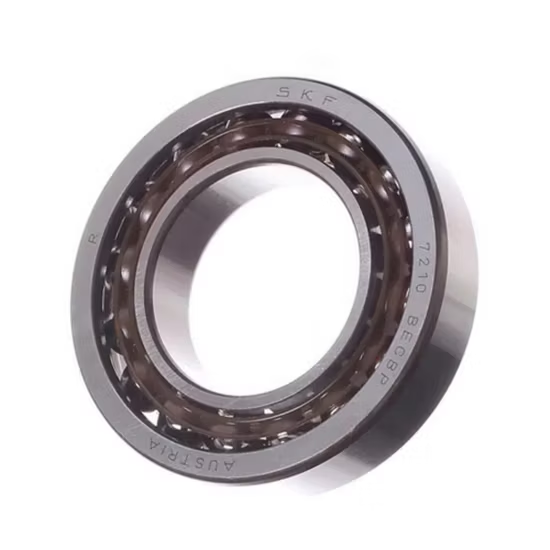

71808 CD/P4 Angular Contact Ball Bearing 40 mm Bore P4 Precision — featuring a 15° contact angle to minimize friction heat during high-speed spindle operations. The ultra-thin cross-section design fits compact layouts.
Multi-Brand Authorized Sourcing — Procure the 71808 CD/P4 angular contact ball bearing alongside mixed-brand spindle components in one consolidated shipment, eliminating multi-vendor coordination.
| Parameter | Value |
|---|---|
| Designation | 71808 CD/P4 |
| Product Type | Angular Contact Ball Bearing |
| Bore Diameter (d) | 40 mm |
| Dimension Series | 18 (Ultra-thin cross section) |
| Contact Angle | 15° |
| Precision Class | P4 |
| Material Options | Bearing steel, with ceramic or stainless steel variants available |
| Origin Options | Germany, Japan, Sweden, Malaysia, or China |
| Vibration Levels | Z1V1, Z2V2, Z3V3 |
| HS Code | 8482102000 |
Note: Suffix variations such as "D" or "ga" appearing in cross-references require manufacturer catalog confirmation for exact internal design or preload specifics.
| Industry | Typical Applications |
|---|---|
| Machine Tool Manufacturing | High-speed milling and grinding spindle shaft support |
| Robotics & Automation | Compact joint actuators requiring ultra-thin section profiles |
| Precision Equipment | High-speed pump shafts and optical measuring instrument rotors |
Base number matches do not guarantee internal design compatibility.
Procurement teams often approve replacements based solely on the 71808 bore and series dimensions, overlooking critical suffix variations. I have inspected seized spindles where a standard clearance bearing was forced into a high-speed application requiring specific thermal expansion allowances, leading to catastrophic cage failure within hours . When sourcing a 71808 CD/P4 angular contact ball bearing, ignoring the exact contact angle, precision class, and internal geometry invites severe thermal binding. Precision machining environments cannot tolerate the vibration and heat generated by misapplied internal clearances or incorrect cage materials.
Selecting the correct 71808 CD/P4 angular contact ball bearing requires aligning the ultra-thin cross-section with the exact radial and axial load profiles of the spindle. Our engineering review process verifies that the 15° contact angle and P4 precision class match the original equipment manufacturer's rigidity requirements. We cross-reference not just the base designation, but the exact internal geometry to ensure the replacement handles the specific high-speed切削 forces without premature deflection.
The ultra-thin cross-section of the 718 series leaves minimal volume for lubricant retention and heat dissipation. At elevated rotational speeds, friction heat rapidly degrades standard greases, necessitating precise oil-air or oil-jet lubrication systems to prevent raceway scoring . Furthermore, the thin rings are highly susceptible to deformation during interference fits; excessive mounting pressure can instantly eliminate the internal clearance, causing immediate operational binding and accelerated fatigue.
The "C" suffix designates a 15° contact angle, which optimizes the bearing for high-speed rotation by minimizing centrifugal forces and friction heat compared to higher-angle variants. Achieving P4 precision ensures that the dimensional and running accuracy strictly adheres to tight tolerances, which is mandatory for maintaining the sub-micron rotational accuracy required in machine tool spindles. The ultra-thin 718 series design allows engineers to fit these high-precision components into compact machinery layouts without sacrificing the axial rigidity needed for heavy cutting operations.
Installing counterfeit bearings with soft inner rings or cloned QR codes leads to unpredictable dimensional instability under load. According to ISO 281 frameworks, fatigue life calculations become entirely invalid when material hardness falls below specification, resulting in unplanned downtime and catastrophic damage to the spindle housing . A premature spindle failure not only voids equipment warranties but also scraps expensive workpieces and halts entire production lines.
We maintain authorized distribution channels across major international brands, ensuring every 71808 CD/P4 angular contact ball bearing ships with verifiable batch traceability. Our cross-reference protocol strictly aligns clearance, cage material, and precision suffixes, preventing the common error of supplying a P0 grade when P4 is explicitly required. We provide application-based selection reviews that account for your specific spindle speed and temperature profiles, backed by full documentation packages that satisfy the most rigorous quality audits.
To ensure exact application matching, please provide your spindle's operational parameters, including radial and axial loads, maximum RPM, and operating temperature ranges. Sharing the original OEM equipment number allows our technical team to perform a comprehensive cross-reference check, verifying that all internal geometry and precision suffixes align perfectly with your machinery's design requirements.
Q: How do I verify the authenticity of the 71808 CD/P4 angular contact ball bearing?
A: We supply full batch traceability documentation and a Certificate of Conformity for every shipment. You can verify the bearing's authenticity by scanning the packaging QR code through the manufacturer's official mobile application, which instantly confirms the origin and eliminates the risk of counterfeit components with soft inner rings.
Q: Why is the 15° contact angle critical for my machine tool spindle?
A: The 15° contact angle, indicated by the "C" suffix, generates significantly less friction heat than 25° or 40° variants. This thermal efficiency is essential for high-speed spindle operations, preventing thermal expansion that could otherwise eliminate internal clearance and cause the bearing to seize during continuous machining cycles.
Q: What does the P4 precision class guarantee compared to standard grades?
A: P4 precision ensures exceptionally tight dimensional and running accuracy, which is mandatory for maintaining sub-micron rotational stability in precision equipment. Using a standard P0 or P5 grade in a high-speed spindle introduces unacceptable vibration and runout, directly compromising the surface finish of the machined workpieces.
Q: How should I handle unverified suffixes like "ga" during cross-referencing?
A: Suffixes like "ga" often denote specific preload arrangements or internal design variations that differ between manufacturers. We require the exact OEM equipment number or original bearing photos to cross-reference these unverified suffixes against official catalogs, ensuring the replacement matches the exact preload and rigidity requirements of your spindle.
Our 5-step process ensures every order is engineered, validated, and supported for optimal performance.
Technical needs assessment
Custom specifications
Free samples for $50k+
Pre-shipment inspection
On-site & predictive
Our certified engineers respond within 24 hours with detailed technical specifications, pricing, and lead time information.
![7201 Becbp Angular Contact Ball Bearing High Speed Precision NSK Timken [WARN] draft identifier mismatch](https://skfiso.com/wp-content/uploads/2026/09/7201-becbp-angular-contact-ball-bearing-high-speed-precision-nsk-timken-warn-draft-identifier-mismatch-c9f392.avif)


