01
Consultation
Technical needs assessment


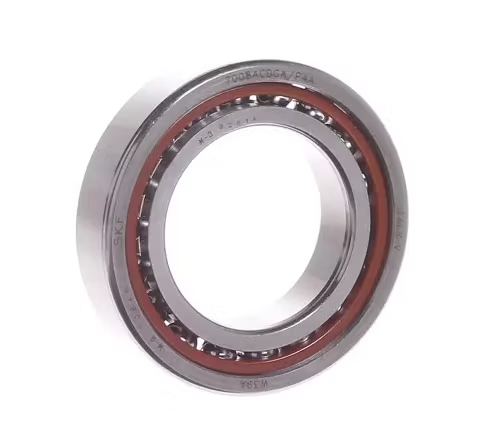
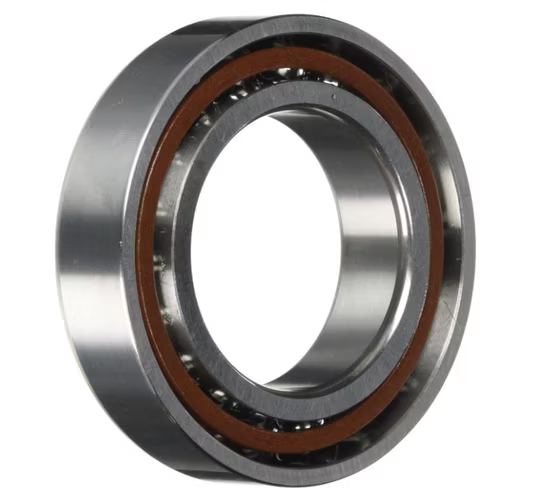
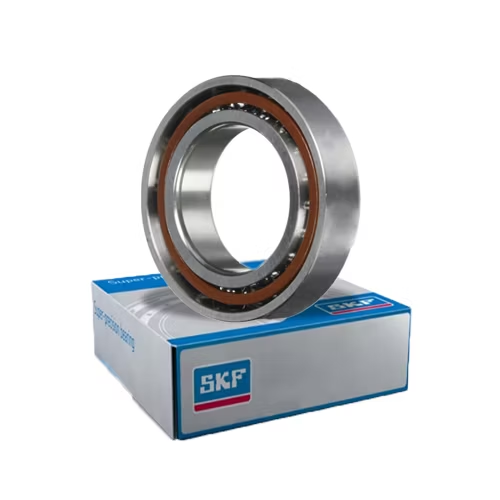
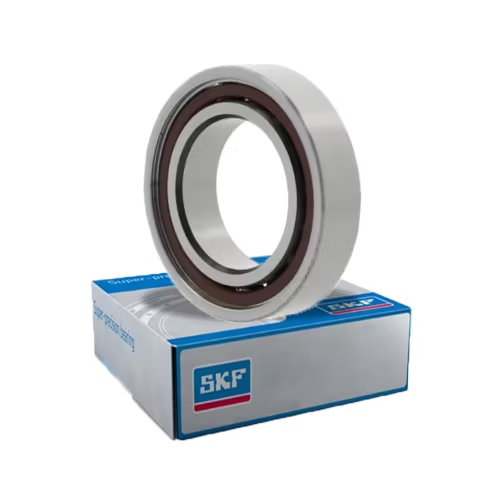
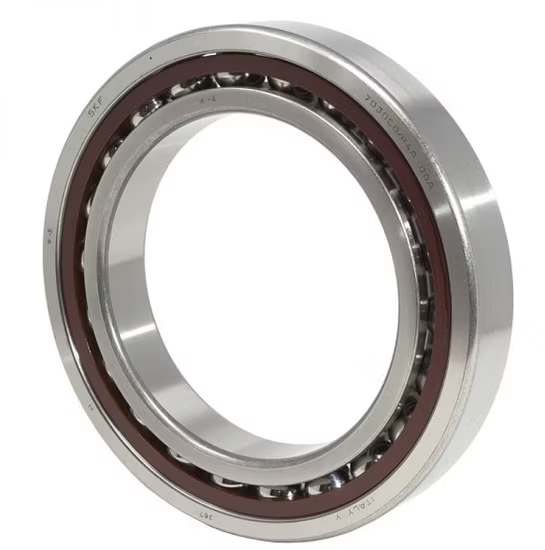
7011 CD/P4a Angular Contact Ball Bearing — engineered with a 15° contact angle to minimize friction heat and P4a precision for demanding machine tool spindles.
Strict Cross-Reference Alignment — verifying clearance, cage material, and precision suffixes prevents thermal binding in high-speed spindles.
| Parameter | Value |
|---|---|
| Designation | 7011 CD/P4a |
| Bearing Type | Angular Contact Ball Bearing |
| Material | Bearing Steel (ceramic or stainless steel variants available) |
| Contact Angle | 15° (CD design) |
| Precision Class | P4a |
| Vibration Level | Z1V1, Z2V2, Z3V3 |
| Origin | Germany, Japan, Sweden, Malaysia, China |
| HS Code | 8482102000 |
Note: The dga suffix found in the 7011 Cdga/P4a cross-reference variant is unverified and requires manufacturer catalog confirmation before procurement.
| Industry | Typical Applications |
|---|---|
| Machine Tool Manufacturing | High-speed motorized spindles and precision grinding heads |
| Industrial Automation | High-precision robotic arm joints and rotary indexing tables |
| Fluid Machinery | High-speed pump shafts requiring strict axial positioning |
Installing standard precision bearings in high-speed spindles guarantees premature thermal failure.
During my early days in quality inspection, I watched an entire batch of precision spindles get rejected because standard P0 grade bearings were forced into the housings. The excessive vibration and rapid heat buildup ruined the machining accuracy . When a 7011 CD/P4a angular contact ball bearing is specified, substituting a lower grade or ignoring the 15° contact angle design leads to catastrophic thermal binding. The internal geometry simply cannot dissipate the friction heat generated at high rotational speeds, causing the cage to fracture and the spindle to seize.
High-speed machining demands exceptional rotational accuracy and minimal heat generation. The 7011 CD/P4a angular contact ball bearing delivers the exact P4a dimensional and running accuracy required to maintain tight tolerances during heavy cutting operations. By strictly aligning the 15° contact angle with the spindle's axial load profile, we ensure the bearing operates within its optimal stiffness range without generating excess friction.
Spindle environments subject bearings to extreme centrifugal forces and rapid temperature fluctuations. At high RPMs, lubricant degradation accelerates, demanding precise oil-air or grease lubrication strategies to prevent cage starvation. The 15° contact angle minimizes sliding friction compared to steeper angles, directly reducing the thermal load on the lubricant . Furthermore, tight housing fits combined with operational heat can eliminate internal clearance, making the initial precision grade and correct mounting practices absolutely critical to avoid preload spikes.
The CD suffix designates an optimized 15° contact angle, which strikes the ideal balance between axial load capacity and high-speed friction reduction. This specific geometry generates noticeably less heat than 25° or 40° alternatives, making it the standard for motorized spindles. The P4a precision class dictates exceptionally tight dimensional and running accuracy tolerances, far surpassing standard P5 or P0 grades. This strict tolerance control ensures the inner and outer rings remain perfectly concentric under load, eliminating the micro-vibrations that degrade surface finish quality in precision grinding and milling applications.
Ignoring suffix variations during cross-referencing leads to unplanned downtime and severe equipment damage. A base number match that overlooks the P4a precision requirement will introduce unacceptable runout, ruining expensive cutting tools and scrapping machined parts. Similarly, substituting a different contact angle alters the internal load distribution, causing premature fatigue and catastrophic spindle seizure . These failures void machine warranties and result in massive financial losses far exceeding the initial component cost.
We enforce a strict three-point alignment on clearance, cage material, and precision suffixes during every cross-reference, ensuring the 7011 CD/P4a matches your exact OEM requirements. Our batch traceability goes back to the manufacturer's production facilities, eliminating the risk of counterfeit bearings with soft inner rings that plague the market. We provide comprehensive application-based selection reviews, verifying that the 15° contact angle and P4a tolerances suit your specific speed and load parameters. Every shipment includes verified documentation, giving procurement engineers absolute confidence in the component's authenticity and performance.
To ensure precise technical validation, please provide your spindle's radial and axial load profiles, maximum operational RPM, and target operating temperatures. Sharing the specific OEM equipment number allows our engineering team to perform a rigorous cross-reference check against the 7011 CD/P4a specifications. This data enables us to confirm the L10 life calculation and verify that the P4a precision class and 15° contact angle perfectly align with your machining requirements.
Q: Why does the P4a precision class matter for this specific application?
A: The P4a class guarantees exceptionally tight dimensional and running accuracy, which is mandatory for high-speed spindles. Standard grades introduce micro-vibrations that degrade machining surface finishes and cause premature tool wear. This strict tolerance ensures the bearing operates smoothly under high centrifugal forces without generating excess friction heat.
Q: How does the 15° CD contact angle affect spindle performance?
A: The 15° contact angle provides an optimal balance between axial stiffness and high-speed capability. It generates noticeably less sliding friction than steeper 25° or 40° angles, keeping the spindle cooler during continuous high-RPM operations. This thermal stability is crucial for maintaining tight machining tolerances over long production cycles.
Q: What risks exist when cross-referencing this bearing to other brands?
A: Matching only the base number while ignoring suffixes like CD or P4a leads to severe operational failures. A different contact angle alters internal load distribution, while a lower precision grade causes unacceptable runout. We strictly align the clearance, cage material, and precision suffixes to ensure the replacement performs identically to the original specification.
Q: Is the 7011 Cdga/P4a variant identical to the standard CD/P4a?
A: While both share the 15° contact angle and P4a precision, the "dga" suffix in the cross-reference variant is currently unverified. It may indicate a specific preload, cage design, or pairing arrangement that differs from the standard configuration. Always consult the manufacturer's catalog or our engineering team to confirm the exact suffix meaning before procurement.
Our 5-step process ensures every order is engineered, validated, and supported for optimal performance.
Technical needs assessment
Custom specifications
Free samples for $50k+
Pre-shipment inspection
On-site & predictive
Our certified engineers respond within 24 hours with detailed technical specifications, pricing, and lead time information.