01
Consultation
Technical needs assessment


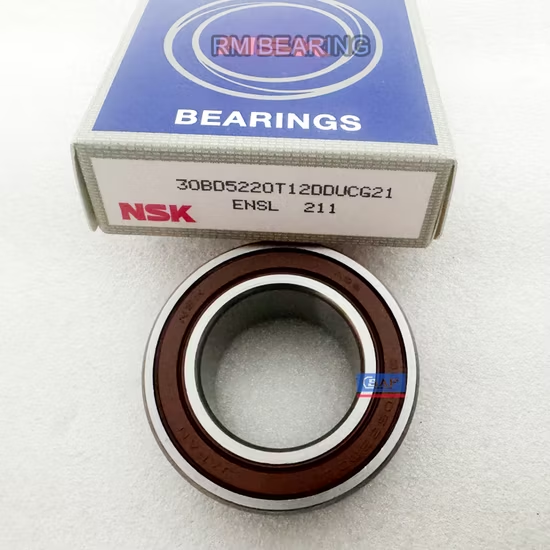

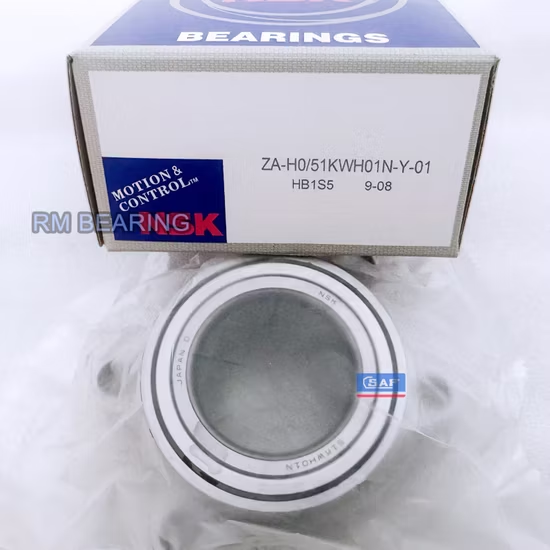


43kwd07 Wheel Hub Bearing 43×77×42 mm
Precision Cross-Reference Alignment — We verify base dimensions, internal clearance, and ABS encoder compatibility when matching 43kwd07 to OEM equivalents.
| Parameter | Value |
|---|---|
| Designation | 43kwd07 |
| Bearing Type | Wheel Hub Bearing |
| Bore Diameter (d) | 43 mm |
| Outside Diameter (D) | 77 mm |
| Width (B) | 42 mm |
| Material | Chrome Steel |
| Precision Class | P4 |
| Clearance Class | C0 |
| ABS Feature | With ABS |
| Number of Rows | Double Row |
| Seal Type | Nylon / Brass / Iron Seal |
| Certification | ISO9001 |
| Industry | Typical Applications |
|---|---|
| Automotive | Passenger vehicle front wheel hub assemblies |
| Light Commercial Vehicles | Delivery van steering knuckle wheel ends |
| Agricultural Machinery | Tractor front axle steering joints |
Matching the outer dimensions is only the first step; the magnetic encoder ring must perfectly align with the vehicle's sensor gap.
I have seen repair shops install hub units where the physical fit was flawless, yet the dashboard lit up with ABS warnings at highway speeds. A slight variance in the encoder tooth count or internal clearance causes signal dropout or thermal binding. Sourcing a 43kwd07 wheel hub bearing 90366-T0007 requires verifying the exact magnetic pole configuration, not just the 43x77x42mm envelope . When cross-referencing to 90366-T0008, overlooking the seal type or encoder depth leads to premature moisture ingress or sensor misalignment.
The 43kwd07 wheel hub bearing 90366-T0007 is engineered to handle the combined radial and axial loads typical in front-wheel-drive steering knuckles. Our technical team reviews the specific vehicle weight distribution and cornering forces to ensure the double-row internal geometry provides adequate load sharing. By confirming the P4 precision class and C0 clearance, we guarantee the hub maintains strict rotational accuracy under dynamic steering inputs.
Front wheel hubs endure severe impact loads from potholes and continuous lateral forces during cornering, demanding high structural rigidity from the chrome steel rings. Water and road salt constantly threaten the internal grease, making the integrity of the nylon or iron seals critical for long-term survival. Temperature fluctuations during braking can alter internal clearance, meaning a C0 class must be precisely matched to the axle's thermal expansion characteristics. Proper installation pressure is equally vital, as excessive force during pressing can brinell the raceways and destroy the ABS encoder .
The double-row configuration distributes cornering loads evenly across the rolling elements, preventing edge stress that typically destroys single-row setups in hub applications. Achieving P4 precision ensures the inner and outer rings maintain strict concentricity, which directly stabilizes the air gap for the ABS sensor. The C0 standard clearance is specifically selected for standard automotive operating temperatures, avoiding the excessive play that a C3 clearance would introduce in this compact 43x77x42mm housing. Depending on the specific vehicle environment, the seal type can be configured with nylon, brass, or iron shields to balance friction and contamination exclusion.
Installing a hub unit with the wrong internal clearance or an incompatible ABS ring inevitably leads to unplanned downtime and compromised vehicle safety. A mismatched encoder causes the anti-lock braking system to disable itself, creating severe liability risks for fleet operators. Furthermore, incorrect seal materials allow rapid grease washout, resulting in catastrophic wheel detachment if left unchecked . Relying on superficial cross-references voids warranties and forces repeat repairs.
We do not just ship boxes; we validate the magnetic encoder pole count to ensure absolute compatibility with the target vehicle's ECU. Our cross-reference checks for 90366-T0007 and 90366-T0008 strictly align the internal clearance and seal materials, eliminating the guesswork that causes field failures. Every batch is traced back to the manufacturer's production facilities, providing full transparency for quality audits. We supply mixed-brand orders with unified documentation, saving purchasing managers from coordinating multiple vendors. Our application engineers review your specific load and speed parameters to confirm the selection before dispatch.
Share your specific vehicle application, including OEM equipment numbers and operating environments, so our engineering team can validate the cross-reference accuracy. Providing details about the braking system type and typical load conditions allows us to confirm the seal and clearance suitability. In return, you receive a comprehensive technical review ensuring the selected hub unit integrates flawlessly with your existing chassis architecture.
Q: What parameters must align when cross-referencing the 43kwd07 beyond basic dimensions?
A: Beyond the 43x77x42mm physical envelope, you must verify the internal clearance class, the exact ABS encoder tooth count, and the seal material. A base number match that ignores these factors will result in thermal binding, sensor dropout, or rapid moisture ingress in the field.
Q: How should the integrated ABS encoder be protected during installation?
A: The magnetic encoder ring is highly sensitive to physical damage and metallic debris. Installers must avoid using magnetic tools near the sensor surface and ensure the pressing force is applied strictly to the correct ring to prevent internal deformation that distorts the signal.
Q: Where is the boundary between selecting C0 and C3 clearance for wheel hubs?
A: C0 is standard for typical automotive thermal profiles where the housing and shaft expand uniformly. C3 is reserved for applications with extreme heat generation or tight interference fits that compress the inner ring, requiring extra internal play to prevent thermal seizure during operation.
Q: How can I verify the authenticity and batch history of the delivered hub units?
A: Each unit is accompanied by original manufacturer batch traceability documents. You can scan the provided QR codes using the official brand application to instantly verify the production origin, material certifications, and dimensional inspection records before installation.
Our 5-step process ensures every order is engineered, validated, and supported for optimal performance.
Technical needs assessment
Custom specifications
Free samples for $50k+
Pre-shipment inspection
On-site & predictive
Our certified engineers respond within 24 hours with detailed technical specifications, pricing, and lead time information.