01
Consultation
Technical needs assessment

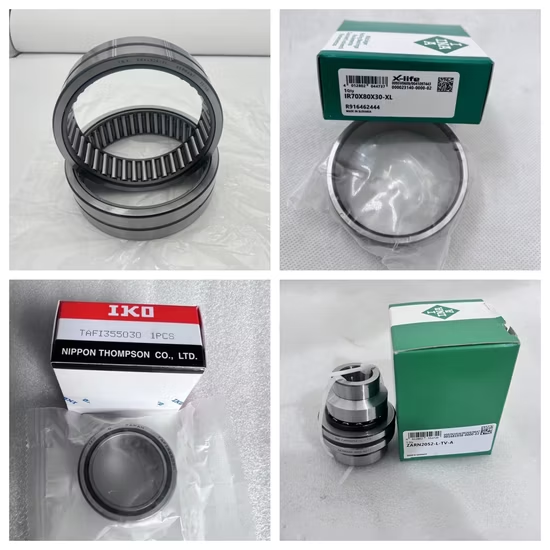
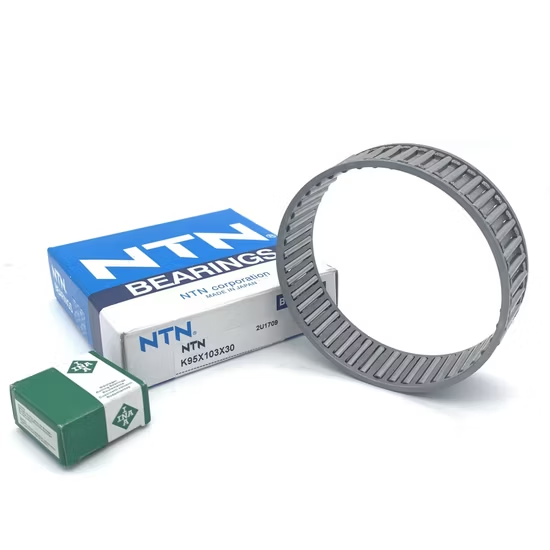
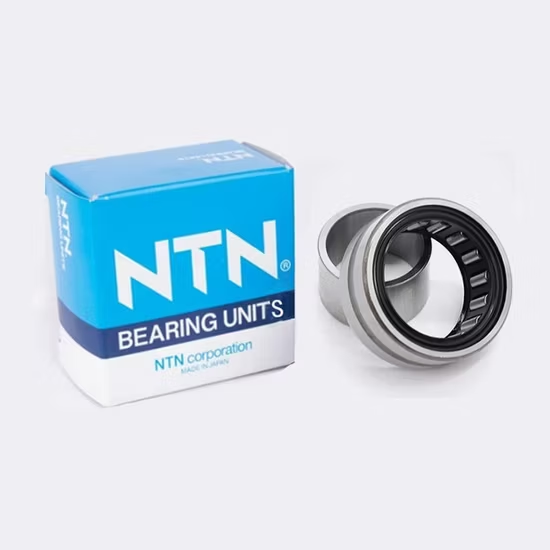
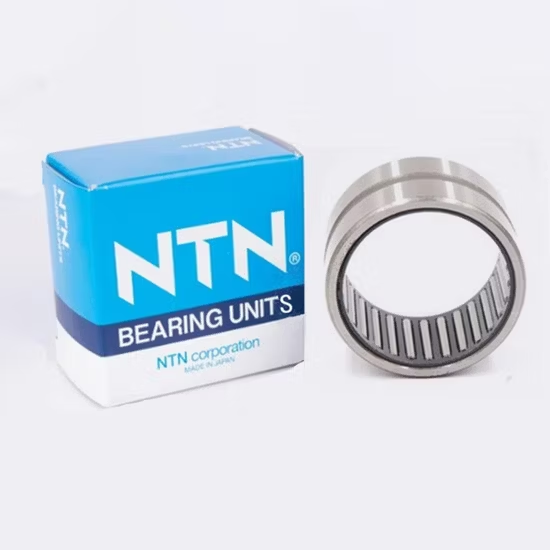
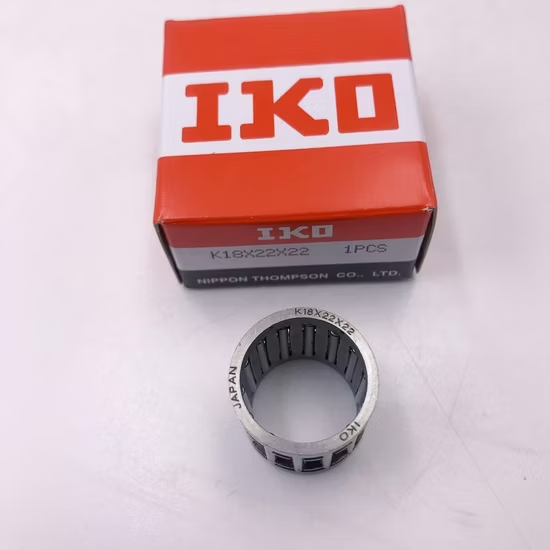
HK 3512 Drawn Cup Needle Roller Bearing features an open end design requiring external sealing and lubrication during installation. The thin-walled drawn cup construction delivers reliable radial load capacity in space-constrained assemblies, utilizing bearing steel for standard industrial durability.
Cross-reference triplet alignment — matching the base designation, dimensional width code, and open-end configuration to prevent assembly interference in compact housings.
| Parameter | Value |
|---|---|
| Designation | HK 3512 |
| Product Type | Needle Roller Bearing |
| Bearing Type | Drawn Cup, Open End |
| Material | Bearing Steel |
| Load Direction | Radial |
| Seal or Shield Type | Open |
| Origin | Multi-origin authorized sourcing |
| Industry | Typical Applications |
|---|---|
| Automotive Components | Transmission shafts, steering column joints, and pedal assemblies |
| Industrial Gearboxes | Planetary gear sets, pivot joints, and counter-shaft supports |
| Material Handling | Conveyor roller ends, lift mechanism linkages, and pallet jack wheels |
Most drawn cup failures stem from ignored housing tolerances rather than the HK 3512 needle roller bearing itself.
When procurement teams source replacement parts, they often match the base number but overlook the open-end configuration. In heavily contaminated environments like agricultural gearboxes or material handling conveyors, an open design without adequate external sealing allows abrasive grit to infiltrate the rolling elements. I have seen countless instances in Dongguan auto-part workshops where the stamped steel cage shattered into fragments because debris compromised the radial clearance, causing the equipment to seize completely under high-vibration conditions . Sourcing genuine components with verified dimensional accuracy is the only way to prevent these catastrophic field failures.
The thin-walled outer ring of this HK 3512 needle roller bearing requires a precise housing bore to maintain its structural integrity during operation. Our technical selection review ensures that the cross-brand interchange matches not just the basic dimensions, but also the exact drawing depth and open-end geometry required by your specific assembly.
Automotive steering columns and transmission shafts subject these components to continuous radial loads combined with high-frequency micro-vibrations. Without the correct housing fit, the drawn cup can creep or distort, leading to premature cage wear. Furthermore, the open type design demands that the surrounding assembly provides sufficient secondary sealing to block moisture and particulate ingress, which is critical for maintaining lubrication effectiveness over the component's service life .
The "HK" prefix explicitly designates a drawn cup needle roller bearing with an open end, meaning it lacks an integrated bottom seal or shield. This open architecture facilitates easier lubrication flow-through in systems where oil splash or continuous grease purging is utilized. The "3512" suffix represents the specific dimension series and width code, dictating the exact radial cross-section and axial space the component occupies. Understanding this nomenclature is vital; substituting a closed-end variant into a blind housing can trap air and cause seal blowout, while ignoring the width code leads to axial misalignment in gear trains.
Installing a component with incorrect width tolerances or unverified material hardness inevitably leads to unplanned downtime and catastrophic damage to the surrounding shaft and housing. When the drawn cup deforms under load due to substandard steel or improper heat treatment, the rolling elements skew, generating excessive friction heat and eventual cage disintegration. According to failure analysis frameworks, a significant share of premature failures in compact radial applications traces back to unverified supply chains providing out-of-tolerance replacement parts .
We provide authorized coverage across all major international brands, allowing you to consolidate mixed-brand requirements into a single, traceable order. For drawn cup bearings, where the thin outer ring is highly susceptible to deformation during transit and handling, our batch traceability ensures every unit is verified against the manufacturer's original production data. We perform strict cross-reference matching on the dimension series and open-end configuration, preventing the costly mistake of receiving sealed variants when your application requires open-ended lubrication flow. Our pre-shipment inspections specifically check the running accuracy and dimensional tolerances of the drawn cup to guarantee a perfect press-fit.
To ensure optimal performance and avoid assembly interference, please provide your exact radial load calculations, operating speed, and housing bore tolerances for our engineering team to review. If you are replacing an existing component, sharing the OEM equipment number or the specific shaft diameter allows us to perform a precise cross-reference check. This technical validation guarantees that the open-end configuration and dimensional width code perfectly align with your lubrication and spatial constraints.
Q: How do I verify the authenticity of HK series needle roller bearings using official brand apps?
A: You can scan the QR code located on the original manufacturer packaging using the brand's official mobile application. This digital verification confirms the batch number, production date, and material origin, ensuring the drawn cup bearing is genuine and has not been compromised by counterfeit supply chains.
Q: What are the critical cross-reference checks when interchanging open-end needle roller bearings?
A: Beyond matching the base designation, you must verify the exact width code and confirm the open-end configuration. Substituting a closed-end variant in a through-bore housing will block lubrication flow, while incorrect width dimensions will cause axial binding or misalignment in tight gear assemblies.
Q: How should I handle the open type design if the application is exposed to heavy contaminants?
A: Since the open type lacks integrated seals, your housing design must incorporate external labyrinth seals, lip seals, or continuous grease purging mechanisms. This external sealing strategy is essential to prevent abrasive particles from entering the rolling elements and destroying the stamped steel cage.
Q: What are the recommended mounting tools for thin-walled drawn cup needle roller bearings?
A: You must use a specialized stepped mounting mandrel that applies the press-fit force exclusively to the outer drawn cup ring. Applying force to the inner rolling elements or cage during installation will instantly deform the thin-walled structure and cause immediate operational failure.
Our 5-step process ensures every order is engineered, validated, and supported for optimal performance.
Technical needs assessment
Custom specifications
Free samples for $50k+
Pre-shipment inspection
On-site & predictive
Our certified engineers respond within 24 hours with detailed technical specifications, pricing, and lead time information.


![Hf0306 0406 0612 0812 1012 1216/Kfr One-Way Needle Roller Bearings for Machinery [WARN] draft identifier mismatch](https://skfiso.com/wp-content/uploads/2026/09/hf0306-0406-0612-0812-1012-1216-kfr-one-way-needle-roller-bearings-for-machinery-warn-draft-identifier-mismatch-155baa.avif)
![Zarn 55115 Ltn Combined Needle Roller Bearing 55x115x82mm [WARN] draft identifier mismatch](https://skfiso.com/wp-content/uploads/2026/09/zarn-55115-ltn-combined-needle-roller-bearing-55x115x82mm-warn-draft-identifier-mismatch-e60599.avif)