01
Consultation
Technical needs assessment

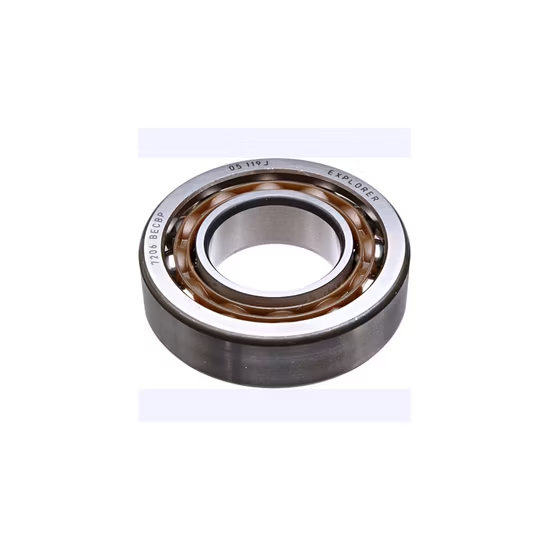


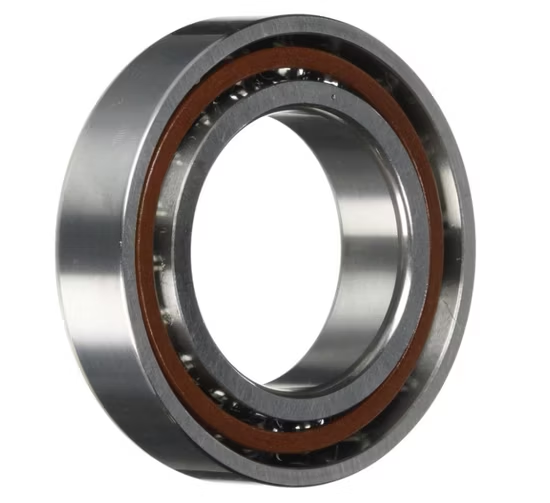


7005acd/P4a dB P4 Angular Contact Ball Bearing — features a 25° contact angle and back-to-back arrangement for high rigidity in machine tool spindles. The P4 precision class ensures tight running accuracy during high-speed operations.
Traceable via official apps — Every 7005acd/P4a dB P4 angular contact ball bearing ships with verifiable QR codes linking directly to the manufacturer's authentication portal.
| Parameter | Value |
|---|---|
| Designation | 7005acd/P4a dB P4 |
| Bearing Type | Angular Contact Ball Bearing |
| Number of Rows | Double |
| Material | Bearing Steel |
| Contact Angle | 25° |
| Arrangement | Back-to-back (dB) |
| Precision Class | P4 |
| Vibration Level | Z1V1, Z2V2, Z3V3 |
| Separated | Unseparated |
| Origin | Germany, Japan, Sweden, Malaysia, China |
Note: The P4a suffix denotes a specific manufacturer's precision variant and requires official catalog confirmation for exact tolerance thresholds.
| Industry | Typical Applications |
|---|---|
| Machine Tool Manufacturing | CNC spindle front and rear support, high-speed milling head |
| Precision Engineering | Robotics joint actuators, coordinate measuring machine axes |
| Fluid Machinery | High-speed pump shaft support, compressor rotors |
Precision suffixes dictate survival in high-speed machining.
Procurement teams often approve replacements based solely on the base number, ignoring critical suffix variations. In my years working across the Pearl River Delta manufacturing hub, I witnessed a P0 grade bearing mistakenly installed in a precision CNC spindle. The resulting high-speed vibration ruined an entire batch of aerospace components. When sourcing a 7005acd/P4a dB P4 angular contact ball bearing, overlooking the contact angle or pairing arrangement leads to thermal binding and catastrophic cage failure under operational loads .
The 25° contact angle in this configuration provides an optimal balance for CNC spindles that experience combined radial and axial cutting forces. Unlike 15° variants designed purely for ultra-high speeds with light axial loads, or 40° versions meant for heavy axial thrust, this specific geometry maintains rigidity during intermittent milling operations. We review your exact load profiles to ensure this 7005acd/P4a dB P4 angular contact ball bearing aligns with your spindle's operational demands.
High-speed spindle operations generate significant friction heat, altering internal clearances and preload conditions. The back-to-back (dB) arrangement places the load lines outside the bearing span, providing high rigidity and excellent resistance to moment loads caused by tool overhang. As temperatures rise, the shaft expands more than the housing, which naturally increases the preload in a back-to-back setup, preventing the dangerous loss of stiffness that causes chatter marks on machined surfaces .
The P4 precision class ensures tight dimensional and running accuracy, which is mandatory for minimizing spindle runout at elevated RPMs. The acd suffix confirms the 25° optimized internal design, while the dB designation guarantees the back-to-back pairing. Because these components are unseparated and matched at the factory, the internal load distribution is precisely calibrated. The bearing steel construction, combined with controlled vibration levels up to Z3V3, ensures smooth rotation without the harmonic disturbances that degrade surface finish quality.
Installing a bearing with the correct base number but wrong internal geometry leads to premature fatigue and unplanned downtime. If a face-to-face pair is substituted for this back-to-back requirement, the spindle loses its moment load rigidity, causing severe tool deflection. Such mismatches void equipment warranties and result in catastrophic damage to the spindle housing, far exceeding the initial component cost .
We enforce strict cross-reference alignment on clearance, cage material, and precision suffixes, not just the base designation. For this model, we verify the exact dB pairing marks to prevent assembly errors that compromise preload. Our authorized coverage across major brands means you receive genuine products with full batch traceability, eliminating the risk of counterfeits with soft inner rings that fail under high-speed centrifugal forces. We provide application-based selection reviews to confirm the 25° contact angle suits your specific thermal and load environment.
To ensure optimal spindle performance, share your specific radial and axial cutting forces, maximum operating RPM, and expected thermal gradients. Our engineering team will perform an L10 life calculation and verify the preload suitability for your exact housing tolerances. Providing the OEM equipment number allows us to execute a precise cross-reference check, confirming all internal design parameters match the original specification.
Q: How do I verify the authenticity of the delivered bearings?
A: Every unit includes a unique QR code scannable via the manufacturer's official mobile application. This provides instant verification of the production batch, origin, and precision grade, ensuring you receive genuine components rather than counterfeits with compromised metallurgical properties that fail under high-speed CNC operations.
Q: Why must cross-referencing include the dB and acd suffixes?
A: Matching only the base number ignores critical internal geometry. The dB suffix ensures back-to-back rigidity for moment loads, while acd confirms the 25° contact angle. Substituting different arrangements or angles alters preload behavior and thermal expansion characteristics, leading to rapid spindle failure and poor machining accuracy.
Q: What is the impact of the P4 precision class on spindle runout?
A: The P4 class guarantees exceptionally tight dimensional and running accuracy tolerances. This minimizes radial and axial runout at high rotational speeds, which is essential for achieving fine surface finishes and maintaining tight dimensional tolerances on the workpieces produced by the CNC machine tool.
Q: How does the back-to-back arrangement affect rigidity compared to face-to-face?
A: The back-to-back (dB) configuration places the pressure lines outside the bearing span, creating a wider effective support base. This provides significantly higher rigidity and resistance to overturning moments caused by tool overhang or intermittent cutting forces, making it the preferred choice for most precision milling and grinding spindles.
Our 5-step process ensures every order is engineered, validated, and supported for optimal performance.
Technical needs assessment
Custom specifications
Free samples for $50k+
Pre-shipment inspection
On-site & predictive
Our certified engineers respond within 24 hours with detailed technical specifications, pricing, and lead time information.
![71915 CD/P4a Angular Contact Ball Bearing NSK NTN Timken Koyo P4A Precision [WARN] draft identifier mismatch](https://skfiso.com/wp-content/uploads/2026/09/71915-cd-p4a-angular-contact-ball-bearing-nsk-ntn-timken-koyo-p4a-precision-warn-draft-identifier-mismatch-fffc66.avif)

