01
Consultation
Technical needs assessment

![71915 CD/P4a Angular Contact Ball Bearing NSK NTN Timken Koyo P4A Precision [WARN] draft identifier mismatch - 1](https://skfiso.com/wp-content/uploads/2026/09/71915-cd-p4a-angular-contact-ball-bearing-nsk-ntn-timken-koyo-p4a-precision-warn-draft-identifier-mismatch-fffc66.avif)
![71915 CD/P4a Angular Contact Ball Bearing NSK NTN Timken Koyo P4A Precision [WARN] draft identifier mismatch - 2](https://skfiso.com/wp-content/uploads/2026/09/71915-cd-p4a-angular-contact-ball-bearing-nsk-ntn-timken-koyo-p4a-precision-warn-draft-identifier-mismatch-b8f8a4.avif)
![71915 CD/P4a Angular Contact Ball Bearing NSK NTN Timken Koyo P4A Precision [WARN] draft identifier mismatch - 3](https://skfiso.com/wp-content/uploads/2026/09/71915-cd-p4a-angular-contact-ball-bearing-nsk-ntn-timken-koyo-p4a-precision-warn-draft-identifier-mismatch-75c4d5.avif)
![71915 CD/P4a Angular Contact Ball Bearing NSK NTN Timken Koyo P4A Precision [WARN] draft identifier mismatch - 4](https://skfiso.com/wp-content/uploads/2026/09/71915-cd-p4a-angular-contact-ball-bearing-nsk-ntn-timken-koyo-p4a-precision-warn-draft-identifier-mismatch-33ccef.avif)
![71915 CD/P4a Angular Contact Ball Bearing NSK NTN Timken Koyo P4A Precision [WARN] draft identifier mismatch - 5](https://skfiso.com/wp-content/uploads/2026/09/71915-cd-p4a-angular-contact-ball-bearing-nsk-ntn-timken-koyo-p4a-precision-warn-draft-identifier-mismatch-d38c5c.avif)
![71915 CD/P4a Angular Contact Ball Bearing NSK NTN Timken Koyo P4A Precision [WARN] draft identifier mismatch - 6](https://skfiso.com/wp-content/uploads/2026/09/71915-cd-p4a-angular-contact-ball-bearing-nsk-ntn-timken-koyo-p4a-precision-warn-draft-identifier-mismatch-b73d4a.avif)
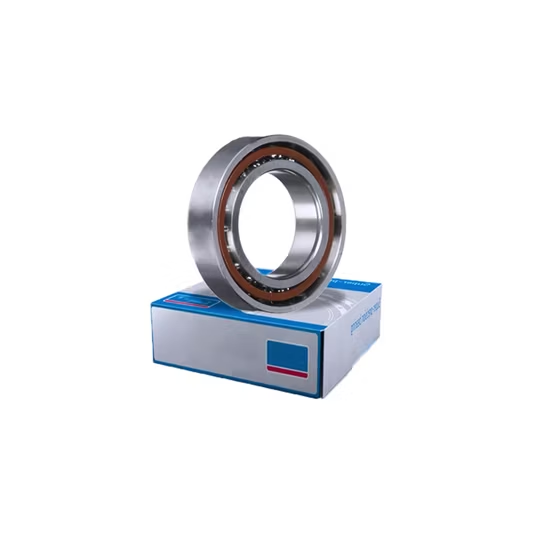
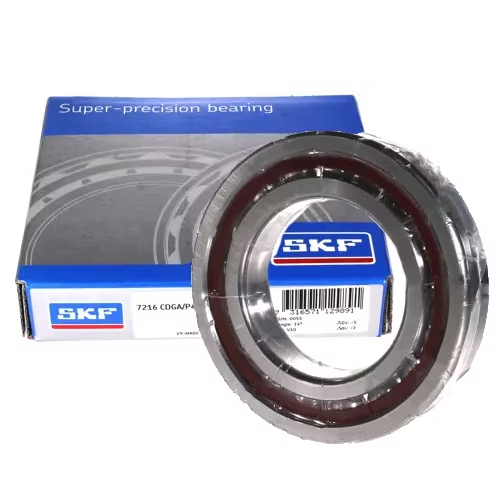
71915 CD/P4a Angular Contact Ball Bearing
Official App QR Verification — Every 71915 CD/P4a angular contact ball bearing we dispatch includes a scannable code linking directly to the manufacturer's authenticity database.
| Parameter | Value |
|---|---|
| Designation | 71915 CD/P4a |
| Product Type | Angular Contact Ball Bearing |
| Bore Diameter (d) | 75 mm |
| Outside Diameter (D) | 105 mm |
| Width (B) | 16 mm |
| Contact Angle | 15° |
| Precision Class | P4A |
| Number of Rows | Single |
| Material | Bearing Steel |
| Origin | Germany / Japan / Sweden / Malaysia / China |
| Industry | Typical Applications |
|---|---|
| Machine Tool Manufacturing | High-speed milling spindle front and rear supports |
| Precision Equipment | Optical grinding machine headstock assemblies |
| Robotics | High-rigidity rotary joints and actuator mechanisms |
| Industrial Pumps | High-speed centrifugal pump shaft locating supports |
Precision is defined by the suffix, not the base number.
Sourcing teams often match the 75x105x16 mm envelope dimensions and assume the job is done, overlooking the critical CD and P4a designators. I have walked into workshops where standard P0 grade bearings were pressed into high-speed spindles, resulting in immediate vibration spikes and thermal seizure once the machine hit operating RPM. A 71915 CD/P4a angular contact ball bearing requires exact alignment of the contact angle and running accuracy to function. When procurement ignores these specific suffixes during cross-referencing, the resulting mismatch guarantees premature failure and costly unplanned downtime .
The CD suffix dictates a 15° contact angle, an optimized geometry specifically engineered for high-speed, light-load applications. In machine tool spindles, this narrower angle minimizes internal friction and heat generation compared to larger 25° or 40° alternatives. When selecting a 71915 CD/P4a angular contact ball bearing for a milling headstock, this specific geometry ensures the spindle maintains thermal stability during prolonged high-RPM operations, preventing the thermal expansion that typically destroys running accuracy.
High-speed spindle environments generate significant friction heat, which directly impacts internal clearance and lubricant lifespan. The 15° contact angle helps mitigate heat generation, but the lubrication strategy must match. Oil-air or oil-mist lubrication is typically required to carry heat away from the contact zones without creating the churning losses associated with grease. Furthermore, the precision ground raceways demand ultra-clean lubricants to prevent microscopic particle indentation, which rapidly degrades the P4A running accuracy .
The P4a suffix indicates P4A precision, a classification that strictly controls both dimensional tolerances and running accuracy (such as inner and outer ring runout). While standard P4 or ABEC 7 bearings meet basic dimensional requirements, the enhanced running accuracy of the P4A class is non-negotiable for precision spindles. This stringent control ensures that the spindle nose exhibits minimal radial and axial runout, which is the fundamental requirement for achieving mirror-finish surface quality in precision grinding and high-speed milling operations.
Installing a bearing that lacks the P4A running accuracy controls leads to tolerance stacking within the spindle assembly. This misalignment forces the rolling elements to skid rather than roll, rapidly degrading the raceways. According to failure analysis frameworks, this skidding manifests as smearing and eventual cage breakdown. The hidden costs extend far beyond the replacement part; they encompass scrapped workpieces, missed delivery deadlines, and the extensive labor required to rebuild the entire spindle cartridge .
We do not just pick boxes from a shelf; we verify the cross-reference against the actual application demands. Many suppliers will substitute a standard P4 or a 25° contact angle variant when the exact 71915 CD/P4a angular contact ball bearing is unavailable, assuming the base dimensions are sufficient. Our engineering review catches these dangerous substitutions before they ship. By providing authorized coverage across major international brands, we ensure that the specific CD geometry and P4A running accuracy you require are exactly what gets installed in your spindle.
To ensure the selected configuration meets your exact operational demands, please provide the spindle's maximum operating speed, expected radial and axial cutting forces, and the target operating temperature range. If you are replacing an existing unit, sharing the OEM equipment serial number or the original spindle drawing allows our technical team to perform a precise cross-reference check and L10 life calculation, confirming the suitability of the 15° contact angle and P4A precision class for your specific machining process.
Q: Why is the P4A suffix critical compared to standard P4?
A: While both denote high precision, P4A enforces significantly tighter controls on running accuracy, specifically inner and outer ring runout. For high-speed machine tool spindles, this enhanced running accuracy prevents vibration and ensures superior surface finish on machined parts, which standard P4 tolerances cannot consistently guarantee under dynamic loads.
Q: What happens if I substitute a 25° contact angle for the CD suffix?
A: The CD suffix specifies a 15° contact angle optimized for high-speed, light-load applications. Substituting a 25° or 40° variant increases internal friction and axial stiffness, generating excessive heat at high RPMs. This thermal expansion alters the internal geometry, leading to premature failure and loss of spindle accuracy.
Q: How do we verify the authenticity of the received batch?
A: Every bearing we supply features a unique QR code that can be scanned using the manufacturer's official mobile application. This digital verification confirms the production facility, batch number, and original specifications, ensuring the P4A precision grade and material traceability are genuine and untampered.
Q: Can this bearing be used in a paired arrangement?
A: Yes, single-row angular contact bearings are frequently used in back-to-back or face-to-face pairs to handle bidirectional axial loads and increase rigidity. However, the mating surfaces and shaft seats must be machined to tight tolerances to ensure the load is distributed evenly across both rings without inducing internal preload errors.
Our 5-step process ensures every order is engineered, validated, and supported for optimal performance.
Technical needs assessment
Custom specifications
Free samples for $50k+
Pre-shipment inspection
On-site & predictive
Our certified engineers respond within 24 hours with detailed technical specifications, pricing, and lead time information.