01
Consultation
Technical needs assessment



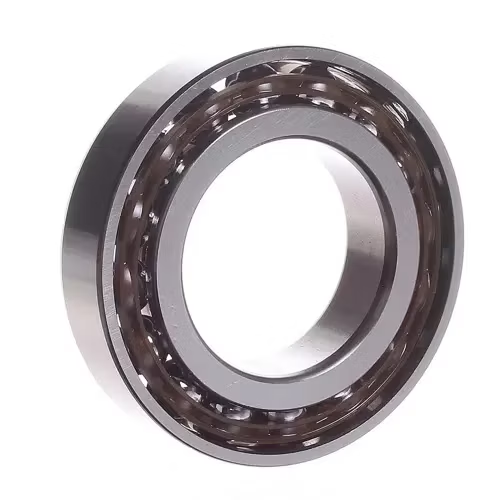

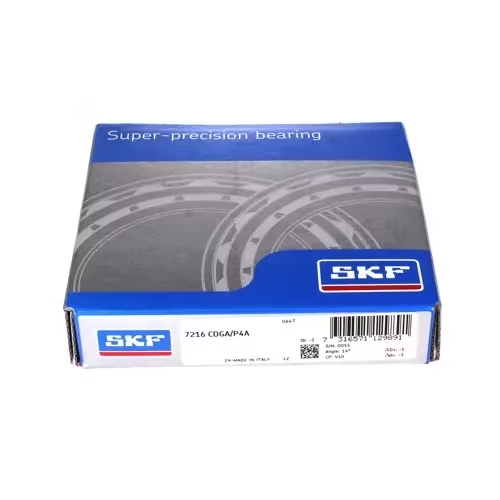
71902 CD/P4a Angular Contact Ball Bearing
Multi-Brand Authorized Coverage — Sourcing mixed OEM requirements for precision spindles becomes straightforward when a single supply channel handles NSK, NTN, and Timken equivalents with uniform traceability.
| Parameter | Value |
|---|---|
| Designation | 71902 CD/P4a |
| Product Type | Angular Contact Ball Bearing |
| Contact Angle | 15° (CD suffix) |
| Precision Class | P4a (ISO 492 Class 4) |
| Material | Bearing Steel |
| Cage Material | Available in polyamide, machined brass, or pressed steel variants |
| Seal or Shield Type | Open design for external precision lubrication |
| Clearance Class | Standard precision clearance optimized for spindle preloading |
| Bore Type | Cylindrical |
| Origin | Germany / Japan / Sweden / Malaysia / China |
| Industry | Typical Applications |
|---|---|
| Machine Tool Manufacturing | High-frequency motorized spindles and precision grinding wheel heads |
| Robotics & Automation | High-speed articulated joint actuators and servo motor encoders |
| Precision Equipment | Optical measuring instrument rotary tables and coordinate measuring machines |
| Fluid Machinery | High-speed centrifugal pump shafts and vacuum compressor rotors |
Assuming all 15-degree contact angles are identical is the fastest route to thermal binding in precision grinding heads.
Procurement teams often match the base number while overlooking the specific contact angle optimization suffix, assuming any standard angular contact design will perform equally at high RPMs. In reality, substituting a standard 15-degree profile with an optimized high-speed geometry alters the internal load distribution and friction heat generation. When a standard profile is forced into a motorized spindle application, the excessive thermal expansion quickly eliminates the internal clearance, leading to catastrophic cage failure.
Operating a high-frequency motorized spindle requires a bearing that maintains strict rotational accuracy while minimizing friction heat. The 71902 CD/P4a angular contact ball bearing is engineered specifically for these demanding environments, where even minor deviations in running accuracy translate directly into poor surface finish on machined parts. By supplying fully traceable units across major international brands, we ensure your engineering team receives the exact internal geometry required for stable high-RPM operation, eliminating the guesswork in cross-brand replacements.
At the extreme rotational speeds typical of modern grinding spindles, friction heat becomes the primary limiting factor for bearing life. The lubrication method—whether oil-air mist or oil jet—must perfectly match the open bearing design to prevent starvation or churning losses. Furthermore, the thermal expansion of the shaft and housing materials directly impacts the internal clearance and preload state. If the operating temperature exceeds the thermal stability limit of standard bearing steel, dimensional changes will compromise the P4a running accuracy, making precise thermal management and correct initial preload setting absolutely critical.
The "CD" suffix indicates a 15-degree contact angle with an internal geometry specifically optimized for high-speed operation, featuring smaller ball diameters or specialized raceway curvatures to reduce centrifugal forces and friction heat. The "P4a" precision class denotes ISO 492 Class 4 dimensional and running accuracy, but the "a" signifies an even tighter tolerance on running accuracy, specifically radial and axial runout, which is vital for minimizing spindle vibration. This combination ensures the bearing can sustain the rigid preload required for heavy cutting while maintaining the extreme rotational accuracy needed for fine finishing.
Installing a standard P4 or P5 grade bearing in a slot designed for P4a precision inevitably leads to premature spindle vibration and unacceptable part surface finishes. This geometric deviation forces the machine tool into unplanned downtime for spindle rebuilding, a process that incurs massive costs in lost production and specialized labor. Furthermore, utilizing counterfeit or unverified bearings with soft inner rings causes rapid raceway wear, voiding the machine builder's warranty and resulting in catastrophic damage to the surrounding spindle housing and tooling interfaces.
We maintain authorized distribution agreements across all major bearing manufacturers, allowing you to consolidate mixed-brand spindle requirements into a single, fully documented purchase order. Our technical team cross-references designs based on the exact internal geometry and precision suffixes, preventing the common error of supplying a standard 15-degree profile when the optimized CD high-speed design is mandated. Every shipment includes batch traceability to the manufacturer, ensuring you receive genuine components that pass strict dimensional verification. We also provide application-based selection reviews to confirm that the chosen precision class and contact angle align perfectly with your specific spindle preload and speed parameters.
To ensure the selected bearing perfectly matches your spindle design, please provide the exact radial and axial load profiles, maximum operating RPM, and the target operating temperature range. Sharing the specific OEM equipment serial number or the original spindle assembly drawing allows our engineering team to perform a comprehensive cross-reference check and verify the L10 life calculation. This technical review guarantees that the contact angle, precision class, and internal geometry are fully optimized for your specific machining application before any purchase order is finalized.
Q: Why must the CD suffix be matched exactly during cross-referencing?
A: The CD suffix specifies a 15-degree contact angle with an internal geometry optimized specifically for high-speed operation. Substituting it with a standard 15-degree design alters the internal friction and heat generation profile. In high-RPM spindle applications, this mismatch leads to excessive thermal expansion, loss of internal clearance, and eventual thermal binding or catastrophic cage failure.
Q: What is the practical difference between P4 and P4a precision classes?
A: While both fall under ISO 492 Class 4, the P4a designation enforces significantly tighter tolerances on running accuracy, specifically radial and axial runout. This ultra-precise runout control is mandatory for high-speed machine tool spindles to minimize vibration, ensuring superior surface finish on machined parts and preventing premature wear on the spindle tooling interfaces.
Q: How do I verify the authenticity of the supplied bearings?
A: We supply only authorized, traceable inventory. Each bearing batch can be verified using the manufacturer's official mobile application by scanning the QR code on the packaging. Additionally, we provide a Certificate of Conformity and original batch traceability documents that link the physical product directly back to the manufacturer's production facilities.
Q: Can I use standard grease for lubricating this open-design bearing?
A: No. Open high-speed spindle bearings require specialized lubrication strategies, typically oil-air mist or precise oil jet systems, rather than standard grease packing. Using standard grease in a high-RPM environment causes severe churning losses and rapid temperature spikes, which will quickly degrade the lubricant and destroy the P4a precision running accuracy.
Our 5-step process ensures every order is engineered, validated, and supported for optimal performance.
Technical needs assessment
Custom specifications
Free samples for $50k+
Pre-shipment inspection
On-site & predictive
Our certified engineers respond within 24 hours with detailed technical specifications, pricing, and lead time information.
![7201 Becbp Angular Contact Ball Bearing High Speed Precision NSK Timken [WARN] draft identifier mismatch](https://skfiso.com/wp-content/uploads/2026/09/7201-becbp-angular-contact-ball-bearing-high-speed-precision-nsk-timken-warn-draft-identifier-mismatch-c9f392.avif)


